A foundational investigation spanning multiple South American butterfly groups and a diurnal moth species reveals that convergent evolution—the phenomenon where unrelated organisms develop comparable traits—is not merely a matter of chance. Instead, it adheres to a remarkably consistent genetic blueprint. This breakthrough offers the potential to forecast how species might adapt in response to climatic shifts.
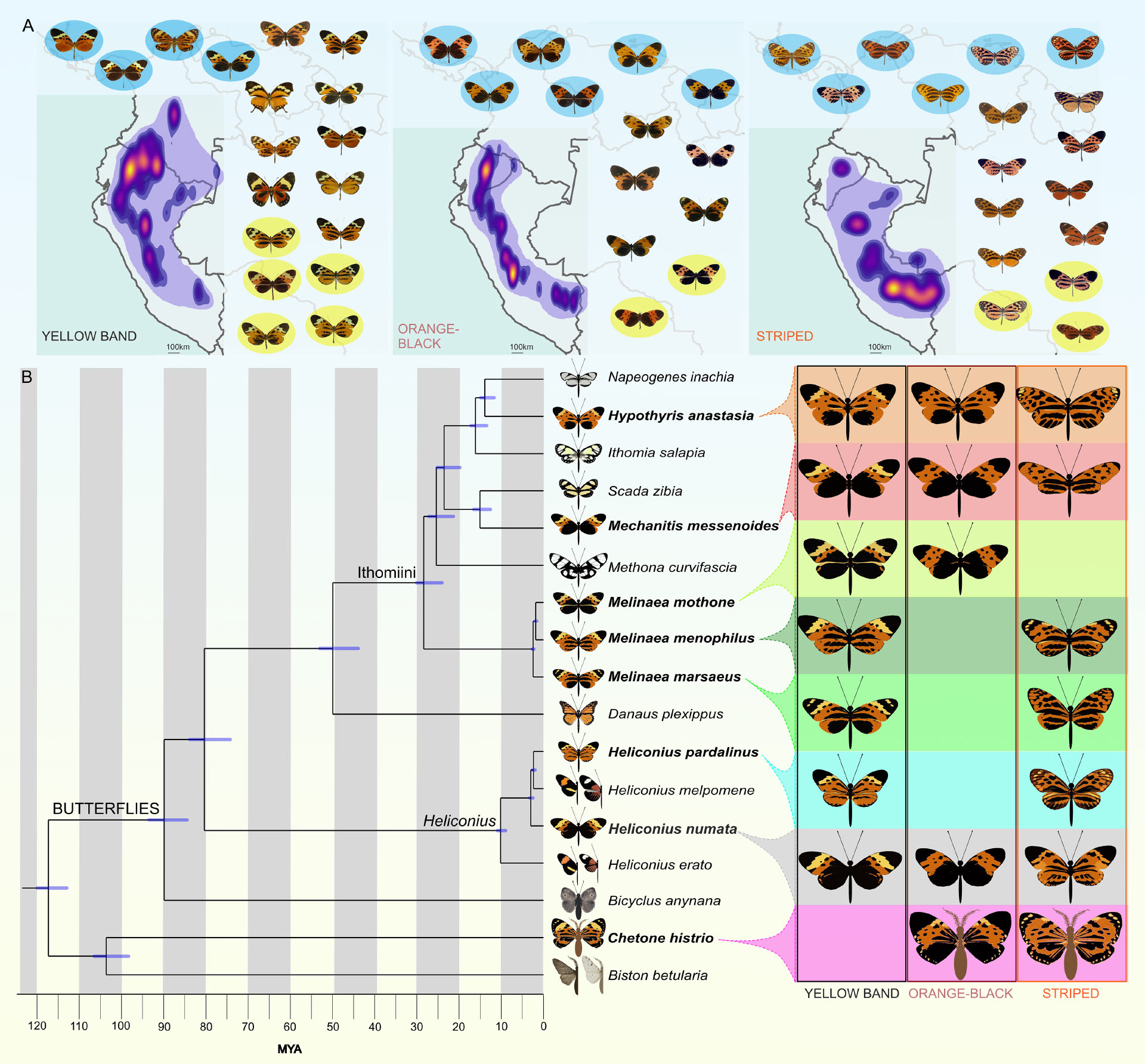
Ben Chehida et al. conducted a study on the convergent evolution observed in various mimetic Neotropical lepidopteran lineages. These lineages diverged over a period ranging from 1 to 120 million years ago and included seven species of Ithomiini and Heliconius butterflies, alongside a day-flying Chetone moth. Image credit: Ben Chehida et al., doi: 10.1371/journal.pbio.3003742.
“Convergent or parallel evolutionary processes represent natural experiments wherein unrelated species independently acquire similar characteristics due to comparable selective pressures,” elucidated Professor Kanchon Dasmahapatra from the University of York and his research associates.
“These findings provide insights into the degree to which evolutionary trajectories are repeatable and, consequently, predictable.”
“Markedly distinct lineages can exhibit significant trait convergence. This is exemplified by the repeated colonization of terrestrial, aquatic, or aerial environments, or the recurrent development of resistance to adversities such as insecticide exposure, drought, and thermal stress.”
“The convergence of traits across different species can be attributed to genetic alterations affecting distinct genes or the same gene (gene reuse),” they elaborated.
“Gene reuse is anticipated to be more prevalent among closely related lineages or in scenarios where developmental pathways leading to shared optimal fitness levels are inherently constrained.”
“When genes are indeed reused, convergence may stem from independent mutations within the same gene locus or from the repurposing of identical alleles (allele sharing). This allele sharing can occur either through pre-existing ancestral genetic variation or as a consequence of genetic material transfer between species (introgression).”
In their recent investigation, the authors examined several distantly related butterfly and moth species inhabiting the South American rainforest. These species display analogous wing coloration patterns that serve as a deterrent to predators, a phenomenon known as mimicry.
The objective of their research was to identify the specific genes responsible for these shared mimicry colorations across seven distinct species.
Their findings indicated that, despite significant evolutionary divergence, the diverse butterfly and moth species consistently repurposed the same two genes—ivory and optix—to develop remarkably similar color patterns.
Interestingly, the genetic modifications in the various butterfly species were not located within the genes themselves but rather in analogous regulatory elements, often referred to as ‘switches,’ which control gene activation and deactivation.
The moth species, in a surprising parallel, employed an inversion mechanism—a substantial segment of DNA undergoing a reversal. This represented a genetic strategy nearly identical to one utilized by one of the butterfly species.
“Convergent evolution, wherein numerous unrelated species independently develop the same trait, is a widespread occurrence throughout the biological world,” stated Professor Dasmahapatra.
“However, opportunities to scrutinize the underlying genetic mechanisms of this phenomenon are infrequent.”
“By examining seven butterfly lineages and a day-flying moth, we have demonstrated that evolutionary processes can exhibit a notable degree of predictability. Furthermore, it appears that butterflies and moths have repeatedly employed the very same genetic strategies to achieve similar colorations, a pattern observed since the era of dinosaurs.”
The research outcomes suggest that evolution is not solely a matter of random chance but can be more predictable than previously understood.
“These distantly related butterflies and the moth are all noxious and unpalatable to avian predators,” explained Professor Joana Meier from the Wellcome Sanger Institute.
“Their striking resemblance arises because if birds have already learned to associate a particular color pattern with toxicity and avoidance, it becomes advantageous for other species to adopt the same warning coloration.”
“Our findings indicate that these warning color patterns are particularly advantageous, as their evolution appears to be facilitated by a highly conserved genetic basis that has remained stable for over 120 million years.”
The study’s findings were disseminated online in the esteemed journal PLoS Biology.
_____
Y. Ben Chehida et al. 2026. Genetic conservatism underpins convergent mimicry patterns in Lepidoptera over 120 million years of evolution. PLoS Biol 24 (4): e3003742; doi: 10.1371/journal.pbio.3003742