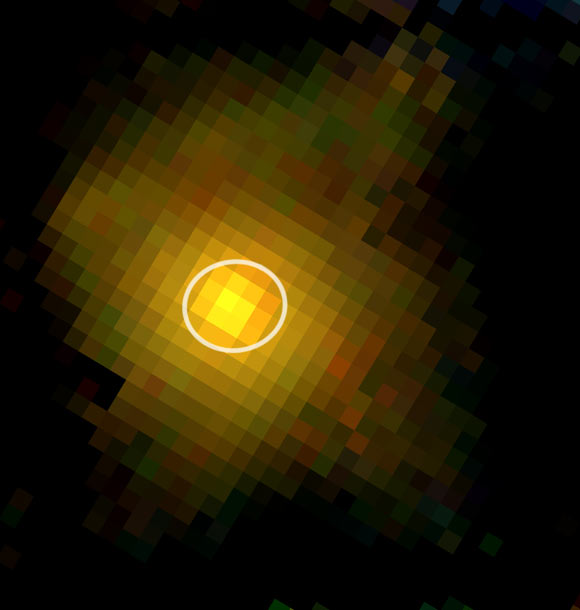
In the present cosmic epoch, the majority of galaxies maintain their structural integrity through ordered rotational motion. However, among the most colossal, quiescent stellar systems that have ceased forming stars, a significant proportion are characterized by the disarrayed movement of their stellar constituents—a category of galaxies identified by astronomers as slow rotators. These galactic entities are anticipated to be exceedingly scarce in the nascent Universe, and until this recent revelation, only rapidly revolving systems had been observed. New empirical data acquired by the James Webb Space Telescope, a collaborative venture between NASA, ESA, and CSA, has furnished evidence of a massive, slow-rotating galaxy, designated XMM-VID1-2075, at a redshift of z = 3.449, signifying that we are observing this galaxy as it existed approximately 12 billion years ago.
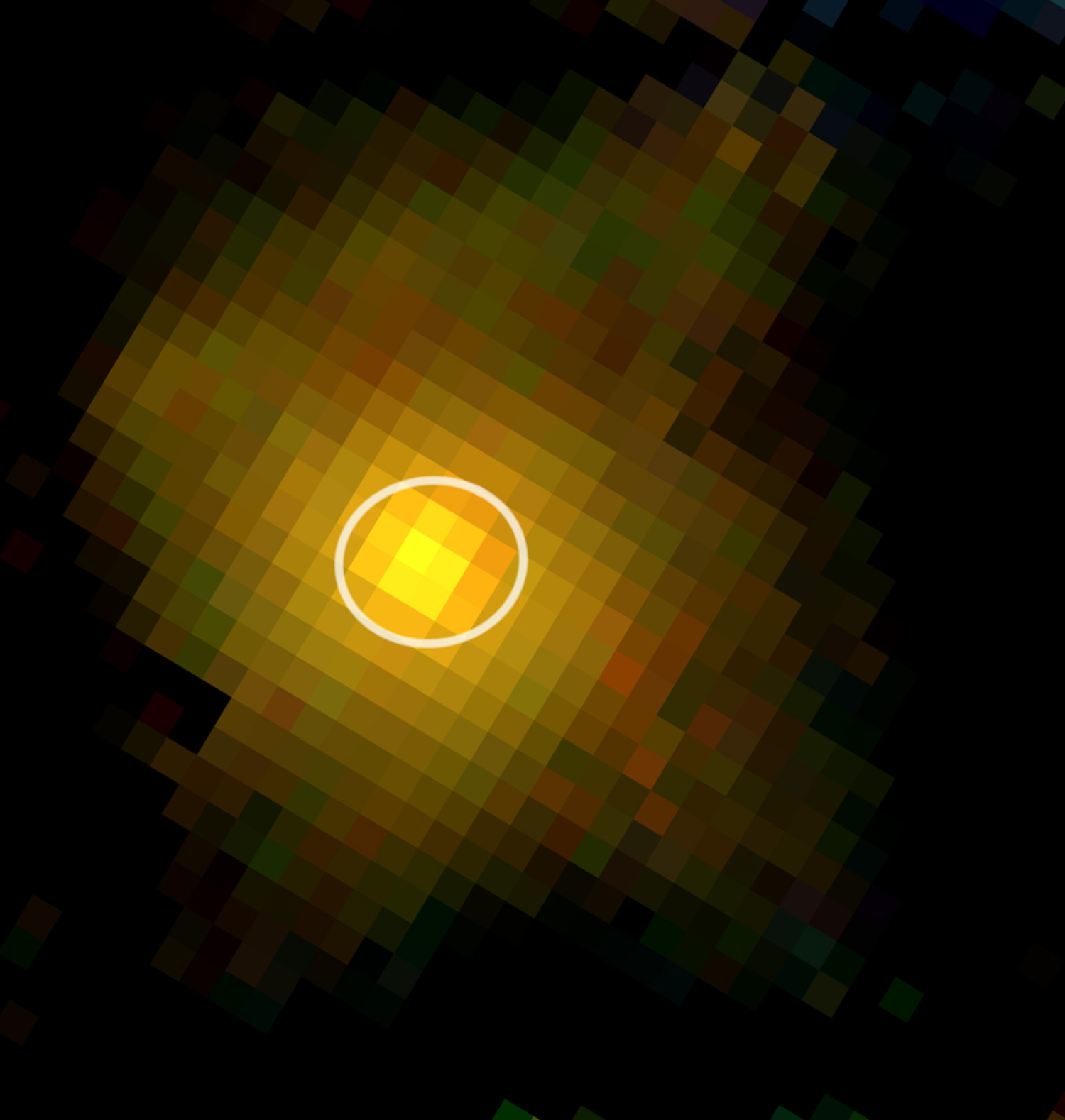
This Webb/NIRSpec/IFU image illustrates the slow-rotator galaxy XMM-VID1-2075. The imagery is credited to Forrest et al., with the supporting documentation available via doi: 10.1038/s41550-026-02855-0.
Current theoretical frameworks posit that as the initial galaxies coalesced, inflowing gas imparted angular momentum, and gravitational forces subsequently induced rotational motion.
Over extended cosmological timescales, certain galaxies, particularly those situated within galactic clusters, have undergone repeated mergers with one another, leading to the summation or partial cancellation of their respective rotational vectors.
Consequently, some galaxies in close proximity to Earth exhibit minimal overall rotation, yet feature substantial random stellar velocities internally.
This evolutionary trajectory is expected to necessitate an exceptionally protracted duration. Therefore, the discovery of the galaxy XMM-VID1-2075 having already attained this quiescent state when the Universe was less than 2 billion years old presents a considerable surprise.
“This phenomenon is typically observed only in the most massive, mature galaxies that are nearer to us in both space and time,” remarked Dr. Ben Forrest, an astrophysicist affiliated with the University of California, Davis.
“What was particularly striking about this object was its complete lack of discernible rotational evidence, which was both unexpected and highly intriguing.”
Dr. Forrest and his collaborators, as part of the MAGAZ3NE (Massive Ancient Galaxies at z>3 NEar-Infrared) survey initiative, had previously conducted observations of XMM-VID1-2075 utilizing the W.M. Keck Observatory located in Hawaiʻi.
“Prior MAGAZ3NE observations had already established this galaxy as one of the most massive in the early Universe, containing several times the stellar population of our own Milky Way, and confirmed its cessation of star formation, thereby designating it as a prime candidate for subsequent, more detailed investigations,” Dr. Forrest elaborated.
In their subsequent work, the astronomers employed the capabilities of the James Webb Space Telescope, a joint project of NASA, ESA, and CSA, to meticulously measure the relative velocities of material within XMM-VID1-2075 and two additional galaxies of comparable antiquity.
“This analytical approach has been extensively applied to nearby galaxies due to their proximity and larger apparent size, enabling ground-based studies. However, such investigations are exceedingly challenging for high-redshift galaxies, as they appear considerably diminished in angular size on the celestial sphere,” Dr. Forrest explained.
“The Webb telescope is truly advancing the frontiers of these specialized astronomical studies.”
“Among the trio of galaxies examined, one clearly exhibits rotational characteristics, another displays somewhat disordered motion, and the third presents no discernible rotation, instead featuring a high degree of random stellar activity.”
“This configuration aligns with observations of the most massive galaxies in our local cosmic neighborhood, though its manifestation so early in the Universe’s history was somewhat unanticipated.”
The critical question remains: how did this galaxy achieve its slow-rotating status in under 2 billion years?
A plausible hypothesis suggests that its current state is not the cumulative result of numerous mergers, but rather the consequence of a singular, cataclysmic collision between two galaxies that were spinning in opposing directions. This hypothesis finds support in the observational data gathered by the research team.
“In the case of this specific galaxy, we have detected a substantial excess of light emanating from its periphery,” Dr. Forrest disclosed.
“This observation is indicative of an external celestial body that has intruded upon the system and is potentially reconfiguring its dynamical properties.”
The findings associated with this groundbreaking discovery have been formally documented in a scientific publication featured in the esteemed journal Nature Astronomy.
_____
B. Forrest et al. A massive and evolved slow-rotating galaxy in the early Universe. Nat Astron, published online May 4, 2026; doi: 10.1038/s41550-026-02855-0