While the Curiosity rover has consistently delivered fascinating insights from the Martian surface, its latest finding presents a distinctly unusual scenario.
The incident commenced in a manner typical for a drilling operation.
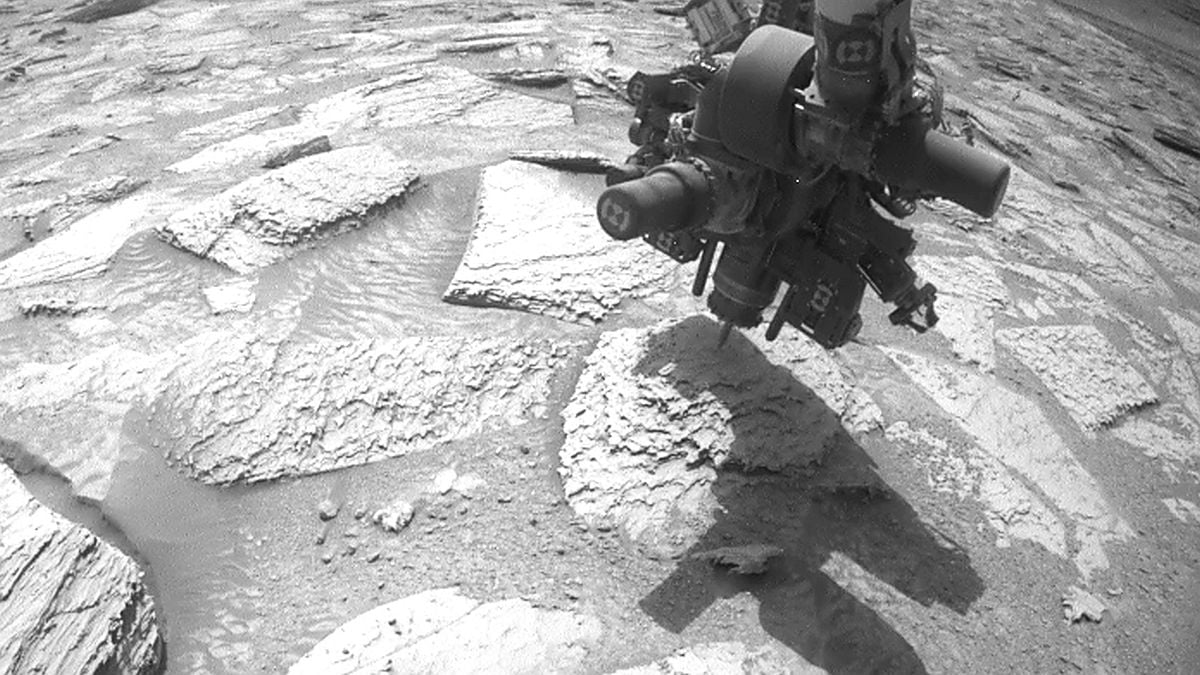
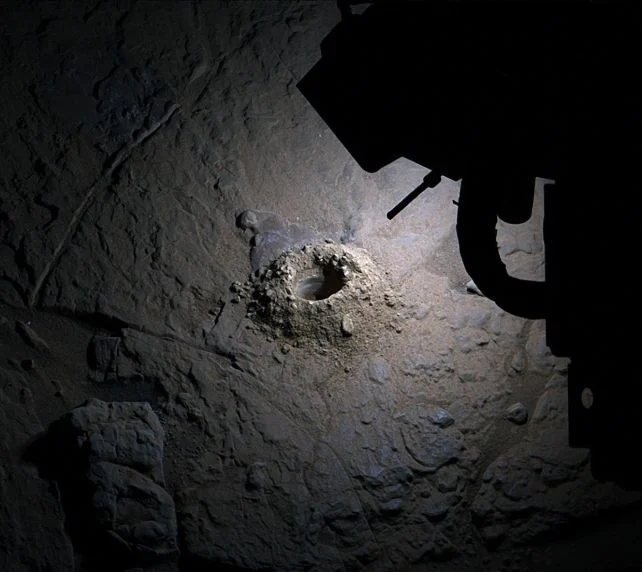
On April 25, 2026, the rover initiated a sampling attempt, engaging its rotary-percussive drill with a rock designated “Atacama.” The objective was to abrade the rock into fine particulate matter for subsequent in-depth analysis, a standard procedure to date.
However, upon retraction of the drill, the entirety of the 13-kilogram (28.6-pound) rock mass adhered to it. This was an unforeseen complication.
NASA highlighted in a recent blog post that this predicament is unprecedented in Curiosity’s 13.5 years of operation on Mars.
“Previously, drilling activities have resulted in the fracturing or separation of superficial rock layers, but never has a whole rock remained secured to the drill sleeve,” the agency elaborated.
The fundamental reality is that even with exhaustive pre-mission stress testing, terrestrial engineers cannot anticipate every challenge a robotic explorer might encounter millions of kilometers from Earth.
Subtle variations in rock composition, such as minute fissures, differences in material density, or the nature of interlayer bonding, can significantly alter how a rock responds to applied force.
Such geological characteristics can be directly assessed on our planet. On Mars, however, these properties often only become apparent at the precise moment of interaction with the drill.
Curiosity has experienced a somewhat tumultuous relationship with the Martian landscape since its landing in 2012, with its drilling apparatus specifically undergoing several significant operational interruptions.
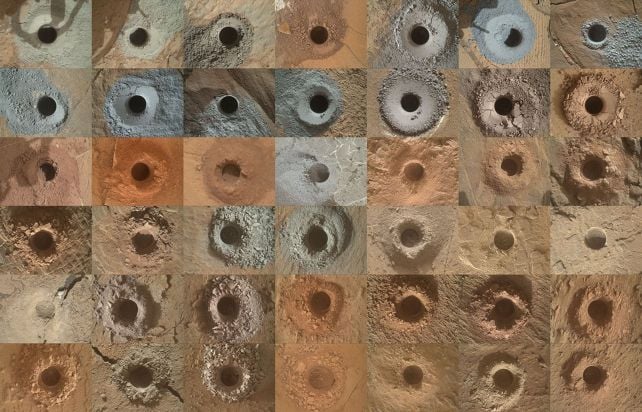
This investigative tool integrates a rotational drilling action with a percussive (impact) mechanism, engineered to break down rock into a fine powder.
This pulverized sample is then captured by the rover and transported to its onboard scientific instruments for detailed chemical and mineralogical examination.
Challenges began to emerge as early as 2015, marked by electrical faults within the percussive system. Later that year, another anomaly surfaced, suspected to be caused by internal particulate matter impeding the brake mechanism.
Subsequently, in November 2016, the drill’s advancement mechanism became immobilized, attributed to the same brake issue. Following a period of progressive deterioration that extended to mid-2017, the drilling operations were temporarily halted indefinitely.
After a comprehensive period of diagnostic testing and validation, NASA’s engineering team successfully developed an effective workaround, and drilling activities resumed in 2018.
Since its recommencement, the rover’s drilling endeavors have led to several significant scientific revelations, including the identification of long-chain alkanes within Martian mudstone—compounds that present challenges for explanation solely through known non-biological geological processes, according to NASA.
Fortunately, the Atacama rock did not remain attached to Curiosity’s manipulator arm for an extended duration.
Initially, the Earth-based mission control team attempted to dislodge the rock by inducing vibrations through the drill. This effort proved unsuccessful.
On April 29, another attempt was made. While some fine material from the rock dislodged, the main mass remained firmly affixed.
Ultimately, on May 1, the rock was successfully detached.
“Curiosity’s operational team re-engaged the drill assembly, increasing the tilt angle, initiating rotational and vibratory movements, and spinning the drill bit,” reported NASA.
“While the team had planned to reiterate these procedures, the rock became dislodged during the initial sequence, fracturing upon impact with the ground.”
The initial operational lifespan projection for Curiosity’s mission was approximately two years.
The scientific discoveries facilitated by this rover have profoundly reshaped our comprehension of Mars, encompassing its hydrological history, geological evolution, and potential indicators of past microbial existence.
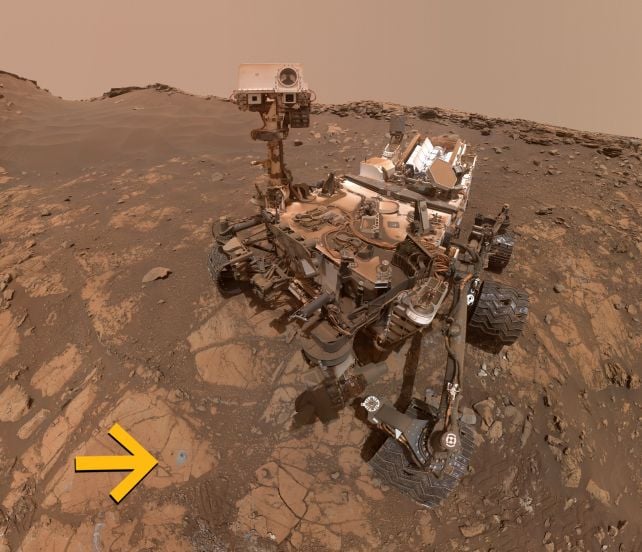
Over its extended service, the rover has ascended Mount Sharp, examined ancient lacustrine sediments within Gale Crater, and detected preserved organic compounds within Martian geological strata.
Although exhibiting some signs of wear characteristic of prolonged operation, Curiosity continues to perform commendably—a testament, in no small measure, to the ingenuity of its Earth-based engineering support crew, who consistently devise adaptive solutions to unexpected Martian challenges.