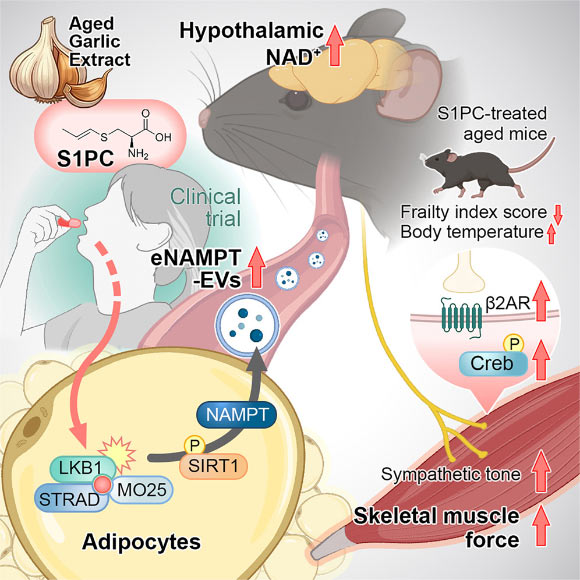
Japanese researchers have identified that S-1-propenyl-L-cysteine, a compound present in aged garlic extract, appears to reverse frailty and bolster strength in elderly mice by engaging a newly delineated signaling pathway.
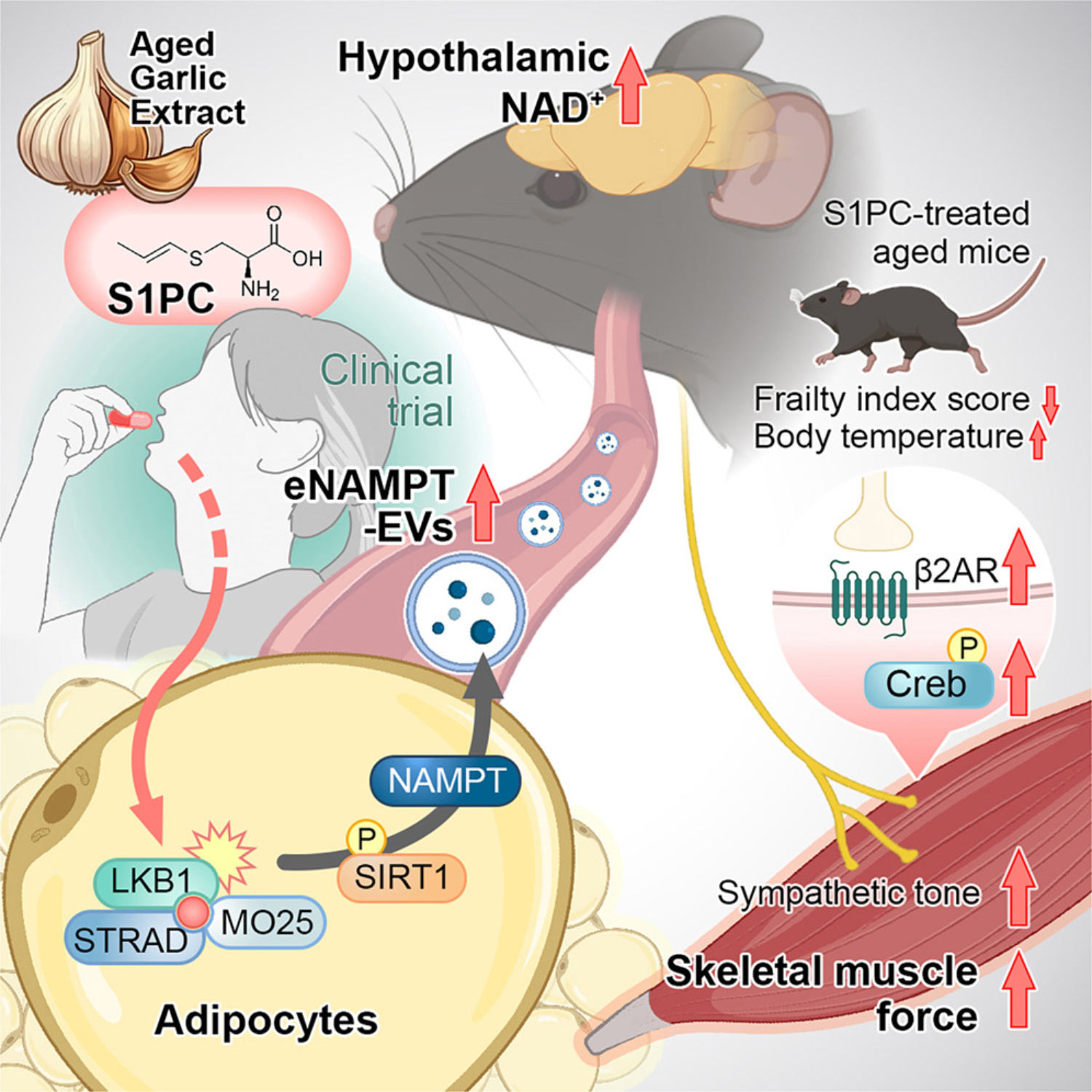
Suzuki et al. report that S1PC, a bioactive compound derived from aged garlic extract, improved muscle function in aging mice and may point toward a low-cost strategy for combating frailty in older adults. Image credit: Suzuki et al., doi: 10.1016/j.cmet.2026.04.006.
Historically, garlic (Allium sativum) has been a widely recognized agent for addressing various ailments and health conditions across the globe.
In antiquity, civilizations in Egypt, Greece, China, and India utilized it as a universal remedy to invigorate vitality, enhance stamina, and ward off infections.
A growing body of scientific investigation now substantiates that both garlic itself and aged garlic extract (AGE) impart substantial health advantages to humans.
Numerous biologically active components have been characterized, including allicin in fresh garlic, and S-allyl-L-cysteine (SAC) and S-1-propenyl-L-cysteine (S1PC) found within AGE.
Among these, S1PC, an amino acid containing sulfur and present in considerable quantities in AGE, has recently garnered extensive research attention. It has demonstrated a spectrum of beneficial pharmacological effects, such as promoting mitochondrial energy metabolism, alleviating atherosclerosis, and safeguarding vascular endothelial cells.
“Throughout my clinical practice as a physical therapist, I frequently encountered the disheartening reality of older adults experiencing a decline in physical prowess and vigor, not due to a specific disease requiring medical intervention, but from a lack of proactive care. This void in preventive strategies has been the primary impetus for my research,” stated Dr. Kiyoshi Yoshioka, a researcher affiliated with the Institute for Research on Productive Aging and the National Center for Geriatrics and Gerontology.
“Our aspiration is that these findings will contribute to enhancing the fitness and muscular strength of elderly individuals through the straightforward incorporation of a nutraceutical into their daily dietary regimen.”
In the course of their study, Dr. Yoshioka and his team ascertained that S1PC actively stimulates the enzyme liver kinase B1 (LKB1), which plays a crucial role in regulating cellular metabolism.
The enzyme eNAMPT is instrumental in the biosynthesis of NAD+, a vital small molecule essential for cellular protection, DNA repair mechanisms, and energy generation.
Rather than exerting its influence directly on muscular tissue, eNAMPT, encapsulated within extracellular vesicles (eNAMPT-EVs) released by adipose tissue, traverses the circulatory system to act upon the hypothalamus, a central regulatory hub within the brain.
This interaction is correlated with an augmented sympathetic nervous system signaling, which consequently contributes to improved muscular function.
These observations illuminate a novel communication network linking adipose tissue, the brain, and skeletal musculature, thereby providing fresh perspectives on the regulatory mechanisms underlying age-related functional deterioration.
The beneficial effects of S1PC on physical function were further validated through experimentation with aged mice.
Prolonged administration of S1PC was associated with reduced frailty metrics, enhanced skeletal muscle force, and the restoration of core body temperature.
Significantly, a human clinical trial indicated that S1PC led to an elevation in circulating eNAMPT levels, particularly in participants possessing adequate adipose tissue.
The discovery that the distinct influence of S1PC on eNAMPT-EV secretion is preserved across cellular, murine, and human subjects carries profound implications for the prospective application of S1PC as an anti-aging intervention in the human population.
“We hypothesize that S1PC is likely to exert a more extensive anti-aging effect that necessitates thorough investigation.”
The findings have been officially presented today in the esteemed journal Cell Metabolism.
_____