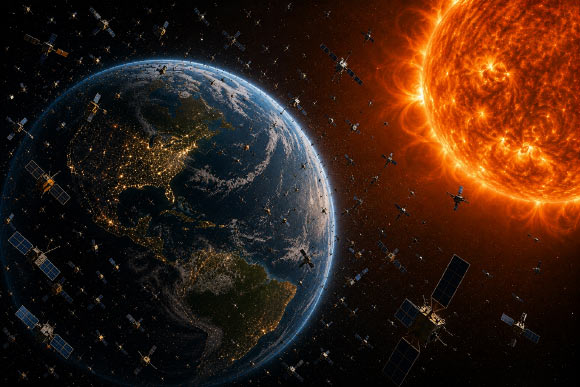
The proliferation of orbital detritus, encompassing defunct satellites, spent rocket components, and fragments resulting from orbital impacts, presents a progressively intensifying hazard to operational spacecraft and human endeavors in space. Emerging scientific investigations indicate that heightened solar exertion can expedite the orbital decay of space debris, necessitating a recalibration of scientific methodologies for forecasting satellite operational spans and estimating collision probabilities.
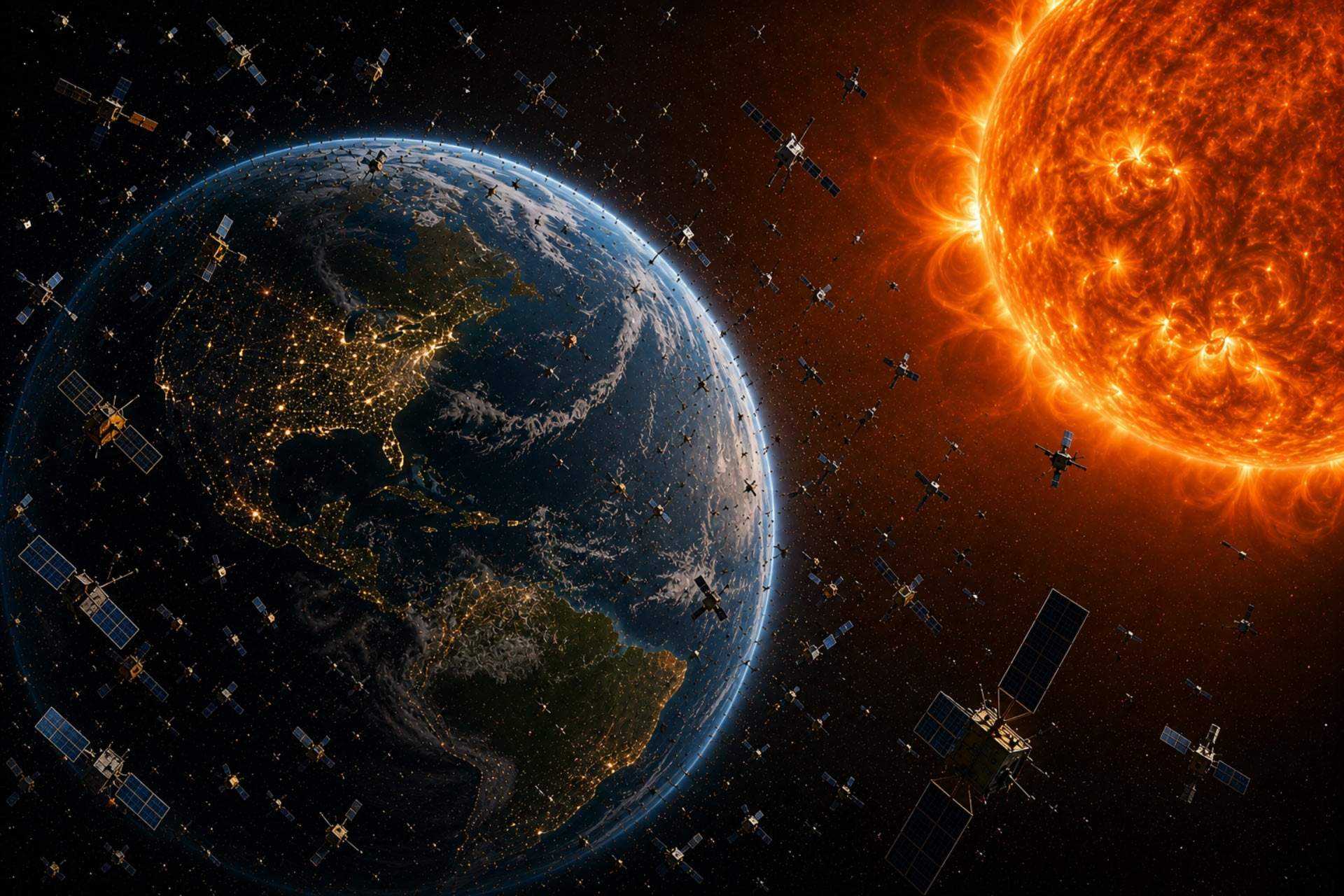
Space junk begins to fall down much faster once the Sun’s activity across the solar cycle reaches approximately 67% of its peak.
The region of low Earth orbit (LEO), situated between altitudes of 400 and 2,000 kilometers, is particularly advantageous for Earth observation and surveillance satellites, as well as for extensive constellations of internet satellites like Starlink.
Regrettably, this orbital domain is presently saturated with ‘junk,’ including defunct satellite remnants and spent rocket stages, which pose a substantial risk to newly deployed space missions. The cascading effect of a single collision could precipitate widespread damage.
Given that robotic missions designed for space debris capture are still in their nascent stages, the current scientific focus is primarily on refining debris tracking techniques to pinpoint the most perilous objects for subsequent removal.
“Our findings demonstrate that space debris in Earth’s vicinity experiences accelerated altitude loss during periods of elevated solar activity,” stated Dr. Ayisha Ashruf, a researcher affiliated with the Vikram Sarabhai Space Centre.
“For the first time, we have observed a discernible and more rapid descent of orbital objects once solar activity surpasses a specific threshold.”
“This discovery is anticipated to be instrumental in the strategic planning of sustainable space operations moving forward.”
The Sun undergoes an approximately 11-year cycle, characterized by phases of heightened and diminished activity, which is correlated with variations in sunspot counts. This cycle influences the intensity of its radiation emissions,
including ultraviolet radiation and charged particles such as helium nuclei and heavier ions.
When the outward flux of these emissions reaches its apex, as was most recently observed in 2024, solar emanations induce heating and expansion within Earth’s thermosphere, a layer extending roughly from 100 to 1,000 kilometers and experiencing temperatures between 500 and 2,500 degrees Celsius.
This atmospheric thermal expansion consequently increases the density of the atmosphere surrounding orbiting bodies (which are situated between 350 and 36,000 kilometers in altitude), thereby augmenting the atmospheric resistance, or ‘drag,’ encountered by these objects. This increased drag decelerates their orbital velocity, leading to a faster descent.
In the course of their research, Dr. Ashruf and her team meticulously analyzed the historical orbital paths of 17 LEO space debris objects spanning a 36-year period from the 1960s, encompassing solar cycles 22 through 24.
These orbital remnants complete a circuit around the Earth approximately every 90 to 120 minutes, at altitudes ranging from 600 to 800 kilometers, and have not yet entered the atmosphere where they would subsequently burn up.
Unlike satellites, which actively perform station-keeping maneuvers, space debris lacks such propulsion systems. Consequently, any alterations in the rate of their orbital decay are solely attributable to variations in thermospheric density.
“This characteristic renders space debris an exceptional proxy for monitoring the long-term impacts of solar activity on atmospheric drag,” the researchers noted.
The researchers correlated the trajectories of these debris objects with historical data compiled by the German Research Centre for Geosciences, which meticulously records sunspot numbers and daily fluctuations in the Sun’s radio and Extreme Ultraviolet (EUV) emissions.
The findings reveal that when the sunspot count exceeds two-thirds of its maximum value, space debris traverses a ‘transition boundary.’ This is a critical point beyond which its orbital descent accelerates noticeably.
“This threshold does not appear to be linked to a fixed level of solar radiation, but rather to the Sun’s proximity to its peak activity,” Dr. Ashruf elaborated.
“Around this phase, the Sun generates more potent EUV radiation, possibly fueled by intensified solar processes that become more pronounced as the peak approaches.”
The scientific team emphasizes that their study’s outcomes are expected to significantly aid space agencies in optimizing satellite trajectory planning, thereby mitigating the risk of collisions with orbital debris.
“Our findings suggest that as solar activity intensifies beyond certain thresholds, satellites, much like space debris, experience a more rapid altitude reduction, necessitating more frequent orbital corrections,” Dr. Ashruf explained.
“This directly influences satellite longevity and their propellant requirements, particularly for missions initiated during periods of solar maximum.”
“What is particularly remarkable is that all this valuable scientific insight originates from objects that were initially launched in the 1960s.
“These historical artifacts continue to contribute to scientific understanding, serving as invaluable instruments for investigating the long-term effects of solar activity on the thermosphere.”
The team’s publication was released today in the esteemed journal Frontiers in Astronomy and Space Sciences.
_____
Ayisha M. Ashruf et al. 2026. Characterizing solar cycle influence on long-term orbital deterioration of low-Earth orbiting space debris. Front. Astron. Space Sci 13; doi: 10.3389/fspas.2026.1797886