Investigative genetic analysis indicates that the well-known seabird is, in fact, comprised of four distinct species, including one previously undocumented by science, with three of these now confronting escalating environmental challenges.
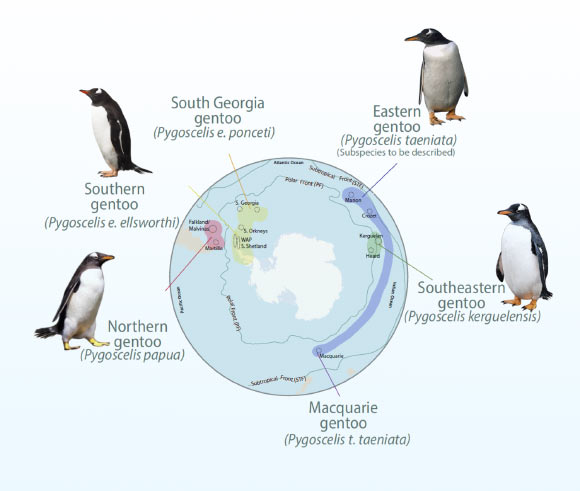
Geographic distribution of the four species of gentoo penguins around the Southern Ocean. Image credit: Noll at al., doi: 10.1038/s42003-026-10081-7.
Within the avian marine population, the gentoo penguin group (Pygoscelis papua) presents a compelling instance of adaptive differentiation, exhibiting morphological, ecological, and genetic disparities among its lineages dispersed across the Southern Ocean.
Recent scientific inquiries have delineated between four and six unique evolutionary branches inhabiting ecological niches with minimal overlap, suggesting that localized environmental factors may have significantly contributed to their adaptive divergence.
“The taxonomy of the gentoo penguin has arguably been the most contentious among all penguin species,” remarked Professor Rauri Bowie from the University of California, Berkeley.
“For over a century, the exact number of species or subspecies has remained a subject of debate.”
“This particular study endeavors to resolve this long-standing question by employing state-of-the-art, integrated research methodologies.”
Professor Bowie and his collaborators have presented genetic evidence affirming that what was historically considered a single, widely distributed species is, in reality, composed of four separate gentoo penguin species.
“North of the Polar Front, where oceanic waters are warmer and possess a higher salinity, the eastern lineage, identified as Pygoscelis taeniata, is now situated on the Crozet, Marion, and Macquarie Islands; concurrently, the northern lineage, Pygoscelis papua, is confined to the Falkland/Malvinas and Martillo Islands in South America,” they reported.
“Positioned directly on the Polar Front is the newly identified southeastern lineage, Pygoscelis kerguelensis, characterized by a small population size. This lineage evolved on Kerguelen Island and likely its adjacent Heard Island.”
“South of the Polar Front resides the southern and most abundant lineage, Pygoscelis ellsworthi, which flourishes along the Antarctic Peninsula, the coastal regions of Antarctica, and South Georgia Island.”
Pygoscelis kerguelensis remained unrecognized previously due to subtle variations in size and vocalization, as it otherwise presents identically to other gentoo penguins: a white ventral side and a black dorsal surface, plumage optimal for evading predators while facilitating prey capture in marine environments.
Nevertheless, it is demonstrably genetically distinct, a phenomenon scientists categorize as a cryptic species.
“While other species in Antarctica, not the gentoo, are currently imperiled by climate change,” stated Professor Juliana Vianna, a researcher at Andrés Bello National University.
“The gentoo, however, is a significant concern within the sub-Antarctic region, an area comprising sparsely populated islands north of Antarctica and administered by a multitude of nations, including Chile, South Africa, France, the Netherlands, Australia, and New Zealand.”
“It is imperative that conservation organizations across all involved nations acknowledge these findings and implement appropriate measures to safeguard these three gentoo penguin species.”
The research team’s publication appeared in the esteemed journal Communications Biology.
_____
D. Noll et al. Integrative evidence reveals adaptive divergence and speciation in gentoo penguins. Commun Biol, published online April 23, 2026; doi: 10.1038/s42003-026-10081-7