Our celestial neighbor, the Moon, endures a continuous bombardment from cosmic debris.
Later this year, an object originating from Earth is projected to strike this closest cosmic companion at a velocity seven times the speed of sound. This projectile, approximately the height of a five-story building, is the discarded upper stage of a Falcon 9 rocket.
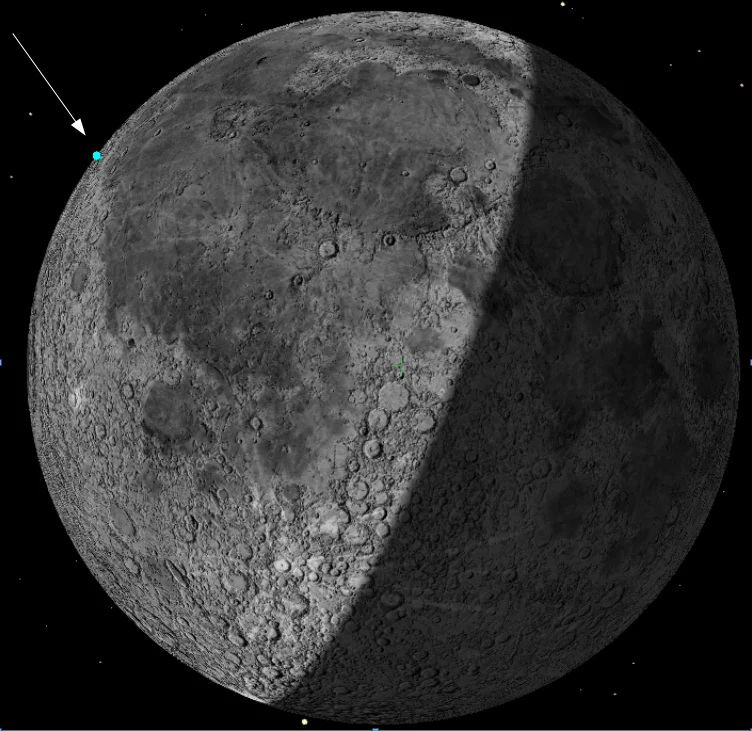
Based on an assessment by independent astronomer Bill Gray, who developed the Project Pluto software instrumental in monitoring near-Earth objects, this spent SpaceX rocket component is slated for lunar impact on August 5, 2026, around 06:44 UTC (02:44 EDT).
Gray’s findings indicate the collision is anticipated to occur near Einstein crater, a region already heavily marked by impacts situated at the boundary between the Moon’s visible and hidden hemispheres.
“The trajectory of space debris is, for the most part, readily predictable; it is governed by the gravitational forces of Earth, the Moon, the Sun, and the planets. These forces are understood with exceptional accuracy,” Gray states.
Concurrently, the pressure exerted by solar radiation, essentially the push from sunlight, exerts a constant and variable influence on such objects.
While this solar pressure is a minor force individually, its cumulative effect becomes unpredictable over time due to the object’s tumbling motion in space. This rotation leads to inconsistent reflection of sunlight depending on its orientation.
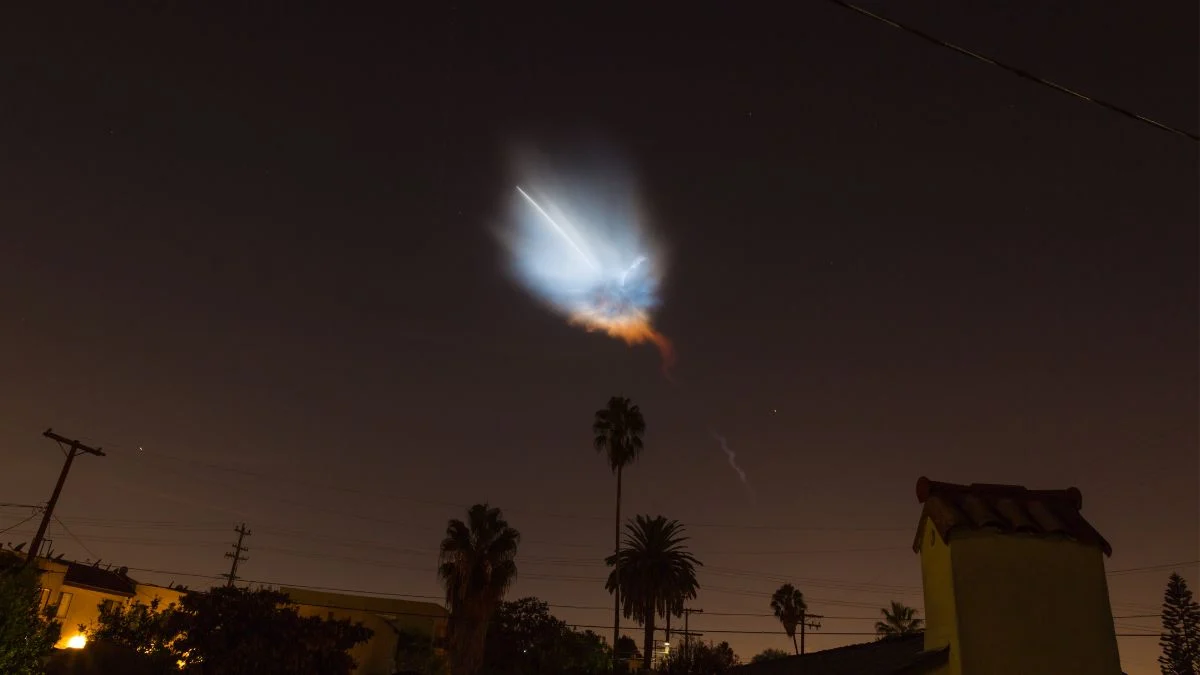
The SpaceX Falcon 9 rocket is a partially recoverable launch system, measuring 70 meters (230 feet) in length and weighing 550,000 kilograms (1.2 million pounds) at liftoff. Its primary, more substantial stage is designed to return to Earth and land on a vessel for refurbishment and reuse, while the subsequent stage remains in orbit.
The upper stage destined for the Moon was part of the 2025-010D Falcon 9 mission, launched in January 2025. Its payload included two lunar landers: the Blue Ghost mission 1 and the Hakuto-R Mission 2.
Although the non-reusable second stages from numerous prior Falcon 9 launches have either re-entered Earth’s atmosphere or entered solar orbits, this particular stage has maintained a local trajectory.
Currently, this Falcon 9 second stage completes an orbital path around our planet approximately every 26 days. At its closest point, or perigee, it passes within 220,000 kilometers (137,000 miles) of Earth before extending to approximately 510,000 kilometers at its farthest point, or apogee.
Consequently, its orbital path intersects with the gravitational influence of the Moon, which maintains an average separation of roughly 400,000 kilometers from Earth.
“To a broad extent, the orbital paths of the Moon and this object intersect. Typically, one object passes through the intersection point while the other is elsewhere,” Gray observes.
Then, in a manner akin to a narrative device designed to bring separated entities together, gravitational forces will orchestrate their convergence: “on August 5, they will arrive at that intersection point simultaneously,” Gray states, concluding an astronomical rendezvous that can be followed by consulting the data for 2025-010D.
This event is far from the initial instance of the Moon serving as a target for kinetic experiments from its parent planet. During the 1970s, several Apollo mission modules were deliberately impacted on the lunar surface, generating minor seismic activity or ‘moonquakes’ to facilitate the study of the Moon’s internal composition (a scientific endeavor devoid of any cheesy revelations).
In 2009, NASA conducted a controlled impact with its LCROSS probe, disturbing regolith that had remained undisturbed for eons, thereby confirming the presence of water ice and other valuable chemical compounds.
The most recent analogous lunar impact occurred in 2022, when a booster believed to be from a Chang’e 5-T1 mission impacted the far side of the Moon. This collision resulted in a distinctive double-crater feature, subsequently imaged by NASA’s Lunar Reconnaissance Orbiter.
The impending impact of the Falcon 9 is also anticipated to leave behind a newly formed crater. While the visual effect of the impact is unlikely to be discernible from Earth, it is possible the Lunar Reconnaissance Orbiter may eventually capture imagery of the resulting landscape.
Fortunately, this particular impact poses no threat.
There are no terrestrial inhabitants or infrastructure that could be endangered by falling rocket debris. Our resilient satellite is populated solely by substantial quantities of discarded space technology and accumulated human waste; alongside a few select personal items and currency with considerable potential collector value.
However, the overarching issue of space debris is escalating.
The irresponsible disposal of orbital detritus jeopardizes operational satellites and could pose risks to human life and equipment in the not-too-distant future.
The Artemis IV mission is scheduled to transport two astronauts to the Moon in 2028, and a Chinese lunar initiative aims for a similar endeavor around 2030.
Both of these programs are components of a broader initiative to establish sustained human presence on the Moon.
Regarding objects on lunar trajectories, the most straightforward method to avert such impacts, as suggested by Gray, could involve “placing upper stages into orbits that will propel them away from Earth and the Moon, directing them into solar orbit, thereby ensuring they will not pose an impact risk to us for an extended period,” Gray proposes.
What transpires after that extended duration, potentially spanning hundreds or thousands of years, will be a concern for future generations.
Gray’s comprehensive analysis report is accessible on Project Pluto.