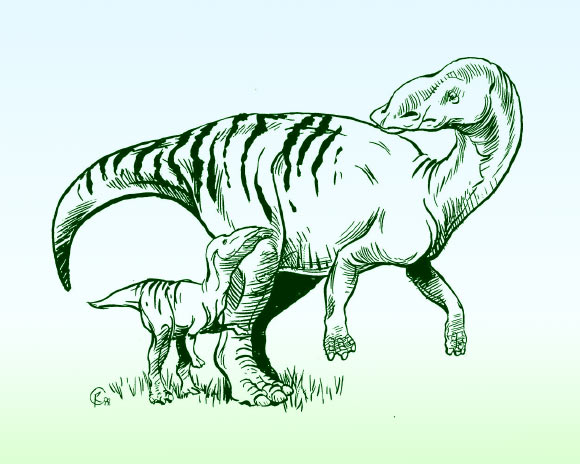
An examination of wear patterns on the fossilized dentition of the hadrosaurian dinosaur Maiasaura peeblesorum suggests that its young may have been provided with a softer, more nutrient-rich diet than the adults, offering insight into advanced parental provisioning among dinosaurs.
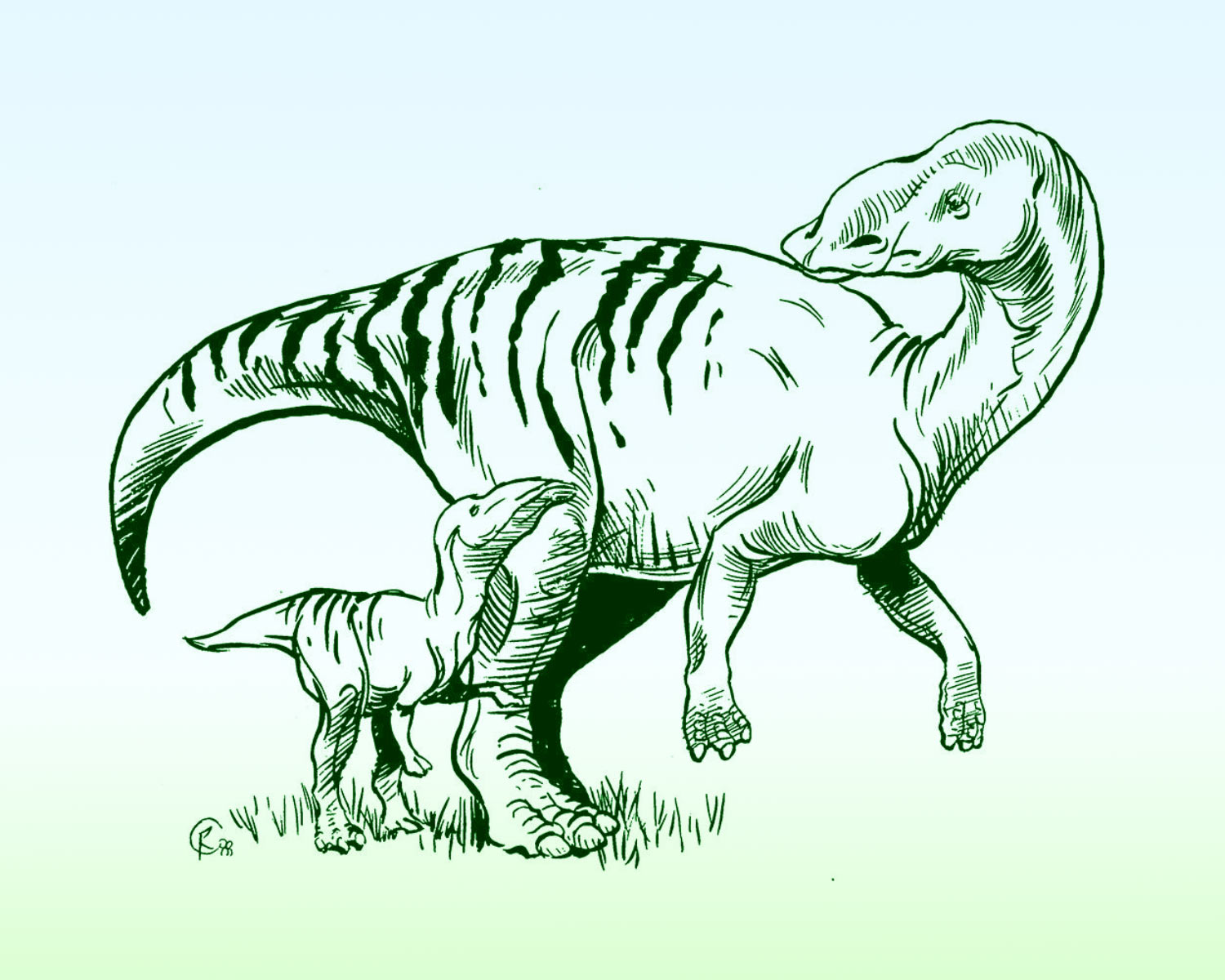
An artist’s reconstruction of adult Maiasaura and young. Image credit: Brian Regal.
Maiasaura peeblesorum is a species of duck-billed dinosaur that inhabited Earth approximately 75 to 80 million years ago, during the Late Cretaceous period.
Initially unearthed in Montana, these substantial, herbivorous creatures are believed to have congregated in herds and exhibited pronounced social behaviors, particularly when contrasted with species that might have employed different reproductive strategies.
Abundant fossil discoveries of preserved Maiasaura peeblesorum nesting sites have since positioned them as a pivotal species for understanding the reproductive behaviors and ecological dynamics characteristic of numerous other types of duck-billed dinosaurs.
In a recent investigation, Dr. John Hunter from The Ohio State University, alongside Dr. Christine Janis from the University of Bristol and Brown University, ascertained that the teeth of juvenile Maiasaura peeblesorum displayed considerably more crushing wear, whereas adult specimens exhibited predominantly shearing wear. This distinction implies that parental dinosaurs might have supplied their offspring with more easily digestible, higher-protein sustenance than what they consumed themselves.
“This form of provisioning is characteristic of modern birds whose young remain in the nest for a developmental period after hatching,” commented Dr. Hunter.
“The instinct to nourish a young one is a very ancient behavioral trait.”
“What our research provides is evidence suggesting this behavior likely predates the origin of birds, potentially extending back to the emergence of dinosaurs.”
Young Maiasaura peeblesorum likely subsisted on more easily processed, lower-fiber foodstuffs such as fruits, while their caretakers consumed a larger proportion of tougher, less nutrient-dense, high-fiber plant matter.
Among contemporary mammals, similar wear patterns would be observed in grazers like horses, antelopes, and cattle, whereas animals that consume low-fiber diets, such as tapirs, would exhibit dental characteristics akin to those of the young dinosaurs.
In their comparative analysis of dinosaur tooth wear, the researchers also proposed that dietary shifts may have played a significant role in early growth and development.
Specifically, their findings indicate that the dietary regimen of juvenile Maiasaura peeblesorum could have facilitated remarkably rapid growth during their initial year of life.
The scientific team also entertained alternative interpretations of their findings. Rather than consuming entirely distinct food sources, it is possible that dinosaur parents offered their young partially regurgitated food, another behavior commonly observed in modern avian species.
Alternatively, juveniles may have ventured out of the nest to forage independently, a behavior currently seen in extant herbivorous lizards.
“While this possibility is less probable given that juveniles were likely helpless and reliant on their parents for sustenance during the initial weeks post-hatching, a deeper understanding of their skeletal remains can broaden scientific perspectives on the sophisticated biological and social systems dinosaurs may have possessed,” stated Dr. Hunter.
“As one ventures further back in geological time, the fossil record becomes less complete, necessitating that paleontologists draw insights from diverse sources and different facets of the extant biological world.”
“Consequently, even within closely related dinosaur groups, there remains a substantial amount yet to be discovered about them.”
“Should the opportunity arise, future investigations could involve examining the dental microwear of other exceptionally young dinosaur fossils to thoroughly test hypotheses concerning dinosaur embryos and hatchlings.”
The team’s disclosures have been published in the esteemed journal Palaeogeography, Palaeoclimatology, Palaeoecology.
_____
John P. Hunter & Christine M. Janis. 2026. Tooth wear in juvenile and adult hadrosaurs: implications for parental care in Maiasaura. Palaeogeography, Palaeoclimatology, Palaeoecology 690: 113707; doi: 10.1016/j.palaeo.2026.113707