
For millennia, the Roman Empire profoundly shaped the course of human civilization during its dominion, and its enduring influence on societal development persists to this day.
However, even the ancients of Rome built upon the foundations laid by preceding eras.
This includes not only earlier cultures such as Egypt and Greece but also a multitude of prehistoric peoples whose groundbreaking innovations have largely faded into obscurity or, in certain instances, have been mistakenly attributed to subsequent societies.
In a recent scholarly investigation, academics have revealed that an advanced plaster fabrication method, long attributed to Roman ingenuity, was also employed by Neolithic populations approximately 8,000 years prior.
But how can this be explained?
Ancient Rome is celebrated for its remarkable feats of engineering, exemplified by iconic structures like the aqueducts and the Pantheon. Beyond their prowess in design and construction, Roman builders likely benefited from the utilization of robust concrete and other superior construction materials.
Certain Roman edifices incorporated a plaster derived from dolomite, a rapid-setting paste that exhibits enhanced durability and superior resistance to moisture compared to the conventional calcitic plasters frequently produced in antiquity.
“Nevertheless, the application of dolomitic lime presents considerable challenges and necessitates a high degree of proficiency at every stage of its preparation, which could elucidate its infrequent appearance in archaeological contexts,” the investigators state.
Dolomite is identified as a mineral compound primarily composed of calcium magnesium carbonate, or a geological formation predominantly consisting of this mineral. Analogous to calcitic limestone, it can serve as a source for lime, an inorganic substance, which in turn is valuable in the production of various construction materials.
The earliest documented reference to the use of dolomitic lime appears to originate from the Roman architect and engineer Vitruvius, dating back to the first century BCE, the authors observe.
While Vitruvius did not explicitly name dolomite, his discourse on lime production seems to allude to the mineral.
Plaster was a common building material for an extended period preceding Vitruvius’s writings, yet there is scant evidence suggesting its use with dolomitic lime before his account around two millennia ago.
Archaeological findings point to calcite and gypsum as the primary constituents for plaster manufacturing during prehistoric times.
However, approximately 10,000 years ago, inhabitants of a Neolithic settlement in the Judean Hills apparently concocted plaster using dolomite, leaving behind subtle indicators that have remained undetected until the present study, according to the researchers.
This region, presently encompassing parts of Israel and Palestine, was already a vibrant center of human activity during that epoch, characterized by thriving settlements millennia before the advent of the Iron Age or the Roman Empire.
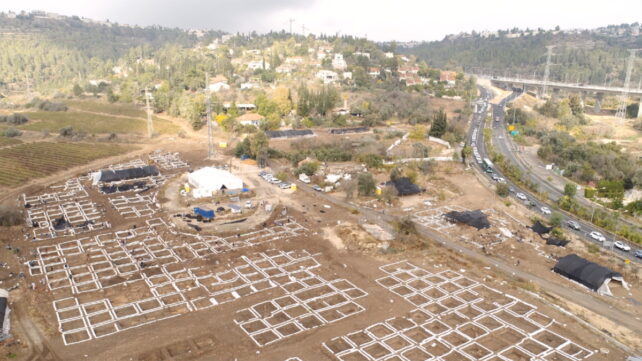
(Maor et al., J. Archaeol. Sci., 2026)
One such settlement evolved into the archaeological site now recognized as Motza, situated approximately 5 kilometers west of Jerusalem. Extensive excavations were undertaken at this location between 2015 and 2021 in anticipation of highway construction through the area.
While examining strata from numerous occupations spanning millennia, the research team concentrated on a substantial Neolithic settlement dating back roughly 9,000 years. Over 100 plaster floors from this period were unearthed, many of which were described as “exceptionally well-preserved and adorned with red pigment.”
Additionally, separate kilns were discovered, indicating that the inhabitants had heated either limestone or dolomite to produce plaster. This points to a level of sophistication not typically associated with Neolithic populations.
The production of plaster from calcitic and dolomitic lime necessitates distinct environmental conditions, the researchers elucidate. Nonetheless, these prehistoric individuals demonstrated an understanding of these requirements, evidenced by the construction of specialized kilns for each material.
While producing plaster from dolomite represented a significant accomplishment for humans of that era, the methodology employed at Motza remains remarkable even by contemporary standards, the investigators further note.
“It is possible they succeeded in creating dolomitic plaster where the dolomite underwent complete recrystallization alongside the calcite, a phenomenon that, to our knowledge, has not been documented elsewhere and was considered physically unfeasible,” they report.
Beyond capitalizing on the local prevalence of dolomite, this approach likely resulted in a superior plaster for construction purposes, offering enhanced strength and water resistance compared to conventional alternatives.
Considering the inherent difficulties in producing dolomite-based plaster, coupled with the absence of earlier evidence, the credit for its invention has historically been assigned to Ancient Rome.
Although it is conceivable that the technique persisted for 8,000 years following the Motza settlement before re-emerging in Rome, the scarcity of intermediate archaeological data suggests that the Romans independently rediscovered this process.
“The findings suggest a technology that has been lost to history,” the researchers conclude.