For many decades, Antarctica appeared to remain unaffected by the global phenomenon of warming.
Since the advent of satellite surveillance of the polar regions in the late 1970s, the annual expansion and contraction of Antarctic sea ice – comprising frozen oceanic water that encircles the continent during winter – exhibited considerable resilience. This phenomenon was frequently characterized as the “heartbeat of the planet.”
In contrast to the Arctic, where sea ice experienced a rapid reduction as the Earth’s temperature climbed, Antarctic sea ice showed minimal overall diminution. In fact, it even expanded between the years 2007 and 2015. However, this demonstrated robustness has now been compromised.
Commencing in 2015, Antarctic sea ice has undergone a precipitous decline. In 2023, the extent of winter sea ice reached unprecedentedly low levels – so substantially below the historical average that scientific assessments indicated a probability of such an occurrence due to random chance of approximately one in 3.5 million.
Antarctica had long been regarded as a segment of the Earth’s climate system anticipated to undergo gradual alterations. Consequently, the rapid pace of the recent sea ice reduction has been startling.
While researchers did foresee a contraction of Antarctic sea ice with escalating global temperatures, the rapidity of this change was not anticipated. The downward trend observed over the preceding decade was not predicted by the climate models employed to comprehend the continent’s response to warming.
This discrepancy renders the recent decline particularly alarming; it suggests that events may be transpiring with greater speed or through different mechanisms than our models are currently equipped to fully elucidate.
The significance of this lies in the fact that sea ice plays a crucial role in reflecting solar radiation back into space and in driving oceanic currents that sequester heat and carbon in the deep ocean. Its diminishment will inevitably have repercussions for the global climate and for the unique ecosystems of Antarctica that are dependent upon it.
A Fundamental Transformation
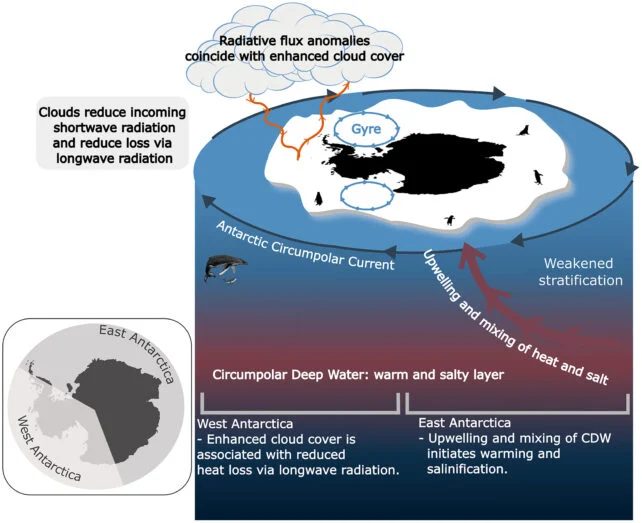
Our recent scientific investigation demonstrates that the marine environment surrounding Antarctica has experienced a fundamental alteration. Heat that was previously confined to deep subsurface layers is now migrating upwards, where it has the capacity to melt sea ice.
The sequence of events initiating this transition commenced several decades ago. Around Antarctica, wind patterns intensified, a consequence of both the ozone hole and the emission of greenhouse gases. These more vigorous winds functioned akin to a pump, progressively drawing warmer, saline deep-sea water towards the surface.
For an extended period, the ocean encircling Antarctica – known as the Southern Ocean – maintained a state of pronounced stratification, with a layer of cold, fresher water overlying warmer, saltier water. This stratification effectively impeded the upward movement of heat.
However, this protective barrier eventually weakened. By 2015, warmer subsurface water had ascended sufficiently close to the surface for prevailing storms and strong gusts to agitate and elevate it further.
The waters in the vicinity of Antarctica have subsequently become ensnared in a self-perpetuating feedback loop. The upwelling of deep water introduces heat and salinity to the surface. This heat leads to the melting of sea ice, while the increased salinity renders the surface waters more dense, facilitating their amalgamation with warmer underlying waters. This process, in turn, permits an even greater influx of heat towards the surface, impeding the formation of new sea ice, and so forth.
The ramifications extend beyond the purely physical realm. Antarctic sea ice provides the foundation for one of the planet’s most unique ecological systems. Algae thrive on and beneath the ice, serving as a food source for krill, which in turn sustain penguins, seals, whales, and seabirds.
A reduction in sea ice extent has already been implicated in the mass mortality of emperor penguin chicks, thereby jeopardizing the survival of the entire species. Consequently, a sustained period of diminished sea ice cover would result in a profound reshaping of not only the climate system itself but also the living organisms within the Southern Ocean.
This is not merely a localized issue. Antarctic sea ice functions as a reflective surface, bouncing sunlight away and contributing to the planet’s cooling. As it diminishes, a greater proportion of solar heat is absorbed by the ocean. Concurrently, alterations in the circulation patterns of the Southern Ocean could diminish its capacity to absorb and store heat and carbon.
Historically, Antarctica has served as a stabilizing influence against global warming. Our findings suggest that it may now be transitioning towards an opposing role.
Whether this heralds a permanent shift remains a subject of uncertainty. However, should conditions of limited sea ice persist, the Southern Ocean could potentially transition from a mitigating factor of global warming to an accelerator of it.