A colossal prehistoric predator, capable of rivaling the most formidable giants known, has recently been unearthed from the quiet confines of a museum’s collection.
While the name Tyrannosaurus rex is indelibly linked with Cretaceous terror, paleontologists have now identified a mosasaur that would have matched it in sheer magnitude and occupied a similar apex position within its aquatic food web approximately 80 million years ago.
This newly identified entity is known as Tylosaurus rex, or “king of the tylosaurs.” The truly remarkable aspect of this find is the implication that numerous previously categorized mosasaur fossils might actually represent this giant, having remained unrecognized until now.
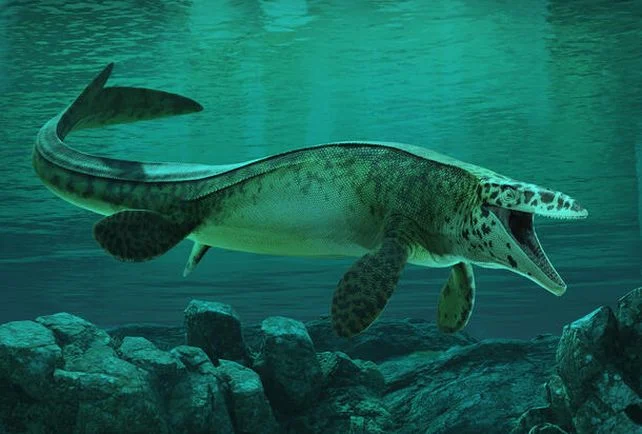
Its impressive dimensions extended to approximately 13.2 meters (43 feet) in length, and evidence of significant trauma on at least one recovered specimen indicates intra-species combat.
“Beyond its immense size, roughly equivalent to twice the length of the largest extant great white sharks, Tylosaurus rex (T. rex) appears to have been a considerably more aggressive creature than its mosasaur relatives,” explains paleontologist Ron Tykoski, who also serves as the vice-president of science and curator of vertebrate paleontology at the Perot Museum in the United States.
“Through our meticulous study and examination of well-preserved fossil remains discovered across the northern Texas region, we have uncovered evidence of intraspecific aggression within this species to a degree previously undocumented in other Tylosaurus specimens.”
During the latter epochs of the Cretaceous period, mosasaurs ascended to a position of oceanic supremacy. These were gargantuan marine reptiles, fundamentally dissimilar to any species inhabiting our oceans today. Envision a hybrid of an enormous saltwater crocodile, a komodo dragon, and an orca—but with lengths that could dwarf those of modern saltwater crocodiles or killer whales.
Our understanding of mosasaurs surpasses that of many other ancient fauna for several compelling reasons. Their predominantly aquatic existence provided an optimal environment for fossil preservation. When a creature dies in the water, its remains naturally descend to the seabed, where they become gradually entombed in sediment.
This environment, characterized by low oxygen levels and minimal disturbance—unlike terrestrial carcasses susceptible to dismemberment by scavengers—allowed for the undisturbed progression of fossilization processes.
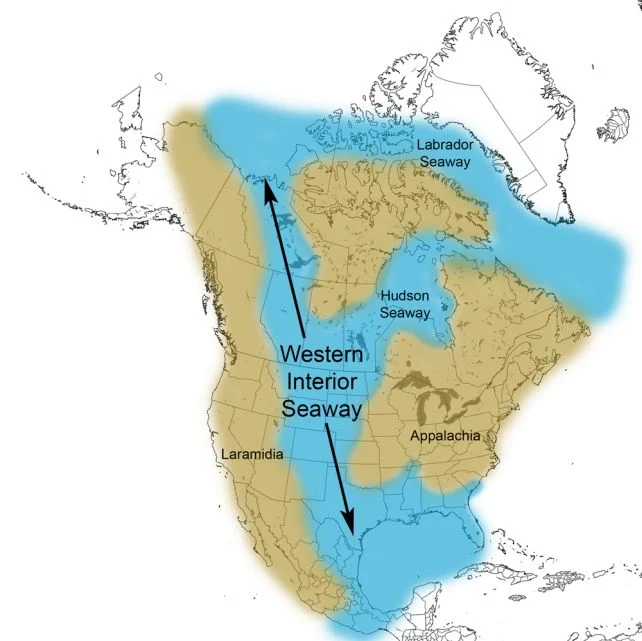
Furthermore, a degree of serendipity played a role. During the Cretaceous era, North America was bisected by a shallow inland sea, now long vanished, which left behind extensive fossiliferous deposits accessible on dry land.
Consequently, a substantial number of mosasaur specimens are preserved in museums and private collections globally. American institutions alone house hundreds of tylosaur specimens, and this represents just a single lineage within the mosasaur group.
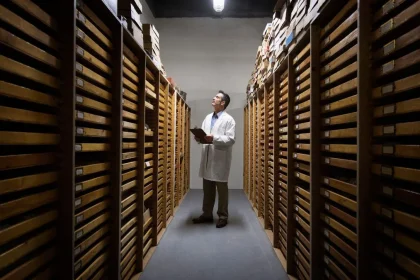
The specific fossil that has now facilitated the formal description of the new species, T. rex, was initially unearthed almost fifty years ago, in 1979, within Texas.
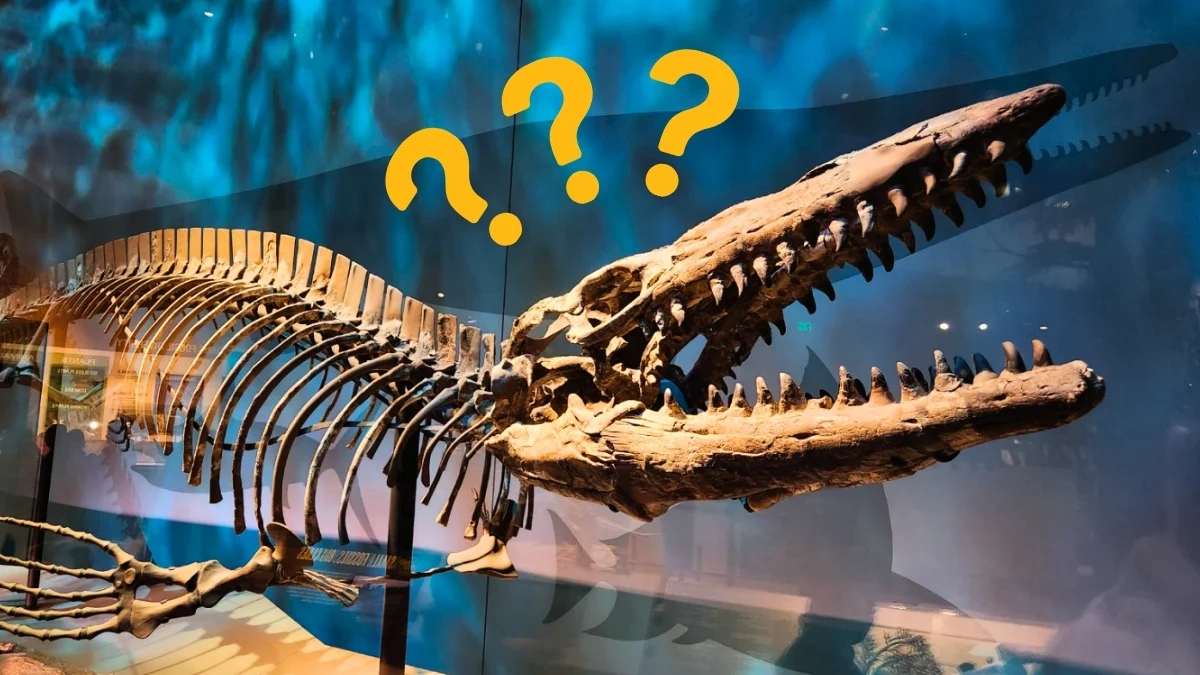
This specimen had been housed within the repository of the Perot Museum of Nature and Science (formerly the Dallas Museum of Natural History), where it had been classified as belonging to a different species—namely, Tylosaurus proriger, colloquially referred to as the Heath Mosasaur.
Paleontologist Amelia Zietlow from the American Museum of Natural History began to suspect inaccuracies upon her examination of the Heath Mosasaur specimen during her doctoral research in comparative biology.
The physical characteristics of the near-complete skeleton diverged from the established descriptions of T. proriger. While prior research had attributed these variations to potential ontogenetic changes within a species, Zietlow’s increasingly detailed scrutiny diminished the plausibility of this explanation.
Notable discrepancies were observed in the cranial structure, mandibular apparatus, oral cavity, and dentition.
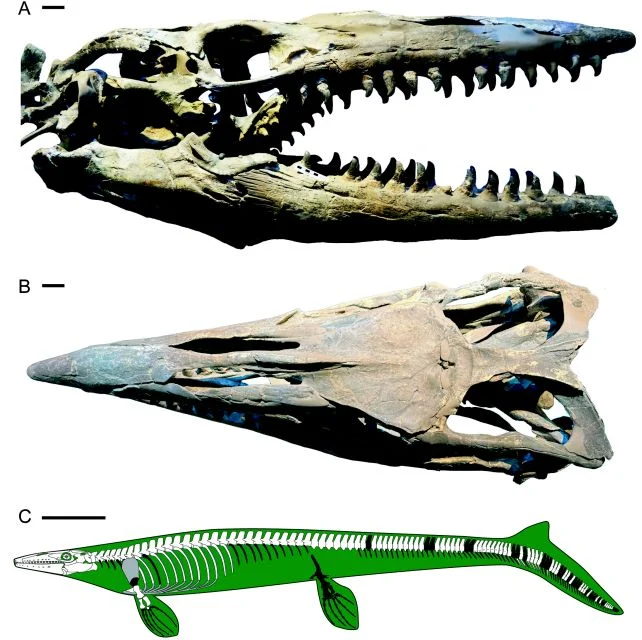
These pronounced differences suggest a particularly robust jaw and neck mechanism, indicative of a formidable predator. Furthermore, its teeth were finely serrated—a feature not commonly encountered in mosasaurs—endowing T. rex‘s bite with a potent capacity for laceration and shearing.
The research team also undertook a re-evaluation of other large mosasaurs that had been assigned to the T. proriger classification, ultimately identifying a total of 12 specimens that they could confidently reassign to T. rex.
Among these is a specimen known as the Black Knight, also curated at the Perot Museum. This individual exhibits substantial damage to its snout and jaw, which the researchers posit as evidence of the species’ formidable biting force, suggesting that only another T. rex could have inflicted such severe trauma.
Several other renowned mosasaur specimens have been reclassified as T. rex, including Bunker, discovered in 1911 and now exhibited at the University of Kansas, and Sophie, a prominent display at the Yale Peabody Museum.
This revised taxonomic assignment offers valuable clarity to the mosasaur evolutionary lineage.
This significant discovery prompts contemplation regarding the potential for other ancient species to remain undiscovered within museum archives, obscured by the passage of time and entrenched assumptions.
“This reclassification transcends the mere designation of a new species,” Zietlow emphasizes. “It underscores the imperative to critically reassess long-held hypotheses concerning mosasaur evolution and to embrace contemporary methodologies for studying these iconic marine reptiles.”