Engaging with virtual reality (VR) environments can induce intriguing alterations in cognitive processing, as a recent investigation has demonstrated.
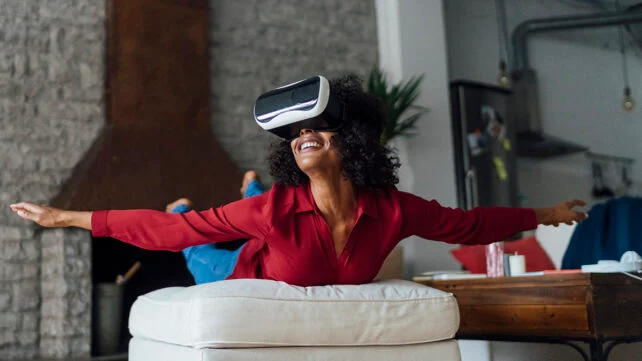
During an experimental protocol, individuals who were equipped with virtual wings for a limited duration began to integrate these artificial appendages into their sense of self, treating them akin to actual bodily extensions.
A specific cerebral region, identified as the occipitotemporal cortex (OTC), is intrinsically involved in the visual interpretation of body parts. Scientific consensus suggests this area has been shaped by eons of evolutionary development to systematically recognize human extremities such as hands and feet.
This latest research, conducted by a collaborative effort from Beijing Normal University and Peking University in China, sought to ascertain the OTC’s response to the perception of body parts in VR that deviate from the typical human anatomy: namely, large, feathered wings.
The observed modifications in the brain’s processing pathways serve as compelling evidence of its inherent plasticity, an adaptive capacity enabling it to accommodate novel inputs. This inherent malleability holds potential for facilitating the mastery of new physical capabilities and adapting to divergent modes of locomotion.
“Technological advancements are increasingly empowering humanity to surmount inherent evolutionary limitations, enabling feats such as unprecedented locomotion speeds or even achieving aerial mobility,” state the investigation’s authors.
“Virtual reality further expands these horizons by providing users with the opportunity to embody artificial, non-human external structures that are biologically absent, such as wings.”
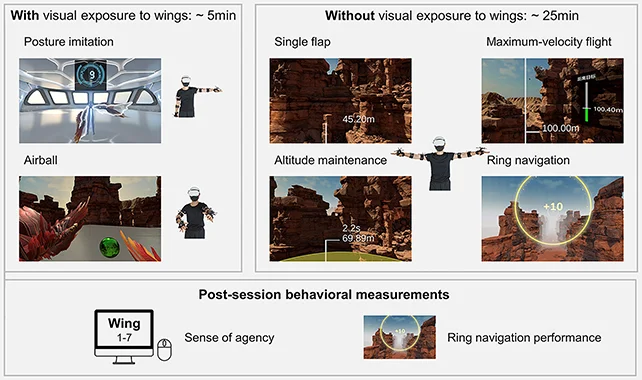
The study enrolled twenty-five participants, who completed four 30-minute VR sessions weekly over a seven-day period to acclimate to their virtual wings. These sessions incorporated guided exercises, including navigating through airborne hoops.
Within the immersive virtual environment, the participants’ arms were entirely substituted by the virtual wings, rendering their biological arms invisible and replaced by these augmented appendages. The design of these wings meticulously replicated real-world aerodynamic principles.
Analysis of functional magnetic resonance imaging (fMRI) scans, acquired from participants both prior to and following the training duration, revealed a discernible rewiring within the OTC. This neurological region demonstrated heightened responsiveness to visual stimuli depicting the VR wings compared to its baseline activation.
Furthermore, the neural signature associated with the wings began to exhibit greater congruence with the patterns observed during the visualization of human arms. This convergence was particularly pronounced in the right hemisphere of the brain, which is predominantly responsible for processing visual information pertaining to non-hand body parts.
The OTC also exhibited enhanced connectivity with other neural networks involved in motor planning and coordination, recognized as the frontoparietal regions.
It is important to clarify that the integration of virtual wings did not entirely supplant the brain’s representation of human arms. The neural activation patterns elicited by the wings bore a closer resemblance to those generated when contemplating tools or animal appendages, rather than a complete replacement of arm representation, though a discernible inclination towards that shift was evident.
“It is crucial to emphasize that our findings do not suggest the wings have been wholly assimilated into the brain’s fundamental body schema,” articulate the researchers.
“We are primarily reporting that their neural response profiles have become substantially more analogous to those of organic body parts.”
Prior scientific inquiry has indicated that the utilization of external implements or prosthetic devices typically maintains a clear distinction within the brain’s perception, categorizing these as external entities requiring controlled engagement.
In contrast, the experience of VR and virtual wings appears to transcend mere perceptual illusion. These highly immersive interactions seem to actively reshape the brain’s perception of reality, potentially extending beyond conventional definitions of human embodiment.
Looking ahead, the research team posits that their discoveries hold significant implications for advancements in rehabilitative therapies, particularly for individuals with limb loss. Furthermore, these findings contribute to a deeper understanding of how virtual reality can be harnessed to challenge and expand ingrained patterns of thought.
“We are profoundly intrigued by the potential ramifications of these insights for the human brain.”