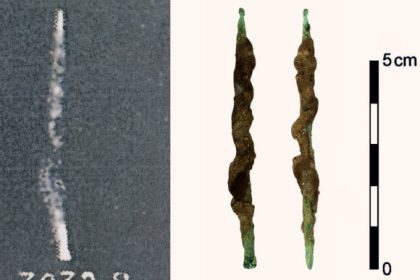
New research spearheaded by archaeologists from the Institut Català de Paleoecologia Humana i Evolució Social and Bar-Ilan University indicates that early hominins at the Gesher Benot Ya’aqov Acheulian site in Israel utilized driftwood gathered along a lake’s edge to sustain their hearths. Analysis of 780,000-year-old charcoal fragments from the locale reveals that survival was not contingent on sourcing specific wood types; rather, it depended on a profound understanding of the landscape’s capacity to provide.

Ancient inhabitants of the Gesher Benot Ya’aqov site in Israel likely used some kind of earth oven that maintained a temperature below 500 degrees Celsius to cook their fish. Image credit: Ella Maru / Tel Aviv University.
“The scarcity of charcoal preservation at such ancient prehistoric sites renders the exceptionally extensive collection from Gesher Benot Ya’aqov an unparalleled glimpse into the daily routines of early fire practitioners,” stated Professor Naama Goren-Inbar of the Hebrew University of Jerusalem and her associates.
“Whereas numerous ancient locales offer only scant or inconclusive evidence of combustion, this Acheulian site furnishes a remarkably comprehensive chronicle of repeated fire utilization spanning tens of thousands of years.”
“Gesher Benot Ya’aqov preserves stratified evidence of human habitation adjacent to the extinct Hula Lake, with over 20 archaeological strata documenting successive generations of Acheulian hunter-gatherers returning to the same locale.”
At Gesher Benot Ya’aqov, the research team unearthed evidence of vigorous activity zones: lithic implements fashioned from flint, limestone, and basalt; the remnants of prey animals; and a broad spectrum of plant sustenance, including fruits, nuts, and seeds procured from the lakeshore.
“One particularly poignant stratum captures a significant moment in time: alongside stone tools and botanical remains, the investigators uncovered the cranial and skeletal remains of a straight-tusked elephant, indicative of extensive hunting and dismemberment,” they reported.
“The spatial configuration of these remains suggests that the animal carcass was processed on the premises.”
“Central to the existence of this ancient settlement was the control of fire.”
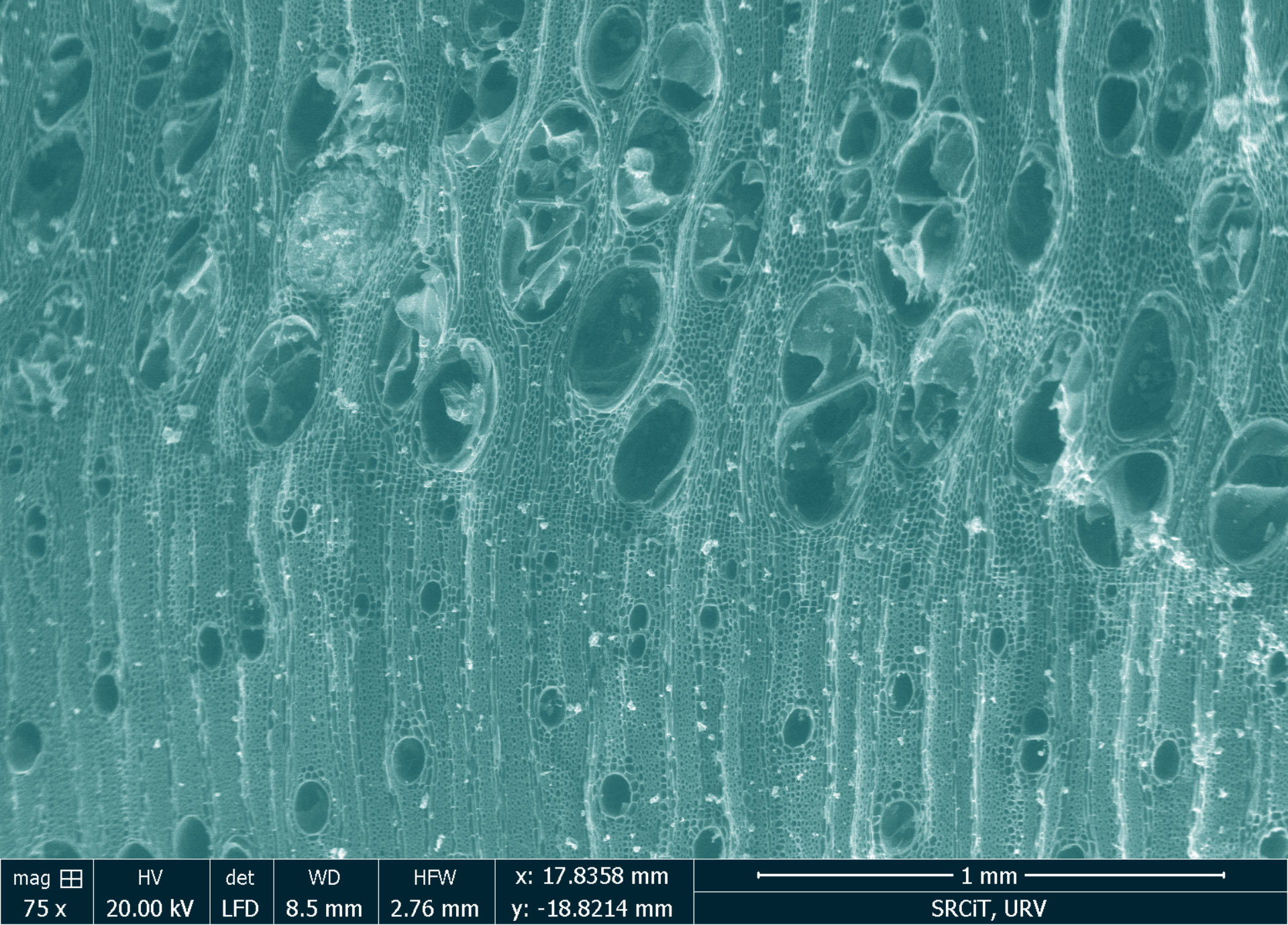
A charcoal fragment observed under an ESEM microscope. Image credit: M. Moncusil, PHES.
In their contemporary investigation, the scientists concentrated on a singular occupation stratum dated to approximately 780,000 years BP.
They meticulously examined 266 charcoal fragments, employing microscopic methodologies to discern the wood’s internal structure and ascertain its botanical origin.
The findings unveiled a strikingly diverse array of plant species, encompassing ash, willow, grapevine, oleander, olive, oak, pistachio, and even pomegranate, marking the earliest known presence of this fruit-bearing tree in the Levant.
Unexpectedly, the charcoal collection exhibited greater botanical heterogeneity than other preserved plant materials from the site, such as seeds, fruits, or uncharred wood.
This observation implies that the procurement of firewood encompassed a more representative sampling of the surrounding ecosystem than other forms of plant utilization.
Collectively, these species construct a vivid tableau of the ancient milieu: a varied landscape characterized by moist lakeside flora and open Mediterranean woodlands.
More critically, however, they illuminate the manner in which early hominins engaged with that environment.
Rather than selectively collecting particular wood types, hominins at Gesher Benot Ya’aqov appear to have predominantly utilized driftwood that naturally accumulated along the lakeshore.
Fallen branches and trunks, transported by water currents and deposited along the shore, would have constituted a readily accessible fuel source.
The species composition of the charcoal closely approximates the woody vegetation available in this ecological setting, suggesting a pragmatic and effective strategy centered on leveraging the landscape’s offerings.
This insight points toward a broader inference: the availability of fuel may have been a pivotal determinant in the settlement choices of these ancient humans.
The lakeside environment provided not only potable water, edible flora, fauna, and materials for tool production but also a continuous supply of combustible fuel, indispensable for maintaining fire.
The team’s spatial analysis demonstrates a correlation between dense charcoal accumulations and concentrations of piscine remains, notably the distinctive dentition of large carp.
This spatial association strengthens the assertion that fish were being prepared using controlled fire at the site nearly 800,000 years ago.
These revelations bolster the concept that hominins possessed sophisticated cognitive capacities.
They were evidently capable of fire management, spatial organization around fire, and its integration into complex sustenance strategies.
Nonetheless, it is noteworthy that while hunting and tool manufacturing necessitated elaborate foresight, the collection of firewood itself appears to have been a more routine undertaking, largely dictated by availability rather than deliberate selection of specific arboreal species.
In unison, these behavioral patterns depict a community that was both highly adept and profoundly attuned to its surroundings, consistently returning to a location that furnished all necessities for survival and flourishing.
“The Gesher Benot Ya’aqov charcoal assemblage offers a singular dataset for scrutinizing the nexus of fire usage, environmental context, and hominin behavior,” the authors stated.
“The discoveries serve to refine existing paradigms of early fire-related practices and underscore the significance of local resource accessibility in shaping patterns of habitation and subsistence during the Middle Pleistocene epoch.”
Their publication is featured in the journal Quaternary Science Reviews.
_____
Ethel Allué et al. 2026. Paleoenvironmental and behavioral insights into firewood selection by early Middle Pleistocene hominins. Quaternary Science Reviews 38: 109973; doi: 10.1016/j.quascirev.2026.109973