A groundbreaking mathematical demonstration, originating from esteemed institutions University College London and the University of California, Davis, asserts that the universe’s accelerated expansion can be accounted for without invoking dark energy. This significant revelation challenges the long-standing Lambda-cold dark matter model, the prevailing cosmological framework for nearly three decades.
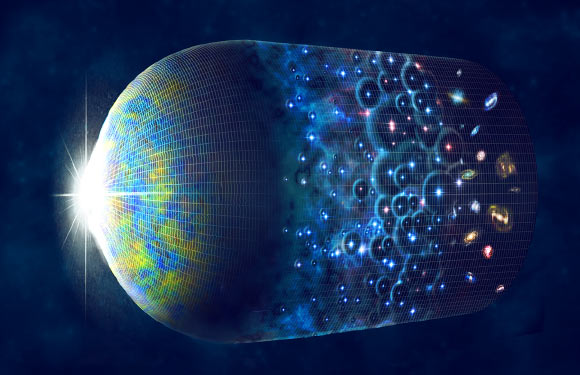
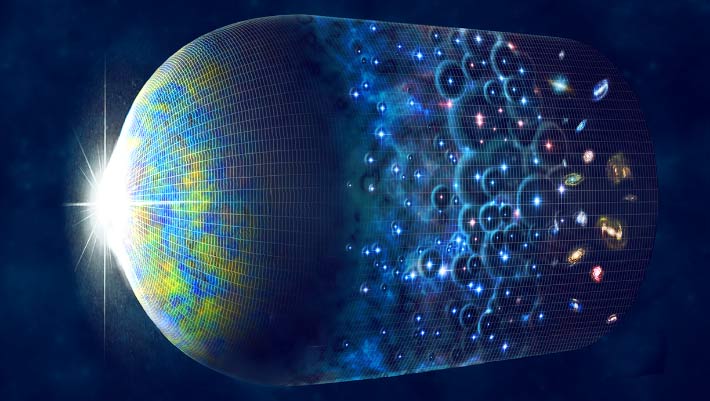
Alexander et al. present a mathematical substantiation indicating that inherent instabilities within the Einstein-Euler equations render the prevailing model of a universe in expansion untenable. Image credit: M. Weiss / Harvard-Smithsonian Center for Astrophysics.
The concept of dark energy, posited as the driving force behind the universe’s accelerating expansion, emerged approximately thirty years ago.
This notion draws its lineage from Albert Einstein’s seminal 1915 field equations that describe gravity within the framework of general relativity.
In an initial effort to conceptualize a static cosmos, Einstein incorporated a repulsive force, which he termed the cosmological constant, into his theoretical structure.
Following Edwin Hubble’s 1929 revelation of the universe’s expansion, Einstein famously characterized the cosmological constant as his ‘greatest blunder,’ acknowledging that its omission would have enabled him to predict this expansion.
Nevertheless, the cosmological constant, and its conceptual equivalence to dark energy, was resurrected in the 1990s to elucidate the phenomenon of the universe’s accelerating expansion.
“The family of Friedmann spacetimes has served as the foundational bedrock for contemporary cosmology since Lemaitre and Hubble first articulated the theory of a universe expanding from an initial Big Bang singularity,” stated University of California, Davis Professor Blake Temple and his collaborators.
“This theoretical construct is predicated upon the explicit solutions to Einstein’s field equations, which were first identified by Alexander Friedmann during the early 1920s.”
“The historical account suggests that in 1922, Friedmann transmitted his solutions to Einstein, who initially dismissed them due to his belief in a static universe, but subsequently reversed his judgment upon Friedmann’s earnest appeal.”
“By 1931, Einstein had come to regard the static model as unstable. Acknowledging Hubble’s 1929 measurements of the expanding universe, he is famously cited as describing Lemaitre’s cosmological framework, grounded in Friedmann spacetimes, as the most elegant and cogent explanation for creation.”
“In our latest publication, we present a theorem demonstrating that the Friedmann spacetimes are, in fact, universally unstable when subjected to radial perturbations, across all orders of magnitude.”
Professor Temple and his fellow researchers embarked on an exploration of alternative hypotheses to explain the universe’s accelerating expansion.
“Our initial hypothesis was that perhaps the universe was expanding due to a shockwave, with the anomalous acceleration representing the expanding wave propagating behind it,” Professor Temple elaborated.
“Subsequently, we recognized the existence of a class of self-similar solutions within the radiation-dominated era of the Big Bang, which could potentially model this expanding wave phenomenon.”
Self-similar equations are employed to characterize physical processes that maintain a consistent pattern or structure, irrespective of their scale or magnitude.
In their published work, the mathematicians utilize a self-similar iteration of the Einstein equations, a derivation from their prior research, to represent the standard cosmological model as a quiescent equilibrium point within the equations’ dynamics.
This methodology establishes a framework for a comprehensive mathematical assessment of the standard model’s stability, and more broadly, the stability of all Friedmann spacetimes during the matter-dominated epoch following the Big Bang.
“We have rigorously demonstrated that, analogous to Einstein’s static model, all Friedmann spacetimes are susceptible to instability from radial perturbations at extensive length scales,” Professor Temple asserted.
“This finding appears to preclude the Lambda-cold dark matter model as a viable, stable resolution of Einstein’s general relativity equations, whether dark energy is considered or not.”
“Consequently, this implies that the Big Bang should, in a general sense, resemble a Friedmann spacetime in close proximity to the point of symmetry. However, at greater distances from this central point, accelerations deviating from the Friedmann model should be observable.”
The investigative team’s findings indicate that the accelerating cosmic expansion is a direct corollary of the Einstein-Euler equations, without the necessity of introducing a cosmological constant or dark energy.
The mathematical derivations also cast doubt upon the Copernican principle, which posits that Earth’s position is unremarkable within the cosmic arrangement.
“Both the Lambda-cold dark matter model and a spherically symmetric spacetime necessitate a specific vantage point, which must be our location for the model to retain physical plausibility,” explained Professor Temple.
“If this principle serves to invalidate one, it must logically invalidate the other as well.”
This seminal research paper was unveiled this week in the esteemed publication, Proceedings of the Royal Society A.
_____
C. Alexander et al. 2026. The instability of critical and underdense Friedmann spacetimes at the Big Bang as an alternative to dark energy. Proc. A 482 (2338): 20250912; doi: 10.1098/rspa.2025.0912