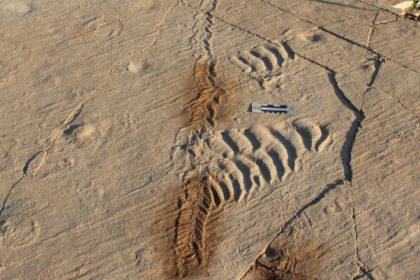
Researchers in Argentina have unveiled a novel species of unenlagiid dinosaur; this ancient creature frequented the freshwater marshlands during the Late Cretaceous period, bolstering the hypothesis that certain dinosaurs evolved specialized hunting techniques for fish.
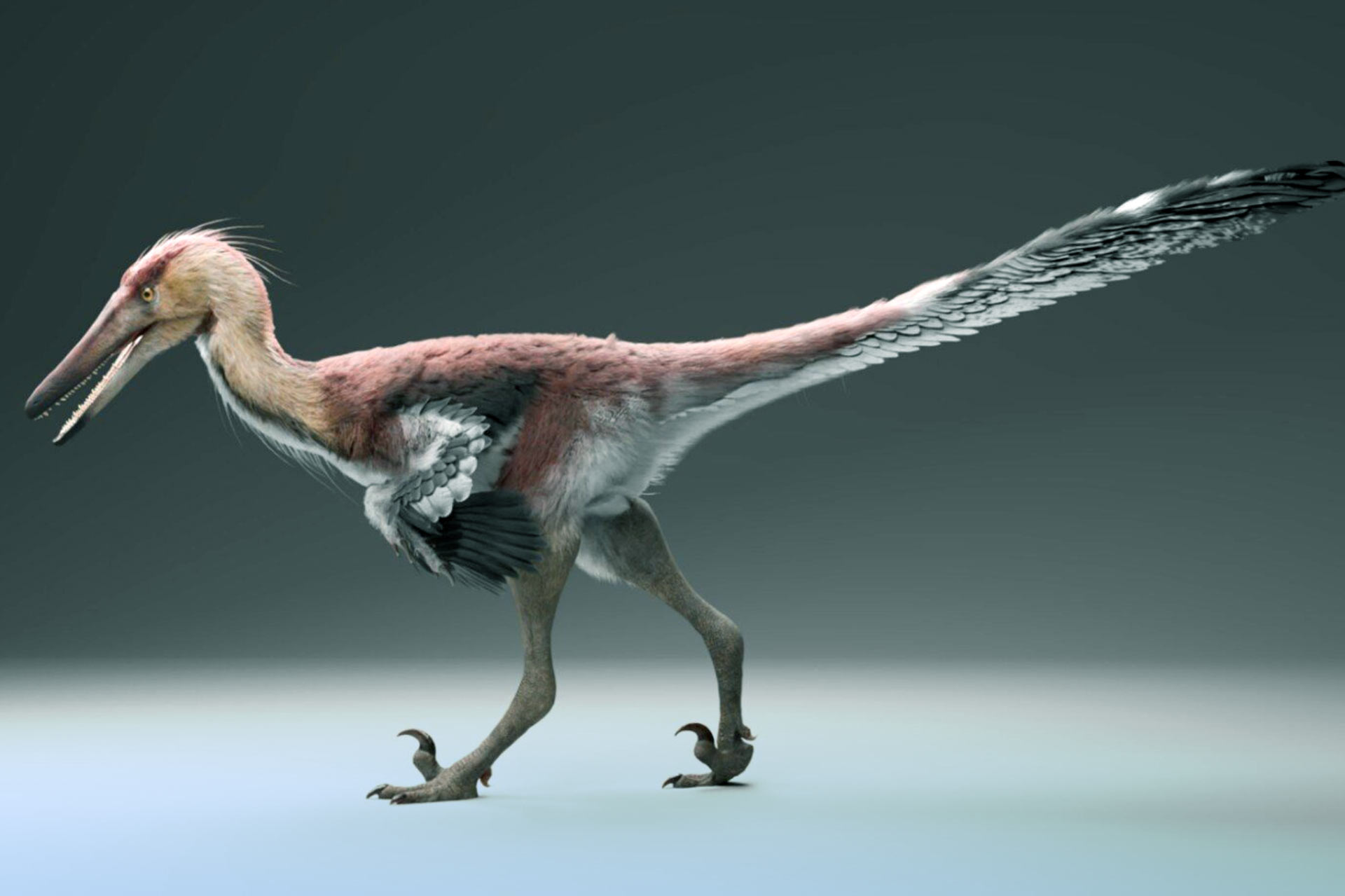
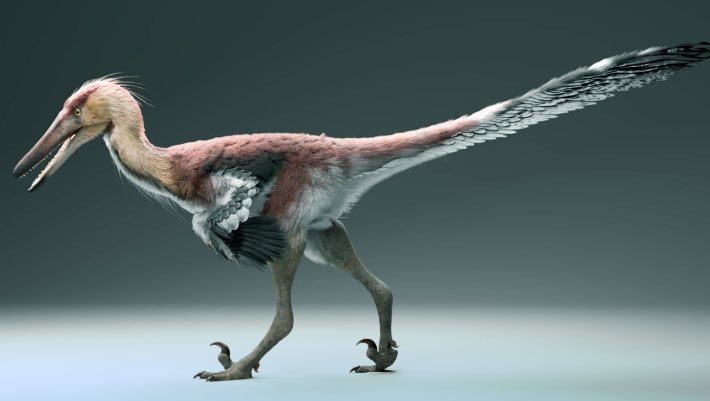
A life-like depiction of Kank australis. Credit: Gabriel Díaz Yantén.
This recently identified dinosaur species inhabited Earth approximately 70 million years ago, during the Late Cretaceous epoch.
This prehistoric reptile existed within an environment characterized by winding rivers and streams interspersed with seasonal ponds, teeming with aquatic flora like water lilies and fauna including fish, insects, and various types of mollusks.
Designated Kank australis, this creature attained a length of approximately 2.5 to 3 meters (8.2 to 9.8 feet).
It belongs to the Unenlagiidae family, a lineage of feathered, avian-like theropods that share ancestry with the renowned Velociraptor. Fossils from this group have been discovered across South America, Antarctica, Australia, and Madagascar.
“The paravian clade Unenlagiidae is represented by fossil discoveries from various Cretaceous geological formations in South America, Madagascar, Australia, and Antarctica. However, the most thoroughly studied species originate from the Neuquén Basin, situated in northern Patagonia,” stated Dr. Matías Motta, affiliated with the Bernardino Rivadavia Natural Sciences Museum, alongside his colleagues.
“This region alone has yielded at least eight distinct species, with the exception of the Maastrichtian-aged Austroraptor cabazai, all other identified specimens are from Cenomanian-Santonian strata.”
“The evolutionary trajectory and the diversity of unenlagiids within South America remain incompletely understood.”
“The presence of Kank australis helps to fill a notable gap in our knowledge of the distributional patterns of this family during the Late Cretaceous in southern Patagonia. It establishes a connection between known fossil records from northern Patagonia and Antarctica, illustrating the wide dispersal of this dinosaur family across various latitudes of South America.”
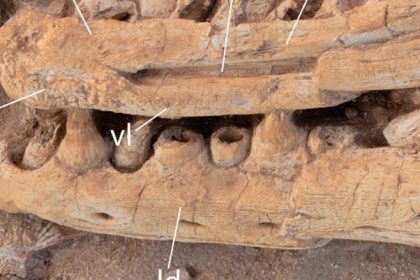
The skeletal remains of Kank australis, which include dental elements, vertebrae, and pedal bones, were excavated from exposures of the Chorrillo Formation at La Anita farm, in proximity to El Calafate city, Santa Cruz Province, Patagonia, Argentina.
“Systematic paleontological excavations have been underway at this locale since 2018, leading to the recovery of a broad spectrum of fossilized flora and fauna,” Dr. Motta elaborated.
“Initial specimens of Kank australis were unearthed in 2018, but these were too fragmented to definitively classify as a new species.”
“Subsequent expeditions facilitated the discovery of additional fossil material; the identification of a cervical vertebra in 2024 proved instrumental in recognizing it as a distinct unenlagiine dinosaur species.”
The paleontological findings also provide valuable insights into the lifestyle and behavioral patterns of Kank australis.
“Observations of the cervical vertebrae of Kank australis reveal specialized structures adapted for muscle attachment and the protection of vascular conduits in the neck. These anatomical features are particularly pronounced in extant avian species that exhibit sophisticated neck articulation, such as herons,” Dr. Motta commented.
“This suggests that Kank australis may have been an adept fisher, a notable departure from the commonly held depiction of raptors as primarily agile terrestrial predators, akin to the northern hemisphere’s Velociraptor.”
“Consistent with other members of the unenlagiine group, it possessed a significantly enlarged, raptorial claw on the second digit of its foot.”
“However, it exhibits distinctive characteristics, including teeth adorned with sharp, prominent longitudinal striations and notably pneumatized cervical vertebrae, meaning they contained internal air spaces.”
“Furthermore, it was comparatively smaller and more slender when contrasted with other unenlagiids from the terminal Cretaceous period, such as Austroraptor cabazai.”
This new discovery contributes to a growing body of evidence indicating that unenlagiids were primarily piscivorous, meaning they subsisted on a diet of fish.
“Their elongated cranial morphology, abundant dentition, and lengthy, flexible necks are indicative of adaptations suited for aquatic predation, mirroring the feeding strategies of modern herons,” Dr. Motta explained.
“In the specific case of Kank australis, its fossilized remains were unearthed in close association with fish fossils, thereby reinforcing this interpretation.”
“Nevertheless, it remains plausible that Kank australis also engaged in predation upon other fauna inhabiting its ecosystem. This included amphibians, reptiles, chelonians, and even early mammals such as Patagorhynchus pascuali, a semi-aquatic monotreme related to contemporary echidnas and platypuses.”
“Kank australis shared its habitat with larger predatory dinosaurs, including Maip macrothorax, an imposing megaraptorid species exceeding 10 meters (33 feet) in length, which could potentially have posed a predatory threat to it.”
The comprehensive research findings were disseminated this week in the esteemed Journal of Vertebrate Paleontology.
_____
Matías J. Motta et al. New unenlagiid from the Chorrillo Formation (Late Cretaceous, Maastrichtian), SW Patagonia, Argentina. Journal of Vertebrate Paleontology, published online May 28, 2026; doi: 10.1080/02724634.2026.2656456