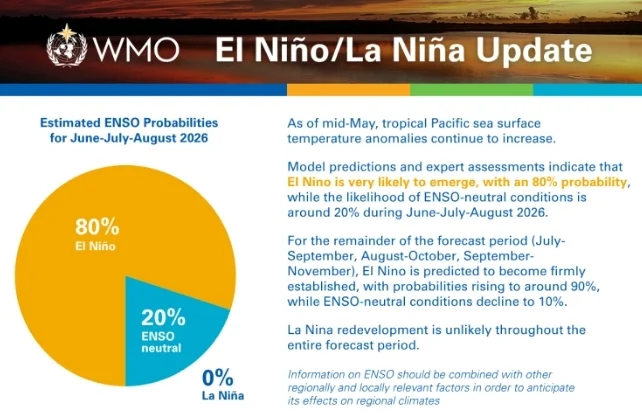
A substantial 80% probability has been identified for the emergence of the warming El Niño atmospheric and oceanic phenomenon between the months of June and August, thereby escalating the potential for severe weather occurrences. This assertion was made by the World Meteorological Organization on Tuesday.
“Driven by exceptionally warm oceanic temperatures in the tropical Pacific basin, El Niño conditions are currently forming and are anticipated to exert an influence on global temperature and precipitation patterns,” announced the WMO, the United Nations’ specialized agency for weather and climate, in a recent statement.
Data derived from the WMO’s global forecasting network “signals a significant transition towards El Niño conditions, with the likelihood reaching 80 percent for the June-August period,” according to the Geneva-headquartered organization.
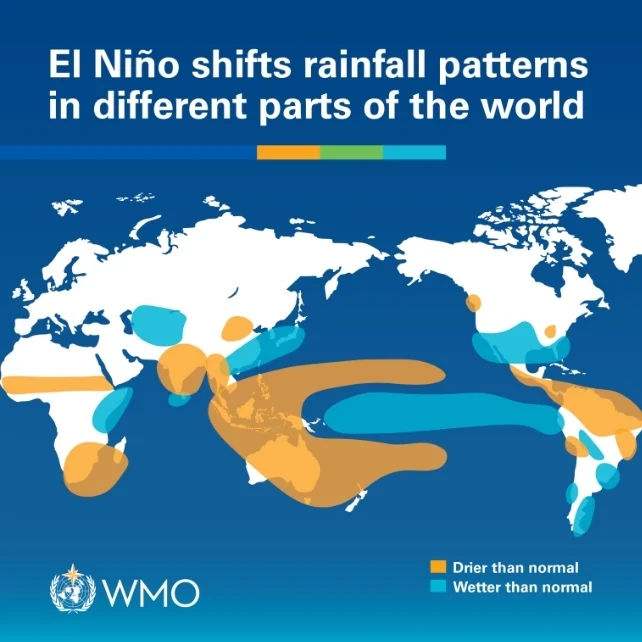
El Niño represents a natural climatic event characterized by elevated surface temperatures in the central and eastern equatorial regions of the Pacific Ocean, which subsequently triggers alterations in global wind, atmospheric pressure, and rainfall regimes.
Typically, this phenomenon recurs on a cycle of two to seven years, persisting for approximately nine to twelve months.
These climatic conditions fluctuate, oscillating between El Niño and its antithesis, La Niña, with periods of neutrality in between.
The probability of El Niño manifesting by November is estimated to be “near or exceeding 90 percent,” with the majority of predictive models indicating that it will likely be “at least of moderate strength – and potentially significant,” the WMO stated in its triennial El Niño/La Niña update.
Celeste Saulo, the head of the WMO, emphasized the global imperative to prepare for an El Niño event that could “intensify drought and heavy precipitation and elevate the risk of heatwaves, affecting both terrestrial and marine environments.”
According to the WMO, even a moderate El Niño event increases the likelihood of certain weather and climate extremes.
The most recent El Niño episode was a contributing factor to 2023 being recorded as the second warmest year on record and 2024 achieving an all-time high, with temperatures approximately 1.55 °C above the pre-industrial average from 1850-1900.
“An Immediate Climate Alert”: Guterres
Between late April and mid-May, sea surface temperatures in the central-eastern Equatorial Pacific – the designated reference area for monitoring – were approaching El Niño thresholds, the WMO reported, with subsurface temperatures registering more than 6 °C above the norm.
Concurrently, the Southern Oscillation Index, which serves as the atmospheric indicator for El Niño, also aligns with the ongoing development of the phenomenon.
The WMO has indicated that there is no empirical evidence to suggest that climate change is increasing the frequency or severity of El Niño events.
Nevertheless, the agency posits that the phenomenon’s impacts can be amplified, given that a warmer global climate, encompassing both oceans and atmosphere, enhances the availability of energy and moisture, thereby exacerbating extreme weather events such as heatwaves and torrential rainfall.
“El Niño is on our doorstep,” stated UN Secretary-General Antonio Guterres in a video address.
“The global community must perceive this as the critical climate warning that it represents. El Niño conditions will undoubtedly intensify the impacts of a warming planet.
“The sole efficacious remedy lies in undertaking climate action commensurate with the magnitude of the crisis – which entails discontinuing our reliance on fossil fuels, expediting the transition to renewable energy sources, providing protection to the most vulnerable populations, and implementing universal early warning systems.”
Saulo noted that 128 nations currently possess multi-hazard early warning systems, with the UN’s objective being the achievement of universal coverage by the end of 2027.
Temperatures Exceeding Norms
While El Niño typically reaches its peak intensity between November and February, the subsequent surge in global temperatures usually becomes apparent at a later temporal point.
Next month’s forecasts are anticipated to offer a more precise indication concerning both the commencement of El Niño and its projected intensity.
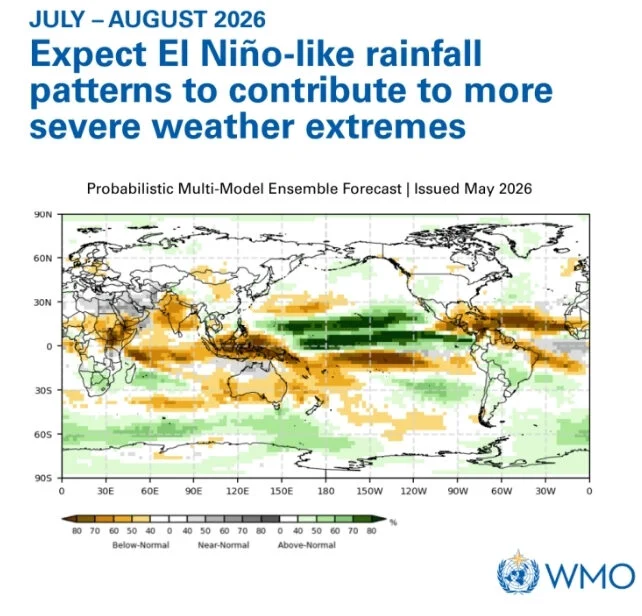
For the period spanning June to August, the WMO indicated that forecasts predict “a virtually universal prevalence of temperatures exceeding normal levels across almost all global regions.”
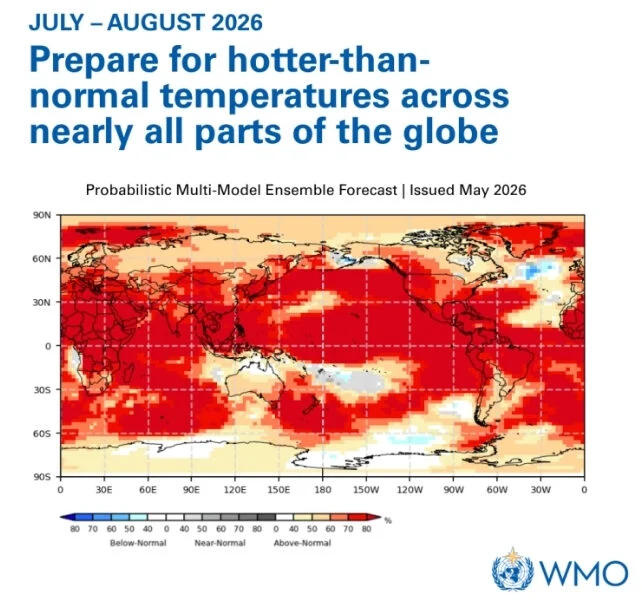
This elevated temperature trend heightens the potential for compounding hazards in certain geographical areas and may accelerate the onset of drought conditions where rainfall deficits are observed, the organization stated.
Saulo elaborated that El Niño would precipitate “cascading effects,” with oceanic warming in tropical zones leading to repercussions for worldwide commerce.
These impacts extend “from climatic variability into the economic stability and the security of populations. Consequently, this information holds significant relevance and importance,” she conveyed to journalists.
The WMO expresses optimism that advance notification will facilitate preparedness, particularly within climate-dependent sectors such as agriculture, water resource management, energy provision, and public health.
Regional climate centers are forecasting “below-normal” precipitation during the crucial June-September rainy season in the northern Greater Horn of Africa; diminished monsoon rainfall in South Asia; and drier, warmer summer conditions across Central America.
Throughout the summer months in the Northern Hemisphere, elevated ocean temperatures associated with El Niño can contribute to the formation of hurricanes in the central and eastern Pacific, while simultaneously impeding their development in the Atlantic Ocean.