The combined experimental medication dasatinib and quercetin, commonly referred to as D+Q, stands as a prominent anti-aging therapeutic currently under development.
While not yet sanctioned for human administration, certain researchers posit that it holds promise in combating disease by enhancing the body’s mechanisms for eliminating aged and compromised cells.
However, a recent investigation has revealed a potentially significant drawback associated with D+Q.
A research group affiliated with the University of Connecticut conducted tests on the neural tissues of mice, uncovering evidence of substantial detriment to the myelin sheaths that insulate nerve fibers.
Previous research examining the neurological effects of D+Q has been limited, which partly motivated this latest inquiry.
These discoveries cast doubt upon the feasibility of widespread clinical application.

Numerous clinical investigations involving D+Q are presently underway, addressing conditions such as renal disease and pulmonary fibrosis.
Fueled by considerable enthusiasm, the investigational drug combination is even being procured and utilized by some individuals without a physician’s prescription, forming part of an off-label ‘longevity’ regimen.
This practice is strongly discouraged by medical practitioners, given that the drug combinations have not undergone thorough evaluation for safety or effectiveness in human subjects.
“Upon administering this combination to test subjects, irrespective of age, the myelin undergoes damage, leading to its degradation – a more pronounced effect observed in younger specimens compared to older ones,” stated immunologist Stephen Crocker.
The neural damage documented herein bears resemblances to the pathological features observed in conditions such as multiple sclerosis and a phenomenon known as ‘chemo brain,’ which arises from chemotherapy and is characterized by cognitive impairment.
Dasatinib, when used independently, serves as a critical medication for the treatment of cancer, often administered concurrently with chemotherapy, a factor that may contribute to the observed myelin deterioration.
When the insulating myelin layer is compromised, neuronal communication becomes less efficient. Much of the observed damage in the rodent subjects’ brains was concentrated around a significant neural pathway known as the corpus callosum.
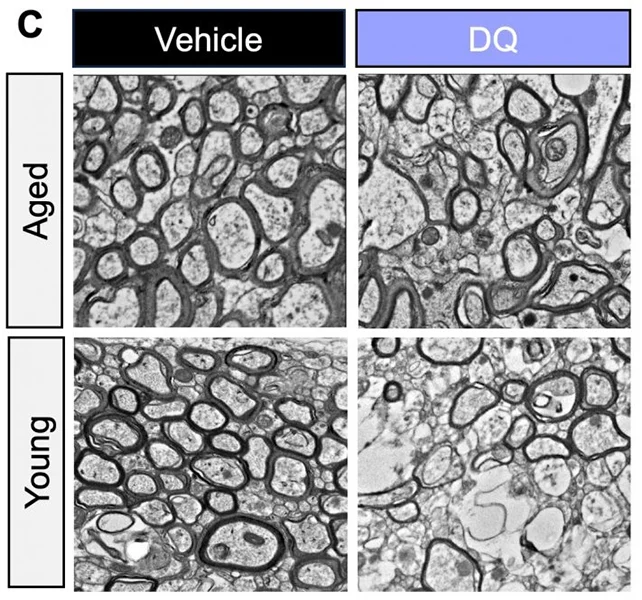
Subsequent laboratory analyses investigated the interaction between D+Q and oligodendrocyte cells, a type of brain cell responsible for the development and maintenance of myelin.
These investigations indicated that the combined drug treatment appeared to induce a regression in oligodendrocytes, causing them to revert to a more juvenile and less complex operational state.
Alterations in oligodendrocyte metabolism were also noted, impeding sufficient myelin production and leaving nerve fibers vulnerable.
Although these findings are derived from a limited number of animal subjects rather than human participants, they present a compelling basis for concern.
Further rigorous scientific examination is now clearly indicated – for instance, through the diligent monitoring of brain cells during ongoing clinical trials of D+Q.
“Our hypothesis is that the pharmacological agents impede the cellular energy supply, prompting the cells to reduce their complexity and revert to a less functional, earlier developmental stage,” explained Crocker.
The compelling aspect of D+Q for the scientific community lies in their function as senolytics – compounds designed to selectively eliminate senescent, or aged and damaged, cells.
These dysfunctional cellular entities, known as senescent cells, accumulate with advancing age. Their presence within the organism provokes inflammatory responses, which are potentially linked to a spectrum of chronic illnesses, including neurodegenerative conditions such as multiple sclerosis and Alzheimer’s disease.
Should senolytic agents like D+Q prove effective in mitigating the burden of senescent cells, the implications for age-related diseases could be profound.
The complex process of aging is implicated in numerous facets of health, underscoring the significant research efforts aimed at decelerating this biological progression.
However, substantial scientific groundwork remains before such advancements can be fully realized.
In light of these recent findings, a cautious approach to future development is strongly advised.
Nevertheless, this research involving rodents does offer some encouraging insights.
The oligodendrocytes that exhibit stress but remain viable bear a resemblance to cells observed in individuals diagnosed with multiple sclerosis.
This similarity suggests that D+Q could potentially be utilized in experimental settings to identify therapeutic strategies that may effectively reverse some of the damage caused by this autoimmune disorder.
“If we can replicate this cellular response, it presents an exceptional opportunity to investigate the capacity for cellular recovery and subsequent brain repair,” observed Crocker.