
A peculiar atmospheric and oceanic phenomenon has been identified in the North Atlantic, situated south of Greenland; this phenomenon manifests as a distinct ‘cold blob’ where temperatures are decreasing, contrarily to the global warming trend.
A recent comprehensive evaluation of this cold region now indicates a significant and pressing climate challenge.
An international consortium of scientific investigators utilized satellite imagery, reanalysis archives, and data on ocean heat content, with records dating back to 1955, to ascertain the underlying mechanisms driving this anomaly.
Two prevailing hypotheses have emerged to explain this occurrence: either a reduction in oceanic currents supplying heat to the area, or an increased dissipation of heat from the ocean surface in that specific zone.
The findings from this investigation lend substantial support to the former explanation, leading to the conclusion that the region is nearing a critical threshold, or tipping point.
The researchers posit that this Atlantic cold anomaly is a direct indicator of a diminishing strength in the Atlantic Meridional Overturning Circulation (AMOC).
Evidence suggests this vital oceanic circulation system is exhibiting signs of a potential complete cessation, a scenario foretold to precipitate consequences for the global climate far more severe than a localized oceanic cooling.
“Considering the well-documented existence of a tipping point for the AMOC, alongside recent research identifying various ‘early warning signals’ indicating its approach to such a critical juncture, the robust evidence for a weakening AMOC presents a grave concern for societal well-being and governmental policy,” articulate the scientists within their published research paper.
The investigators determined that the observed cooling trend originated from deep-water currents, revealing that surface heat loss in the affected area has actually diminished. Therefore, the issue is not an elevated heat escape, but rather a reduced influx of thermal energy.
Given that this zone of cooler ocean water is situated at the apex of the AMOC’s expansive circulatory ‘conveyor belt,’ it is logical that temperatures would decline as the AMOC weakens, consequently reducing the transport of warmer waters from tropical and equatorial regions northward.
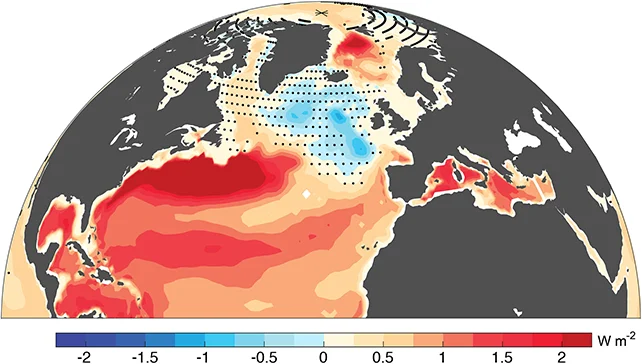
Prior research had already established the deceleration and weakening of the AMOC. This new study provides some of the most compelling evidence to date demonstrating a direct correlation between the cold anomaly and this significant oceanic current system.
This conclusion is in accord with a 2025 study which employed climate simulations, rather than historical empirical data, to establish a connection between the AMOC and the cooler water region, also referred to as the North Atlantic warming hole.
“The observed cooling trend cannot be attributed to alterations in surface heat exchange,” state the authors of the recent publication.
“Variations in heat content over several decades are generally more pronounced and exhibit a stronger correlation with oceanic heat transport compared to the variability of surface heat flux.”
With the fundamental cause of the Atlantic’s cold patch now clarified, the question arises: what lies ahead? Unfortunately, projections based on current scientific models are concerning: experts widely agree that the AMOC is steadily approaching a critical point of instability in its weakening influence, with eventual dissolution anticipated.
The combined effects of ocean warming and glacial meltwater, which introduces freshwater into the ocean, are disrupting the equilibrium necessary for the AMOC to function.
Should the AMOC cease its operation entirely, Europe could face significantly colder and more severe winters, alongside substantial global shifts in weather patterns, ecological systems, and food security.
“While considerable uncertainty persists regarding the Earth’s proximity to this tipping point, standard simulations from CMIP6, which model future global warming scenarios, indicate that this threshold is crossed in a significant portion of these model projections around the mid-century,” note the research team.
Direct monitoring of the AMOC has only been conducted since 2004, providing an insufficient historical record for scientists to definitively ascertain the long-term trajectory of its recent decline.
By employing climate models such as those within CMIP6 (Coupled Model Intercomparison Project Phase 6), we are at least equipped to prepare for and forecast potential outcomes if the AMOC were to falter, as suggested by multiple recent studies.
“This inherent risk warrants immediate consideration by those responsible for policy formulation,” conclude the study’s authors.