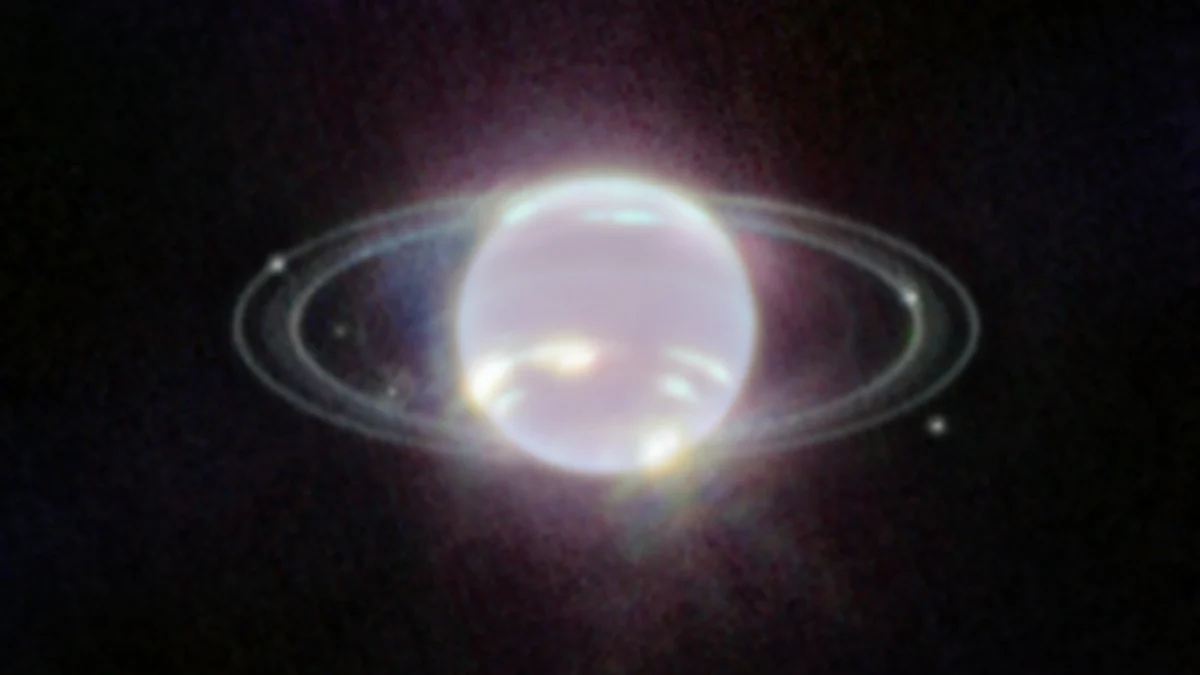
Neptune stands apart from the other gas giants due to its peculiar axial tilt and a unique collection of moons, unlike any encountered elsewhere in our solar system.
A recent publication from researchers at Caltech proposes a compelling hypothesis: Triton, Neptune’s most substantial moon by a significant margin, may have utterly annihilated the planet’s original regular moon system, with Nereid being the sole surviving exception.
To provide context, let’s examine Neptune’s lunar arrangement. Triton is an anomaly; its retrograde orbit, rotating in the opposite direction to Neptune’s spin, strongly suggests it did not originate as an intrinsic component of the planet’s formation.
It is more plausible that Triton was once part of a binary Kuiper Belt Object (KBO) pair, analogous to Pluto and Charon, which was subsequently ensnared by Neptune’s immense gravitational influence.
Nereid itself represents a peculiar case.
NASA/JPL
)
First identified in 1949 by Gerard Kuiper, the namesake of the Kuiper Belt, and over a century after Triton’s discovery, Nereid remained Neptune’s only other recognized moon until the Voyager 2 encounter in 1989.
However, its orbital path is notably irregular, to put it mildly.
Possessing a highly elliptical orbit that spans 360 days, astronomers initially speculated for years that it too was another captured KBO.
This recent research strongly indicates otherwise.
To substantiate this assertion, the study’s authors directed the James Webb Space Telescope’s high-resolution infrared instrument towards Nereid. Their findings revealed that its spectral signature closely resembles that of an icy, indigenous moon of Uranus or Saturn, rather than a dark, dust-laden captured KBO.
In contrast to Phoebe, a known captured KBO, Nereid’s water-rich craters exhibit a markedly different appearance under infrared illumination.
As the authors state in their publication, “Nereid’s unique spectrum among outer Solar System bodies is not consistent with a scenario where Nereid is captured during the early Solar System’s dynamic instability.”
Consequently, this significantly diminishes the likelihood of Nereid being a KBO, leaving its origin as a naturally formed moon of Neptune as the prevailing explanation.
But what accounts for its unusual orbit?
Its orbital distance, degree of ellipticity, and other orbital parameters deviate from those of the majority of other moons within the Solar System. To address this enigma, the researchers employed sophisticated simulations.
They utilized a dynamical simulation tool named REBOUND to model Neptune populated by a series of conventional, circular moons.
Subsequently, they introduced Triton into this idealized model.
Upon its ingress into a highly eccentric, retrograde orbit, the captured KBO wrought considerable disruption upon Neptune’s pre-existing lunar system.
The majority of the original moons were either shattered or expelled from the system entirely during this cataclysmic event.
The resultant debris eventually coalesced to form Neptune’s current ring system, along with some of the diminutive “ring-moons,” such as Proteus.
However, the simulations also unveiled an additional phenomenon.
In approximately 20% of all simulation runs, Triton was observed to displace one of the indigenous inner moons, present prior to its arrival, into a stable, highly elongated, and tilted orbital path. This configuration closely mirrors Nereid’s current orbit.
NASA/JPL/USGS
)
Therefore, within the simulated environment at least, Nereid appears to represent an original moon of Neptune that was propelled into its current eccentric orbit by the capture of the planet system’s most prominent current inhabitant.
If this hypothesis holds true, it could provide invaluable, pristine insights into the formation processes of the Neptunian system, given that its distant orbit would have afforded it a considerable degree of preservation compared to other gas giant moons.
Confirmation of this theory is unlikely until a new probe is dispatched to that region, however.
Planetary scientists have been advocating for such a mission for over a decade, without success to date.
Nevertheless, until such an endeavor materializes, our perception of this particular gas giant moon can evolve from that of a captured icy body to a resilient survivor of one of the most violent lunar cataclysms documented in the Solar System’s history.
This article was originally published by
Universe Today
. Read the
original article
.