
Imagine a cinematic opening where scientists unearth a multitude of seismic disturbances deep beneath Antarctica, in a region geologically inconsistent with such phenomena. One might anticipate an ensuing narrative involving extraterrestrial entities, primordial beasts, or similarly dramatic revelations.
However, this scenario transcends the realm of speculative fiction. A collaborative scientific endeavor involving researchers from the United States and Spain has pinpointed over 500 deep-seated earthquakes in this sub-Antarctic location, and the team is diligently pursuing hypotheses that align with the gathered empirical evidence.
The geographical area in question does not traverse any boundaries between tectonic plates, which are typically the drivers of the frictional forces responsible for generating seismic events.
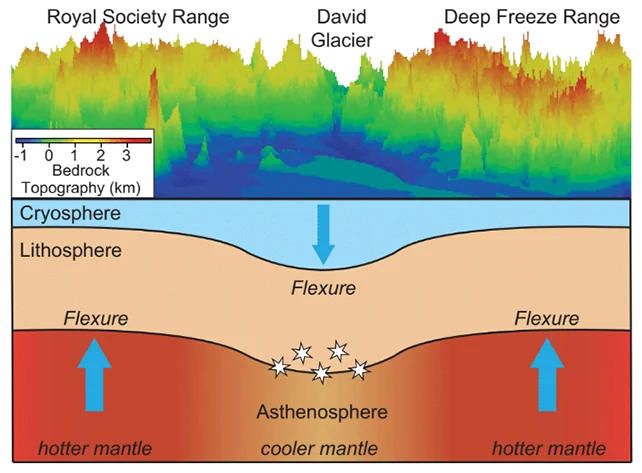
Instead, this profound seismic activity is attributed to the process where more yielding, warmer rock undergoes thermal expansion and deformation, consequently bending the rigid, brittle crust from underneath.
Nevertheless, this investigation substantiates the occurrence of these intraplate seismic events beneath Antarctica, mirroring other enigmatic seismic manifestations observed in locations such as Afghanistan, Morocco, and Romania.
“Intraplate earthquakes, defined as occurrences within the interior of tectonic plates and distant from active plate margins, present a challenge to the conventional plate tectonic model, which posits minimal deformation in these internal regions,” articulate the investigators in their peer-reviewed publication.
“Intermediate-depth earthquakes (IDEs), spanning depths greater than 70 km, situated within intraplate settings are even more perplexing to elucidate, as the elevated temperature and pressure conditions prevalent in the upper mantle are not conducive to brittle fracturing.”
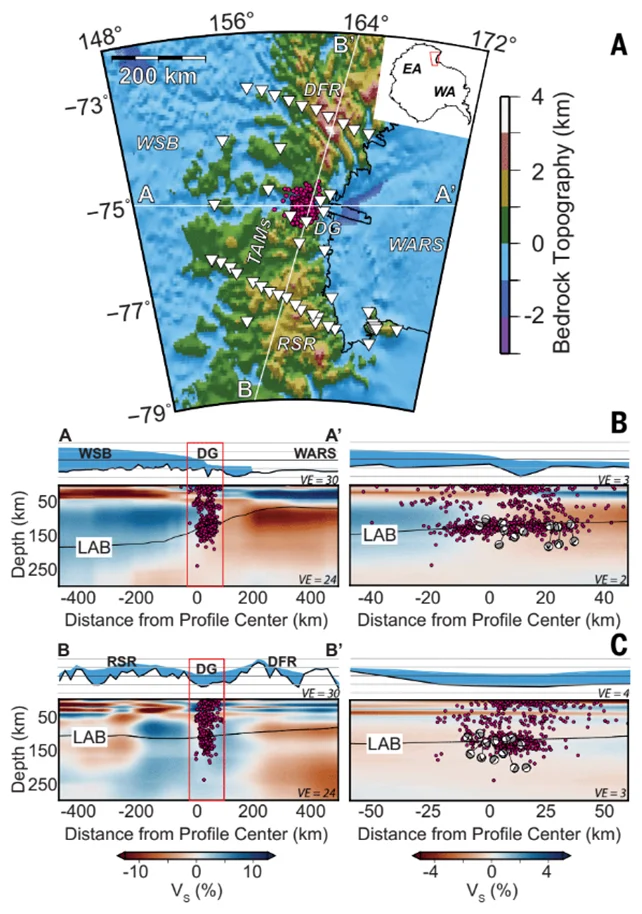
The research cohort amassed data from 49 seismic monitoring stations strategically deployed across East Antarctica. Subsequently, a sophisticated deep learning artificial intelligence methodology was employed to meticulously analyze this dataset, enabling the identification of seismic events amidst background noise.
Through the analysis of rapid primary seismic waves (known as p-waves), which traverse all forms of matter, and the slower secondary seismic waves (termed s-waves), which are incapable of propagating through molten rock, it becomes feasible to detect rock-fracturing occurrences and ascertain their precise geographical coordinates.
This analytical process yielded a comprehensive dataset of 510 IDEs, exhibiting a pronounced clustering directly beneath the David Glacier, with epicenters situated at depths ranging from 100 to 150 kilometers (equivalent to 62 to 93 miles).
The localized magnitudes of these seismic events fell within the spectrum of 1.6 to 3.5, which are considered relatively modest in conventional earthquake classifications.
“We successfully identified and characterized intraplate IDEs occurring beneath East Antarctica by utilizing an automated deep-learning earthquake detection system enhanced with transfer learning, a sophisticated technique that capitalizes on pre-existing trained models to expedite the resolution of novel, yet related, challenges,” the researchers report in their findings.
This discovery contributes to a growing body of research indicating that Antarctica, from a seismological perspective, is not as seismically quiescent as was previously understood.
This then prompts the subsequent critical inquiry: what underlying forces are precipitating these seismic occurrences?
Although the region is not situated along a major tectonic plate boundary, it lies in proximity to a lithospheric boundary, a zone where geological formations of differing densities converge. Specifically, this involves the substantial, frigid slab of East Antarctica juxtaposed with the comparatively thinner, warmer slab of West Antarctica.
The researchers posit that the convergence of these lithospheric plates renders the rock structure in this vicinity susceptible to stress. This, in conjunction with the upward pressure exerted by the hot mantle and the downward force of the overlying ice sheet, could potentially account for the observed seismic activity.
“This configuration engenders a pronounced gradient in lithospheric strength, and it has been theoretically proposed that stress concentrations along such divergent boundaries may precipitate intraplate seismicity at the periphery of the more robust lithospheric block,” the scientific team elaborates.
In essence: The most probable explanation does not involve extraterrestrial visitors or ancient mythical creatures.
These findings furnish geologists with an enhanced comprehension of the intricate subterranean forces and interactions that transpire deep within the Earth’s crust, particularly in regions far removed from active tectonic plate margins.
Furthermore, they underscore the diverse array of mechanisms capable of triggering seismic events, including those occurring in unexpected locales and driven by processes that have only recently become amenable to detection.
Certain enigmas persist: While the proposed “bending” mechanisms offer an explanation for the profound depth of these earthquakes, they do not elucidate their exclusive clustering beneath the David Glacier. Comparable lithospheric boundaries extend across other segments of the Transantarctic Mountains, suggesting that localized, site-specific factors must also play a consequential role.
The research team advocates for the application of deep learning AI and contemporary data acquisition techniques to analogous geological settings worldwide, with the objective of identifying other intraplate IDEs that have heretofore remained undetected.
“As detection capabilities continue to advance, and deep-learning algorithms are refined to discern otherwise concealed seismic signatures, these types of events may prove to be far more prevalent than currently acknowledged,” the researchers conclude.