It has been widely reported that the most affluent 10 percent of the global population bears a disproportionate responsibility for environmental degradation.
Now, scientific researchers have quantified this impact, estimating the monetary value of the ecological damages incurred by this elite group.
Determining a precise monetary value for environmental assets is inherently challenging, and indeed, some academics posit that such an exercise is fundamentally misguided, arguing that nature possesses inherent worth independent of its utility to humanity.
However, in specific contexts, translating environmental costs into economic terms can be advantageous, particularly when addressing the financial considerations that often guide the decisions of the world’s affluent.
This is precisely the approach taken by environmental scientists Inge Schrijver, Rutger Hoekstra, and Paul Behrens, all affiliated with Leiden University in the Netherlands.
Their calculations indicate that the leading 10 percent of consumers globally are accountable to society for trillions of dollars due to their ecological footprint.
This finding gains particular relevance when considering recent reports, such as Elon Musk being recognized as the first individual to achieve trillionaire status.
“Our objective is to illuminate the unequal burden of responsibility borne by the societal top decile and to present this through the lens of potential revenue if they were to settle their environmental obligations,” the researchers, including Schrijver, state in a recently published peer-reviewed article.
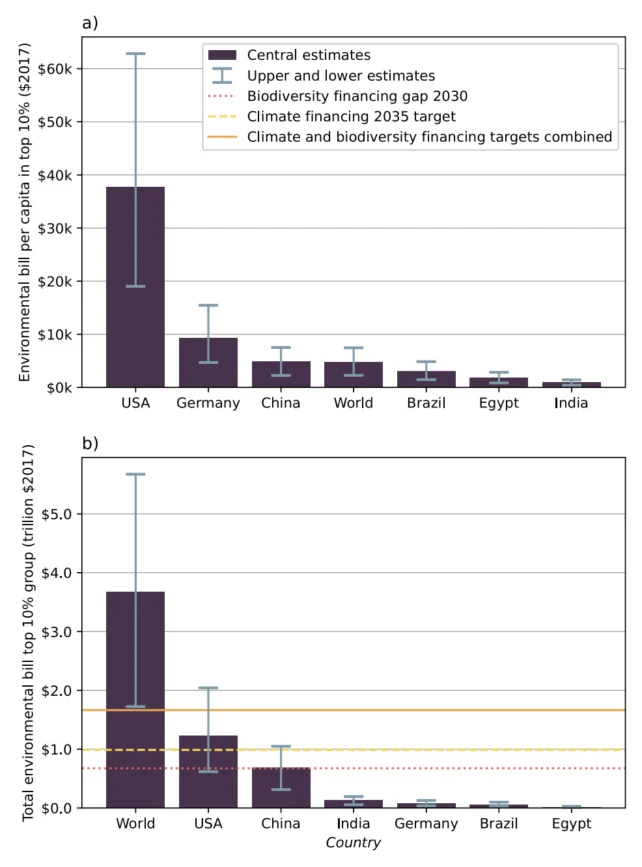
“Our analysis reveals that the annual environmental liabilities incurred by the global top 10 percent range from $1.7 to $5.7 trillion, equating to approximately $2,300 to $7,500 per individual (in 2017 US dollar terms).”
“This figure substantially exceeds the existing international funding shortfalls for climate action and biodiversity preservation.”
In essence, the implementation of environmental levies targeting this demographic could provide the necessary capital for the extensive transformations required to safeguard our societies from ecological collapse and simultaneously enhance the living standards of lower-income populations.
For instance, the study suggests that even conservative estimates for the top decile in the United States and China individually possess the capacity to bridge the $675 billion deficit in biodiversity protection funding projected by 2030.
Furthermore, the intermediate projections for the top 10 percent of consumers in the US alone would be more than sufficient to meet the annual funding requirement of $993 billion necessary to achieve the targets established at COP30 by 2035.
To quantify this substantial financial obligation, the research team began with consumption-based environmental “footprints” for the wealthiest 10 percent of the global population in 2017. It is important to note that this represents the most recent available data for these footprints, making it nearly a decade old.
These footprints provided estimations of carbon dioxide emissions, biodiversity loss, and the displacement of nitrogen, phosphorus, and freshwater resources attributable to this affluent segment of consumers.
Subsequently, the researchers consulted the “Environmental Prices Handbook 2024” to assign monetary values to these environmental damages, reflecting the societal loss incurred. The figures were adjusted to 2017 US dollars to align with the footprint data.
The study revealed significant variations in these valuations across different countries.

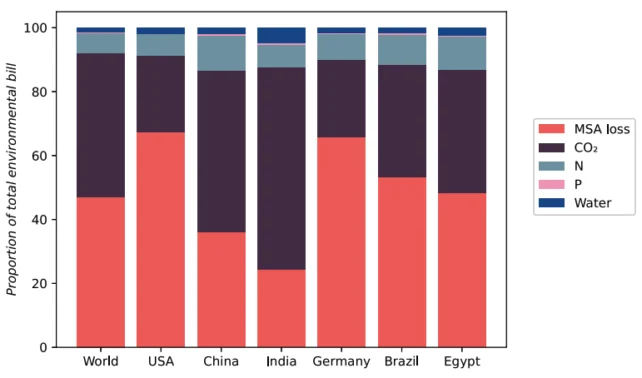
Schrijver and colleagues determined that the two primary drivers of the global “damage bill” for the wealthiest 10 percent are biodiversity loss, accounting for 47–56 percent of the total, and climate change, which contributes 36–45 percent.
For the top 10 percent of US consumers, who represent the largest segment within the global top decile, estimated liabilities ranged from $19,000 to $63,000. This represents a modest proportion of their income, only 6–20 percent, or 0.8–3 percent of their total wealth.
Based on the study’s estimations, these individuals consistently incurred the highest “debt” on a global scale.
In contrast, for India, the top 10 percent faced financial obligations ranging from $410 to $1,400, which constituted approximately 0.8–2.8 percent of their incomes, or 0.2–0.5 percent of their wealth.
“The disparity in financial obligations observed between countries mirrors the inequalities in consumption patterns and emission levels,” the researchers explained in their publication.
While the implementation of environmental taxation may not be a panacea for the severe global crises we face concerning climate change and biodiversity loss, it is a crucial component.
As Schrijver and his team point out, funding for these critical issues must originate from somewhere, and this approach could significantly contribute to transitioning towards more sustainable consumption models.
“These financial implications underscore the mitigation responsibilities of the top 10 percent and highlight the potential revenue stream generated by environmental taxes, should the polluter-pays principle be adopted,” Schrijver and his colleagues concluded.