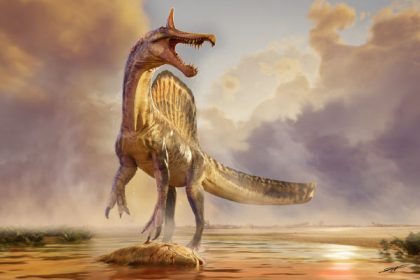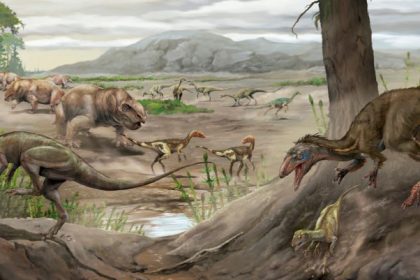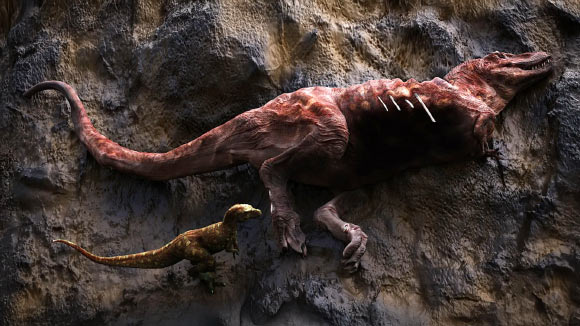
Groundbreaking discoveries by paleontologists at Aarhus University are reshaping our understanding of tyrannosaurs, challenging the long-held perception of them solely as preeminent apex predators. A meticulous examination of sixteen meticulously documented puncture marks on a 75-million-year-old tyrannosaur limb bone indicates that smaller members of this dinosaur lineage engaged in scavenging their own species.
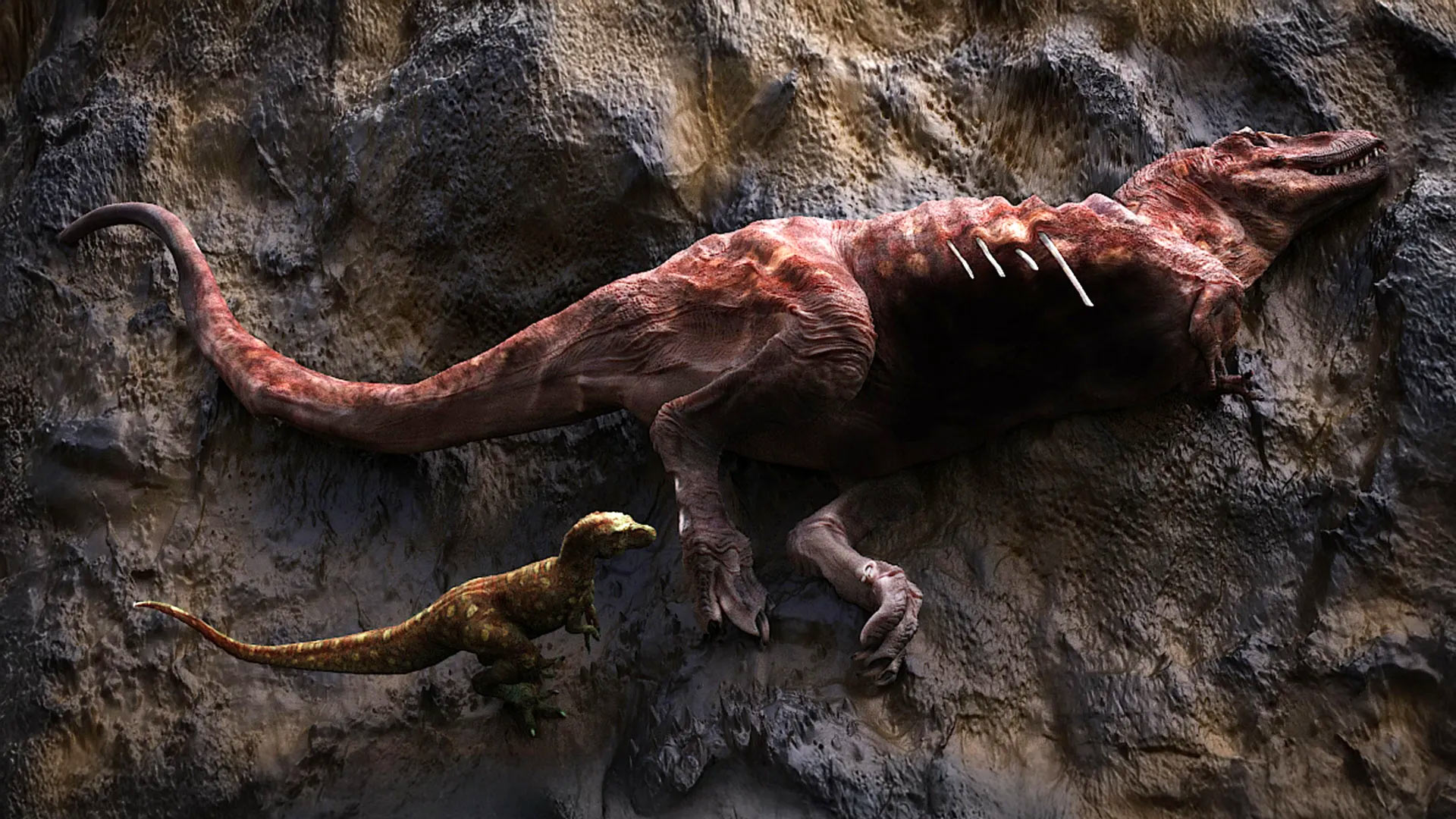
Visualization of a small tyrannosaur feeding on a carcass of a larger tyrannosaur. Image credit: Yu Xin, Shen Li & Liang Junwei, Aarhus Universitet.
“During the Late Cretaceous period, tyrannosaurs were the preeminent terrestrial carnivores inhabiting the northern hemisphere,” stated lead author Josephine Nielsen, a Master’s candidate at Aarhus University, alongside her research associates.
“Among the species identified from the Campanian stage in the northern Western Interior of North America are noted genera such as Daspletosaurus and Gorgosaurus.”
“The Tyrannosauridae family comprised colossal predatory carnivores, possessing robust cranial structures engineered to withstand immense bite pressures and significant physical stress.”
“Their dentition was capable of processing bone, even from prey substantially larger than themselves, a conclusion supported by the presence of bone fragments within fossilized digestive waste (coprolites).”
“While such fossilized evidence does not definitively prove bite force capabilities, ongoing scientific discourse continues to explore the precise feeding methodologies of tyrannosaurs and their ecological interactions.”
Employing state-of-the-art 3D scanning technology, Nielsen and her collaborators successfully identified sixteen distinct bite marks impressed upon a fossilized metatarsal, or foot bone, belonging to a truly colossal tyrannosaur.
“Through the analysis of the depth, inclination, and positioning of these markings within a virtual 3D environment, I can confidently assert that these punctures were not accidental occurrences,” Nielsen elaborated.
“They represent deliberate impressions left by the dentition of a smaller tyrannosaur that was consuming a deceased, significantly larger relative.”
This groundbreaking study offers invaluable insights into the resourcefulness prevalent during the Mesozoic Era, revealing that these formidable creatures were not exclusively hunters but also opportunistic scavengers.
It is theorized that the resilient foot bones were likely consumed during the advanced stages of decomposition, after the majority of the musculature had been consumed.
“The bone exhibits no indications of having healed subsequent to the smaller dinosaur’s infliction of the bite marks,” Nielsen observed.
“Given the location of these marks on the foot, an anatomical region with minimal flesh, it strongly suggests the dinosaur was scavenging, consuming the final remnants from an aged carcass.”
The research team did not physically handle the original fossil; their investigation was conducted using a high-fidelity digital model and a 3D-printed replica.
The metatarsal in question measures 10 centimeters in length and originated from a tyrannosaur that, during its lifetime, would have attained an impressive length of 10-12 meters and a weight of several tons.
This significant fossil specimen was unearthed by an amateur paleontologist within the Judith River Formation of Montana, a geologically rich and eroded landscape that preserves the ancient fossilized remnants of a vibrant 75-million-year-old ecosystem teeming with dinosaur life.
“What imbues this research with exceptional significance extends beyond our enhanced comprehension of dinosaurian food web dynamics from eons past; it also lies in the innovative methodology employed to decipher these ancient traces,”
“By meticulously constructing a digital representation, I gained the ability to magnify and scrutinize extremely minute details.”
The findings of this comprehensive study have been published in the esteemed scientific journal Evolving Earth.
_____
Josephine Nielsen et al. 2026. Investigating size-asymmetric feeding among tyrannosaurids using tooth marks on a metatarsal from the Judith River Formation, Montana, USA. Evolving Earth 4: 100107; doi: 10.1016/j.eve.2026.100107