Gazing skyward on a clear night at a luminous full Moon reveals a celestial body whose visage has been scarred, fractured, and battered for an immense span of four billion years.
The enigmatic dark regions visible upon its surface represent colossal impact basins, violently excavated by forces so immense they profoundly reshaped the lunar landscape.
Conversely, the brighter highland terrains are densely peppered and deeply pitted, a continuous tapestry of craters, each serving as an enduring testament to celestial collisions that predated the dawn of humanity.
In stark contrast to our terrestrial home, the Moon is devoid of meteorological phenomena that might efface these ancient marks; it lacks the erosive power of rivers to fill depressions and the softening touch of wind on its edges. Any cosmic event that strikes its surface leaves an indelible imprint.
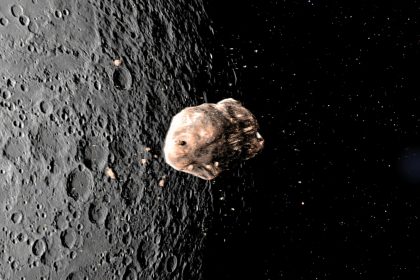
These relentless bombardments are not merely vestiges of a bygone era; the Moon continues to sustain impacts in the present moment, a perpetual cosmic assault.
Celestial debris of all dimensions relentlessly impacts its vulnerable exterior on a daily basis, etching new craters into a terrain perpetually untouched by weathering, erosion, or any mechanism of obliteration.
While the occurrence of such events is understood, direct observation of these impacts in progress is an exceedingly uncommon privilege.
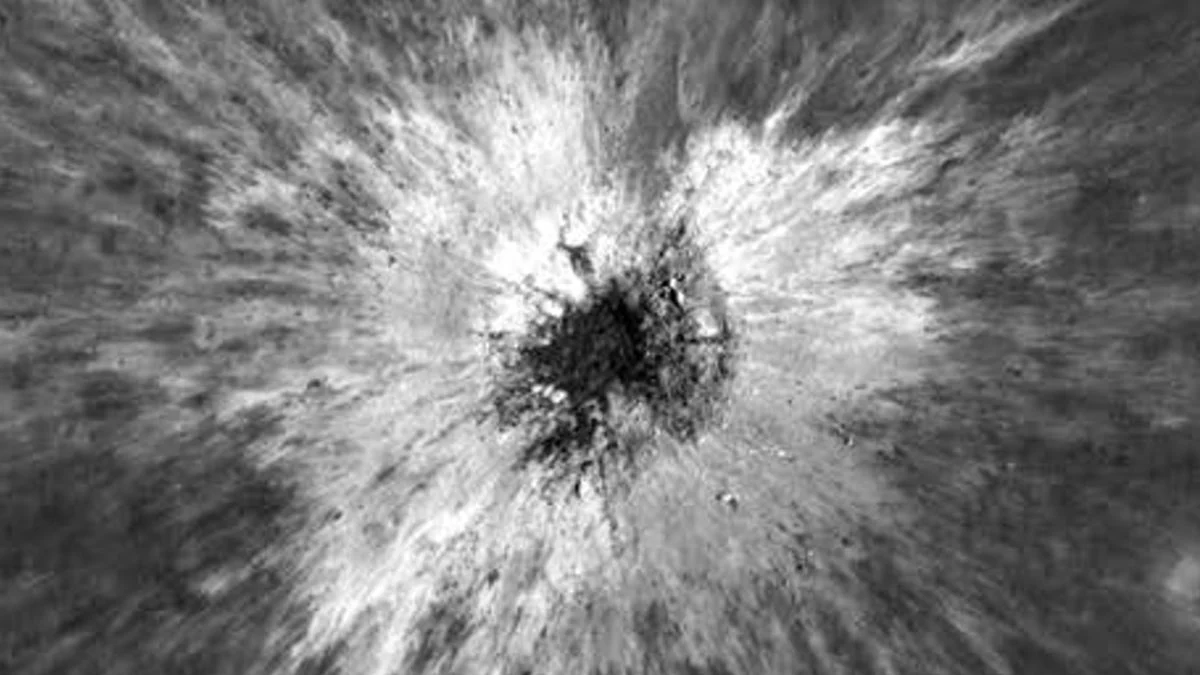
During the latter part of spring in 2024, a notable cosmic event transpired on the Moon. A fragment of space matter, hurtling at exceptional velocity, gouged a crater extending 225 meters in diameter into the lunar regolith.
This dimension is roughly equivalent to the combined length of two football fields laid end-to-end. Fortunately, thanks to the high-resolution imagery captured by NASA’s Lunar Reconnaissance Orbiter Camera, a comparative analysis of pre- and post-impact photographs has enabled a detailed examination of the resultant scar.
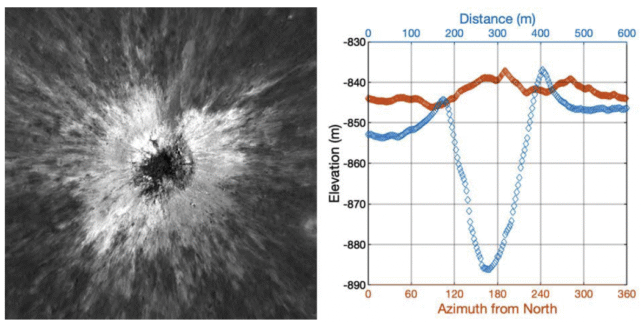
Prior to this significant finding, the most substantial crater identified as originating during the entirety of the LRO mission measured a mere 70 meters across.
This newly discovered aperture is over threefold the diameter of its predecessors. This represents a rare occurrence, as estimations based on impact frequency models suggest that events of this magnitude should transpire only once every 139 years across any given segment of lunar surface. Consequently, its recent formation and subsequent observation are indicative of exceptional fortune.
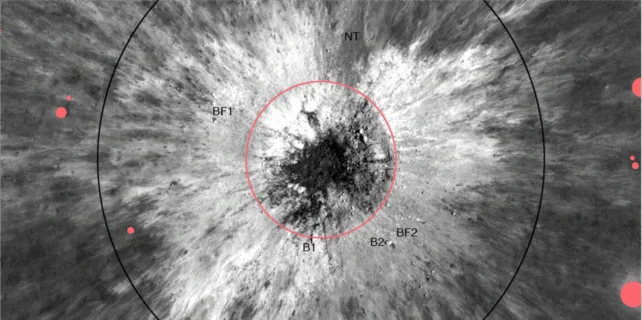
The crater itself exhibits a funnel-like morphology, descending to a depth of 43 meters, with walls of such precipitous inclination that maintaining a stable footing would prove exceedingly challenging. Surrounding its perimeter are substantial fragments of displaced rock, the largest of which measures approximately 13 meters in diameter.
The trajectory of the impacting object can be deduced from the asymmetrical distribution of ejected material; the cosmic projectile appears to have approached from the south-southwest, penetrating the surface and expelling debris northward in a distinctive, tongue-shaped dispersal pattern.
Within the confines of the crater, researchers identified regions composed of remarkably dark material, almost certainly indicative of vitrified rock. This substance was instantaneously fused by the intense thermal energy generated by the impact and subsequently solidified with astonishing rapidity. It stands as a distinct signature of a collision that unleashed an unfathomable amount of energy in mere milliseconds.
The profound scientific value of this discovery lies in the unprecedented quality of the pre- and post-impact photographic documentation. For the very first time, scientists possess high-resolution, meter-scale imagery of a crater of this magnitude captured both before its formation and immediately thereafter.
This constitutes an exceptionally rare and invaluable dataset, which will empower researchers to rigorously scrutinize and refine the computational models employed to comprehend crater formation dynamics, not only on the Moon but throughout the entirety of our Solar System.
The findings stemming from this investigation were formally presented at the 57th Lunar and Planetary Sciences Meeting held in March and are accessible online at this location.
This content was originally disseminated by Universe Today. The initial publication can be accessed here.