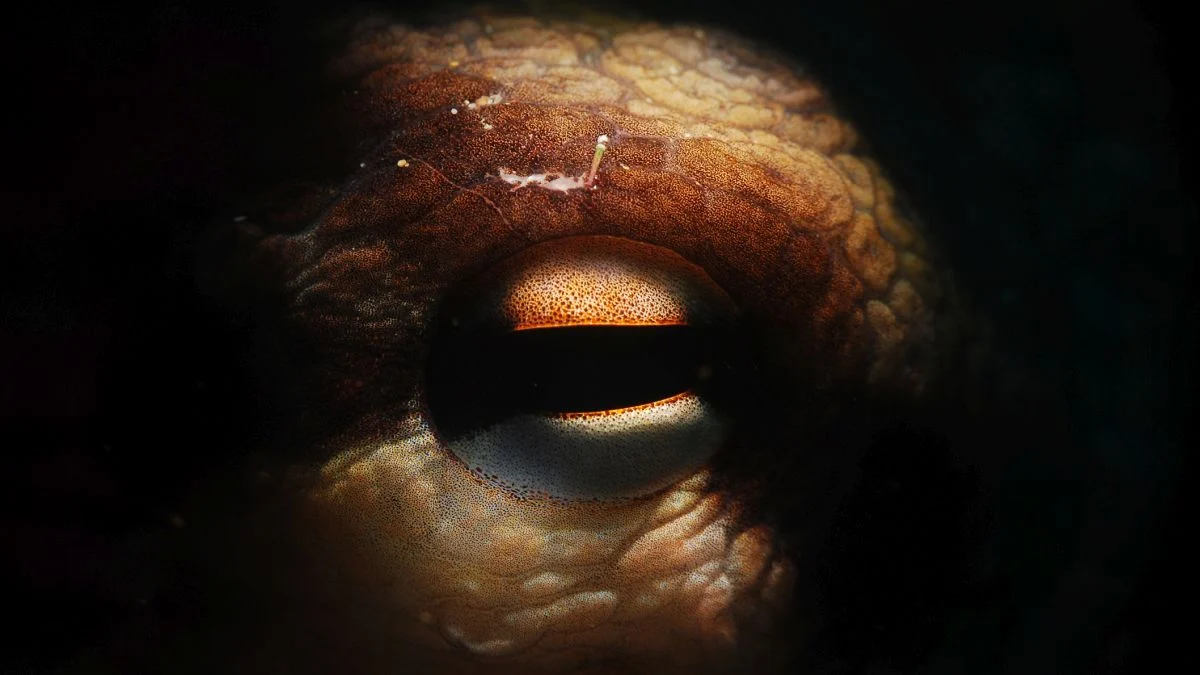
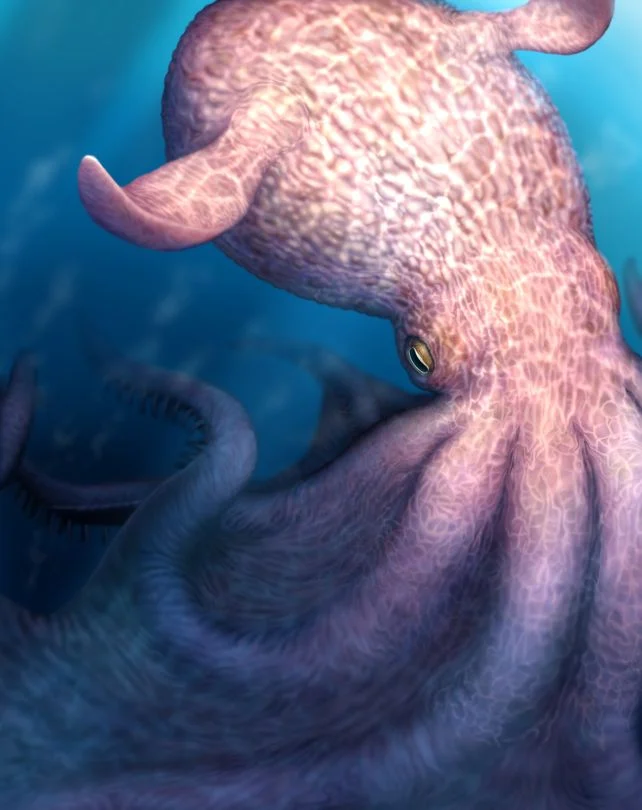
In epochs preceding the reign of the Megalodon in oceanic realms, an equally unsettling creature may have inhabited the abyssal depths – colossal octopuses comparable in magnitude to whales.
A novel examination of over two dozen fossil specimens from the Late Cretaceous period has unveiled octopuses that potentially attained lengths of up to 19 meters (62 feet), positioning them as formidable rivals to other immense marine predators of that era.
Furthermore, the wear patterns observed on these fossilized remnants – specifically the beaks left behind by these predominantly soft-bodied organisms – indicate substantial use in pulverizing the skeletal structures of their prey, a clear sign of a preeminent predator dominating its ecosystem between 100 and 72 million years ago.
“These cephalopods might represent the largest invertebrates ever documented, standing as peers to contemporary giant marine reptiles,” asserts an international cohort spearheaded by paleontologists Shin Ikegami and Yasuhiro Iba from Hokkaido University in Japan.
“Our findings suggest that the development of formidable jaws, coupled with the regression of external skeletal structures, led to a convergent evolutionary trajectory, transforming both cephalopods and marine vertebrates into colossal, intelligent predators.”
A significant portion of the life that has graced this planet throughout its vast history has regrettably vanished. This phenomenon is particularly pronounced for invertebrate species such as octopuses and cartilaginous fish like sharks, whose delicate tissues typically degrade too rapidly for the fossilization process to effectively preserve.
An infrequent exception for these creatures often involves their jaws or teeth – the robust components essential for apprehending and masticating prey.
The Megalodon is renowned for precisely this phenomenon. Its existence is primarily inferred from the fossilized teeth it shed during its apex period, spanning from 23 to 3.6 million years ago. Researchers have extrapolated its dimensions by analyzing the tooth-to-body-size ratio observed in extant sharks, most notably the formidable great white shark, Carcharodon carcharias.
Shin Ikegami and his collaborators have employed a comparable methodology, albeit with a crucial divergence. They cross-referenced fossilized octopus beaks with data from a dozen extant species to establish a broader spectrum of estimations, thereby mitigating potential biases arising from relying on a solitary comparative model.
The research encompassed an aggregate of 27 fossilized octopus specimens from the Cretaceous period. Of this collection, 15 were previously identified and categorized as remains of Octobrachia, housed within museum archives.
The remaining 12 specimens were newly discovered, unearthed through a recently developed technique termed “digital fossil-mining.” This involved meticulous, layer-by-layer sanding of rock samples, subsequent imaging, and the application of artificial intelligence to reconstruct the fossilized material embedded within.
While the researchers did not apply this identical technique to the initial 15 fossils, they did conduct new analyses on select specimens, alongside a thorough re-examination of their characteristics, including detailed wear patterns.
The comprehensive analysis of all specimens indicated their classification into two distinct species of finned octopuses: Nanaimoteuthis jeletzkyi and N. haggarti. Both species were significant in size, with N. haggarti being the larger of the two, estimated to range from 7 to 19 meters based on comparisons with extant species.
For perspective, estimations for the Megalodon’s dimensions typically fall between 13 and 18 meters, while the largest documented mosasaur reached approximately 17 meters.
The planet’s longest living cephalopod, the giant squid, can achieve lengths of up to roughly 12 or 13 meters. In comparison, blue whales can attain a colossal size of around 30 meters.
Additional aspects of the fossil evidence provide further insights into these long-extinct leviathans. The aforementioned wear patterns suggest a powerful crushing action, and the sheer scale implies considerable bite force. However, another intriguing detail emerges.
Certain fossils, particularly the largest specimens, exhibited more pronounced wear on one side. The researchers posit that this asymmetry indicates a form of handedness – a preference for a dominant side, a trait referred to in the study as laterality.
“The asymmetrical attrition of the beak edges suggests lateralized behavior, a phenomenon associated with a sophisticated brain and advanced cognitive functions,” the researchers state.
“This, in turn, implies that the earliest octopuses already possessed a notable degree of intelligence. Laterality is a known characteristic in modern octopuses, whose advanced intelligence is comparable to that of vertebrates.”
Just as giant squids and sperm whales represent formidable adversaries in contemporary oceans, the researchers propose that N. jeletzkyi and N. haggarti would have posed significant challenges to their vertebrate contemporaries. The hypothetical scenario of them clashing with Megalodon, had they coexisted, is an intriguing, albeit speculative, consideration.
The immense size and advanced predatory capabilities of these creatures, the researchers contend, may have been a direct consequence of evolving away from the constraints of rigid skeletal structures. Marine vertebrate predators shed their armor plates and reduced their scales to achieve a more streamlined form. Similarly, cephalopods largely diminished or lost their external shells, adopting a soft-bodied morphology.
These evolutionary adaptations facilitated enhanced swimming performance and increased body size for both groups, at the expense of external protection. This suggests a brief but impactful period of octopus dominance among the apex predators of Earth’s ancient marine ecosystems.
“Long after the emergence of vertebrate apex predators, octopuses developed body plans capable of rivaling them, as this research demonstrates,” the researchers conclude.
“Our discovery of octopus apex predators underscores the critical role of this convergent evolution of robust jaws and the reduction of external skeletons in both cephalopods and vertebrates for achieving the status of large, intelligent marine top predators.”