A remarkable discovery of neoazhdarchian pterosaur footprints in South Korea is providing unprecedented insights into the terrestrial hunting behaviors of these enormous flying reptiles.
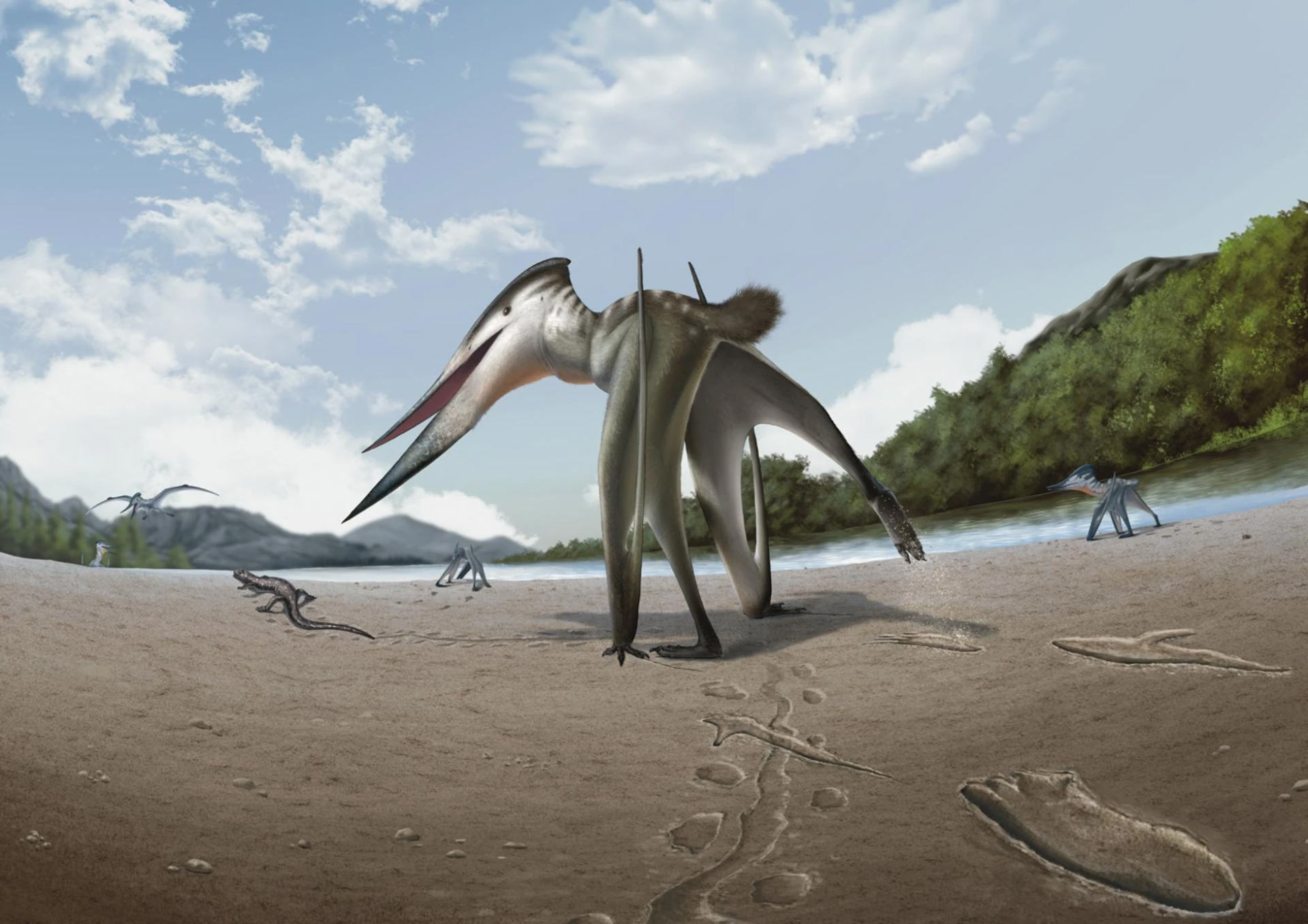
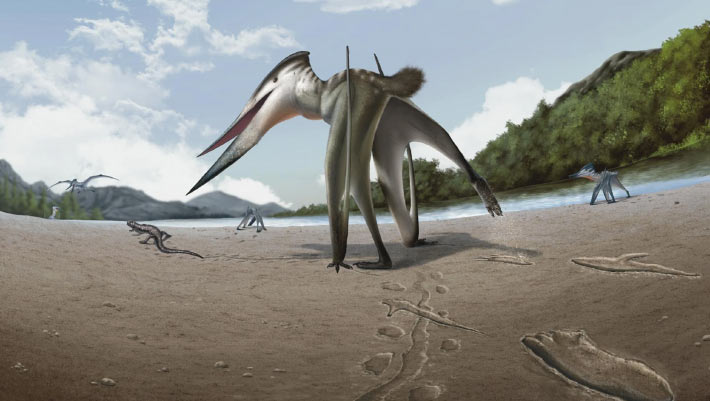
A life reconstruction depicting Jinjuichnus procerus alongside tetrapod trackmakers, illustrating the neoazhdarchian trackmaker in pursuit of a small vertebrate. Image credit: Jun Seung Yi.
Pterosaurs, the pioneering vertebrates to master powered flight, are frequently envisioned gracefully navigating the skies above ancient oceans.
However, for many years, paleontological discourse has suggested that certain pterosaur species dedicated a significant portion of their time to terrestrial activities, ambushing prey in a manner akin to contemporary wading birds.
Concrete evidence substantiating such ground-based behaviors has, until now, remained scarce.
“Pterosaurs were pivotal constituents of Mesozoic ecosystems, flourishing from the Late Triassic through to the Cretaceous period’s conclusion,” stated Dr. Jongyun Jung, a researcher affiliated with the University of Texas at Austin and the Korea Dinosaur Research Center at Chonnam National University, along with his research associates.
“They occupied a broad spectrum of ecological niches and exhibited a wide array of dietary specializations.”
“Specifically, the group known as Neoazhdarchia, encompassing thalassodromids, chaoyangopterids, and azhdarchids, has been theorized to include primarily terrestrial carnivorous predators, a conclusion derived from their anatomical characteristics, functional morphology, and related fossil discoveries.”
“These inferences have led to the proposition that certain lineages might have employed hunting methodologies comparable to extant terrestrial stalkers, such as storks or cranes.”
“Nevertheless, the existing fossil record has, to this point, been devoid of direct corroboration for terrestrial predation among pterosaurs.”
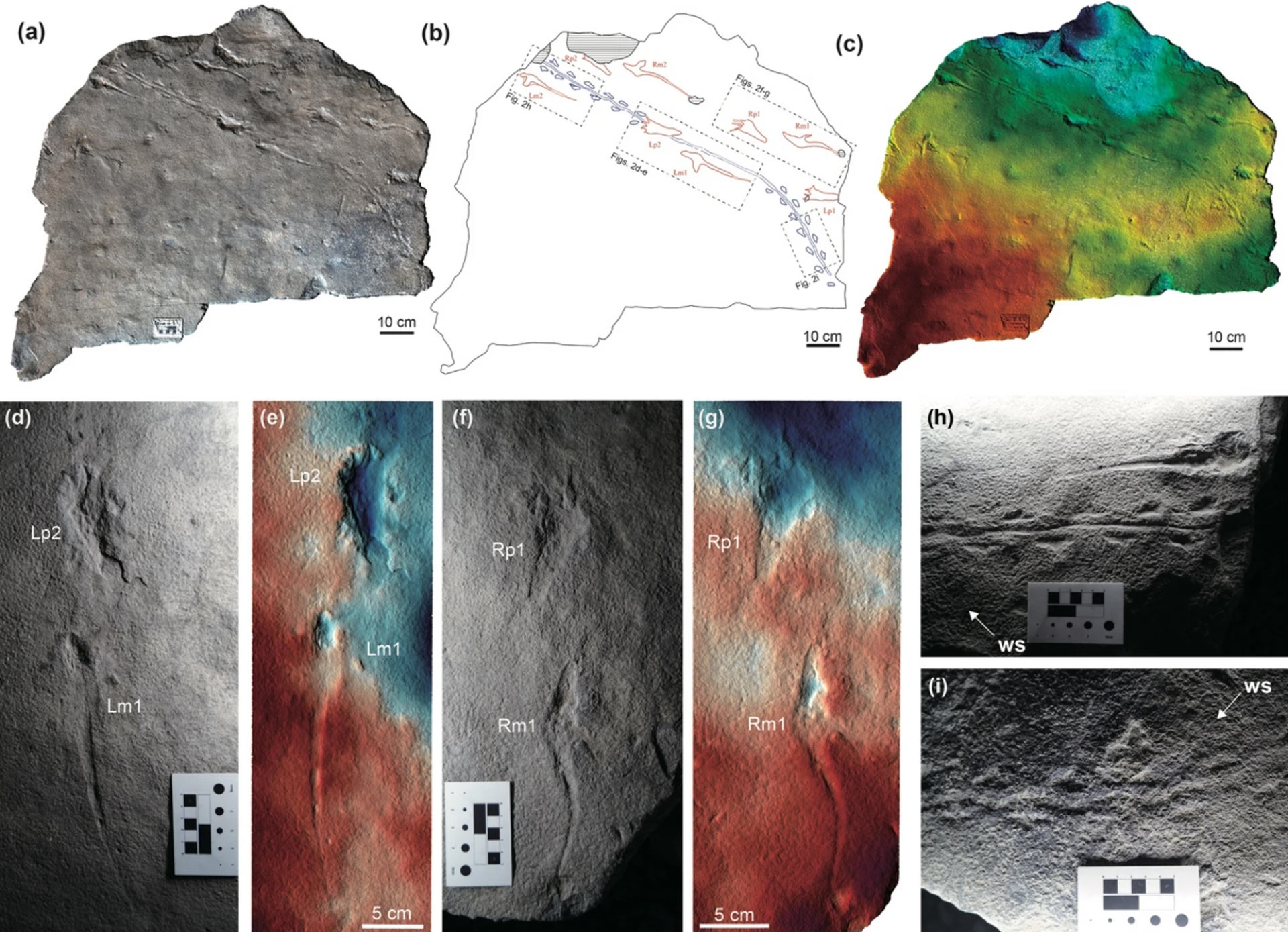
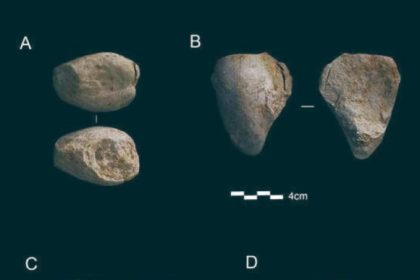
A single slab showcasing the Jinjuichnus procerus trackway alongside congruent trackways attributed to small vertebrates. Image credit: Jung et al., doi: 10.1038/s41598-026-48019-y.
These newly identified fossilized footprints, dating back 106 million years and unearthed within the Jinju Formation, may serve to bridge this informational void.
Designated as a novel ichnogenus and species, Jinjuichnus procerus, these substantial, asymmetrical impressions characterized by elongated digits are believed to have been imprinted by a neoazhdarchian pterosaur.
The trackway of this flying reptile is found in close proximity to a distinct set of impressions likely made by a diminutive, ground-dwelling creature—potentially a salamander or a lizard—thus suggesting the possibility of an ancient predatory encounter.
The smaller animal’s trackway exhibits a sudden alteration in course and a notable amplification in stride length, indicative of a rapid acceleration.
Concurrently, the pterosaur’s locomotion appears to have been relatively swift for its considerable size, estimated at approximately 0.8 meters per second.
This observation aligns with the hypothesis that neoazhdarchians possessed adaptations for effective terrestrial predation.
Nevertheless, a purely coincidental juxtaposition of the two distinct trackways cannot be definitively dismissed.
“This observed proximity offers potential ichnological corroboration for terrestrial vertebrate interaction involving a pterosaur,” the paleontologists commented.
“However, an alternative explanation for the co-occurrence of the two trackways remains plausible, rendering definitive confirmation of any direct engagement between the track-making organisms challenging.”
“The juxtaposition of these paired trackways provides valuable insights into the factors that must be considered when evaluating potential interactions involving a trackmaker.”
“While scenarios such as predation remain subject to interpretation, they nevertheless underscore the inherent complexity in assessing behavioral associations preserved within trackway assemblages.”
The research team’s findings have been formally presented in the esteemed journal Scientific Reports.
_____
J. Jung et al. 2026. New large pterosaur tracks from Korea and their implications on terrestrial behavior. Sci Rep 16, 12363; doi: 10.1038/s41598-026-48019-y