An unprecedented astronomical discovery has been made by researchers operating the Vera C. Rubin Observatory, who have cataloged over 11,000 novel asteroids. This significant find includes hundreds of trans-Neptunian objects and an additional 33 near-Earth asteroids previously undetected.
The recent compilation of astronomical data from the Vera C. Rubin Observatory encompasses approximately one million observations. These observations, gathered over a period of six weeks, have identified more than 11,000 new asteroids alongside over 80,000 previously documented celestial bodies.
These extensive findings have been formally submitted to the Minor Planet Center (MPC), an entity managed by the International Astronomical Union.
Dr. Mario Juric, a lead scientist for the Rubin Solar System project and an astronomer at the University of Washington, commented that this initial substantial data submission, following the observatory’s “Rubin First Look” initiative, represents merely a preliminary glimpse and underscores the facility’s operational readiness.
“What once required years, or even decades, for discovery, Rubin is poised to unearth within mere months.”
“We are now beginning to fulfill Rubin’s profound promise: to comprehensively redefine our understanding of the Solar System’s constituents and to pave the way for discoveries that are currently beyond our imagination.”
Among the newly identified celestial entities are 33 near-Earth objects (NEOs) that were hitherto unknown. NEOs are characterized as small asteroids and comets whose orbital paths bring them exceptionally close to the Sun, specifically within 1.3 times the Earth-Sun distance.
It has been determined that none of these newly cataloged NEOs pose any terrestrial threat, with the largest among them measuring approximately 500 meters in diameter.
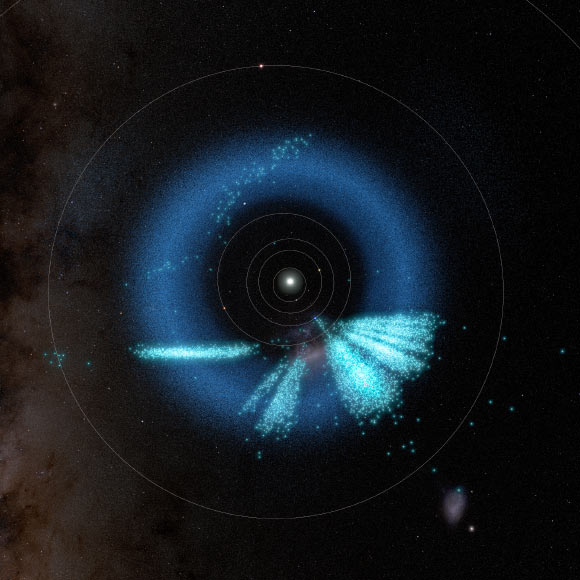
The comprehensive dataset also includes approximately 380 trans-Neptunian objects (TNOs), which are icy bodies that traverse orbits located beyond Neptune.
Two of these TNOs, assigned provisional designations 2025 LS2 and 2025 MX348, have been observed to follow remarkably vast and elliptical trajectories.
At the farthest extents of their orbits, these two celestial bodies venture to distances roughly 1,000 times greater from the Sun than Earth, positioning them among the 30 most remote minor planets currently known.
Dr. Matthew Holman, an astrophysicist affiliated with the Harvard & Smithsonian’s Center for Astrophysics, likened the pursuit of TNOs to an arduous search for a single needle within an immense haystack. He elaborated that discerning likely distant worlds within our Solar System from millions of faint celestial signals necessitated the development of innovative algorithmic methodologies, allowing a computer to meticulously analyze billions of potential orbital configurations.
Dr. Kevin Napier, also from the Harvard-Smithsonian’s Center for Astrophysics, added that objects such as these serve as invaluable probes of the Solar System’s most distant frontiers. He suggested that they could offer crucial insights into the early dynamics of planetary formation and even provide evidence for the existence of a hypothetical, undiscovered ninth large planet still lurking in the outer reaches.