A novel genus and species of pan-shinisaur lizard has been identified by paleontologists based on a partial upper jaw fossil unearthed in southern France, thereby extending the known presence of its evolutionary branch in Europe by a minimum of 30 million years.
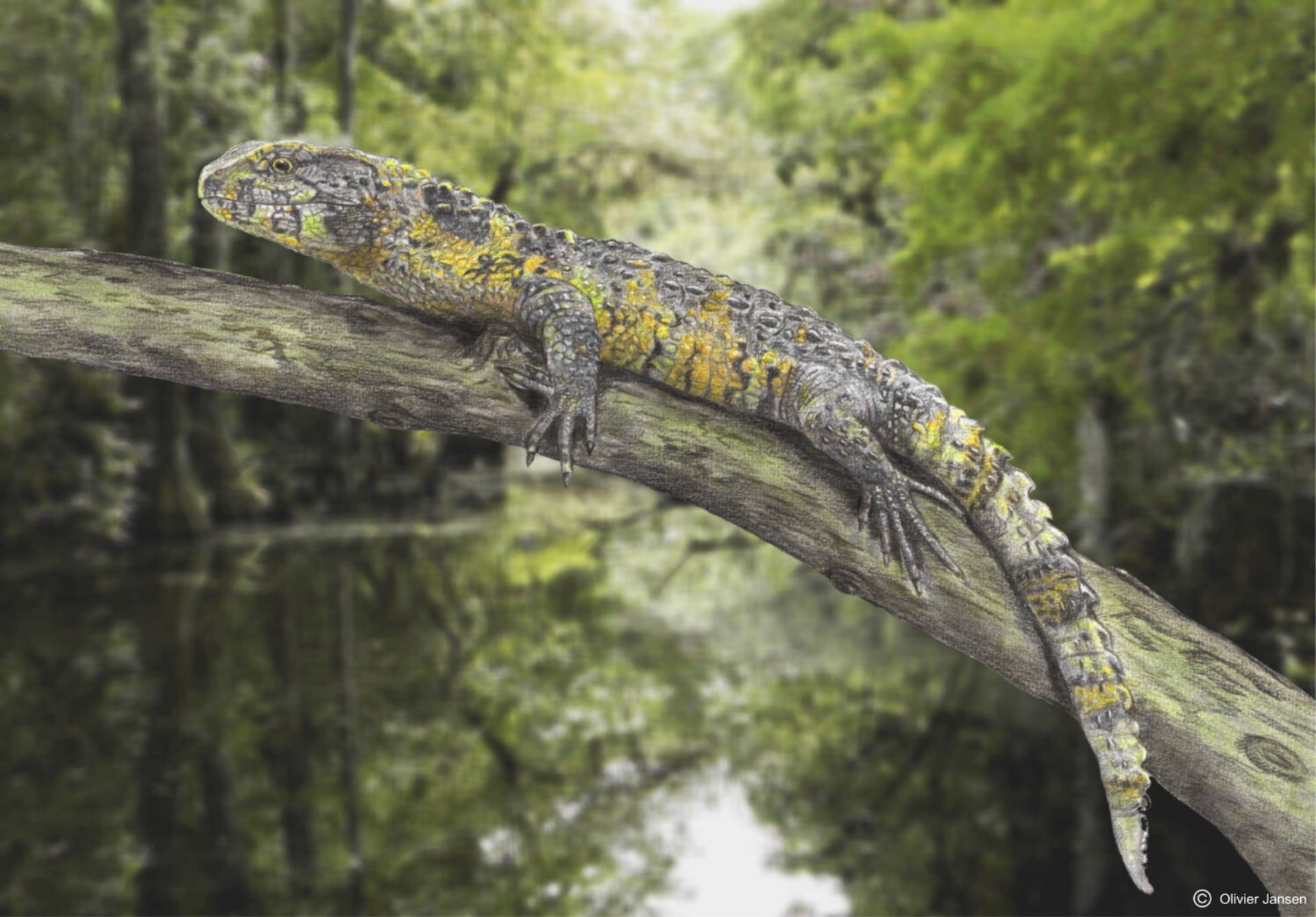
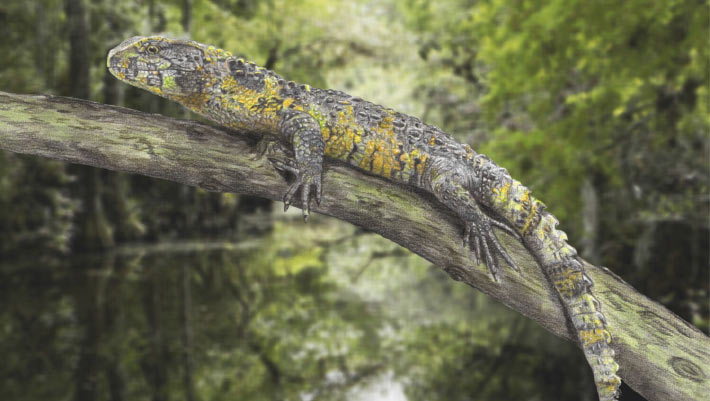
A paleoartistic conception of Acutodon villeveyracensis, representing the most ancient known member of the pan-shinisaur lineage discovered in Europe to date. Image courtesy of Olivier Jansen.
Pan-shinisaurs constitute an ancestral lineage of anguimorph lizards that first emerged during the Early Cretaceous epoch.
Presently, this evolutionary line persists as a single extant species: the Chinese crocodile lizard (Shinisaurus crocodilurus). This critically endangered, semi-aquatic reptile is confined to diminutive forest streams situated in southeastern China and northern Vietnam.
Current scientific assessments suggest that fewer than a few hundred individuals survive in their natural habitats, facing significant threats from habitat degradation, illicit hunting, and climatic shifts.
“The Chinese crocodile lizard, an imperiled species, represents the sole living representative within the clade Pan-Shinisaurus (synonymous with Shinisauria),” stated Dr. Olivier Jansen, a paleontologist affiliated with the Laboratoire Paléontologie Évolution Paléoécosystèmes Paléoprimatologie at the Université de Poitiers and CNRS, alongside his research associates.
“This particular species subsists in small, isolated populations within the lowland forested regions of southeastern China and northern Vietnam.”
“It confronts dire perils, including the obliteration of its habitat and escalating rates of poaching, which are partly fueled by culinary and medicinal demand, but predominantly driven by the lucrative illicit pet trade.”
“Furthermore, the Chinese crocodile lizard is adversely impacted by climate change, given its specialization as a semi-aquatic organism adapted to secluded, densely vegetated, pristine streams nestled within evergreen broadleaf forests, and its dependence on moderate annual temperatures.”
“While this species currently teeters on the precipice of extinction, the evolutionary trajectory of this group remains inadequately comprehended, and the species could vanish before we manage to unravel the enigmas surrounding its origins.”
The recently categorized pan-shinisaur species, designated Acutodon villeveyracensis, inhabited the territory now recognized as France during the Campanian age of the Late Cretaceous period, approximately 83 million years ago.
“This Cretaceous fossil record constitutes the earliest European occurrence for pan-shinisaur lizards,” the paleontologists reported.
“It precedes the documented presence of this clade in Europe by approximately 30 million years, thereby prompting inquiries into the paleobiogeographic history of pan-shinisaur lizards.”
The designation specimen, and the sole known fossil material attributed to Acutodon villeveyracensis, was exhumed in proximity to the town of Villeveyrac, located within the Hérault department of France.
This recovered specimen is a fossilized upper jawbone, measuring around 2.8 cm (1.1 inches) in length, and is arrayed with slender, inwardly curved teeth.
It exhibited several distinctive anatomical characteristics shared with both extant and extinct crocodile lizards, notably specialized tooth replacement structures referred to as resorption pits.
The investigative team concluded that the ensemble of these attributes was sufficiently unique to justify the establishment of an entirely new genus and species designation.
“The classification of Acutodon villeveyracensis as a pan-shinisaur anguimorph is predicated upon a dentigerous maxilla that shares multiple traits with the extant Chinese crocodile lizard and its fossil relatives. These include notably tall, tapered, and recurved dentition, characterized by mesiodistally constricted tooth bases devoid of basal infoldings but featuring medial resorption pits, and a superior alveolar foramen that is shifted posteromedially,” they elaborated.
By analyzing skull proportions derived from contemporary crocodile lizards, the researchers estimated that Acutodon villeveyracensis potentially attained a length exceeding 1 meter (3.3 feet).
“This species was indubitably a predator, engaging in competition for size and habitat niche with two other substantial squamates present in this ancient ecosystem (namely, a terrestrial monstersaur and a freshwater mosasaur),” they posited.
“The distinctive dentition of Acutodon villeveyracensis, comprising thin, tapered, and recurved teeth, is congruent with a diet that encompassed fish and, by analogy with the Chinese crocodile lizard, likely also included other small vertebrates such as frogs, salamanders, and albanerpetontids that inhabited the marshes of the freshwater floodplain at Villeveyrac (Hérault, France).”
The groundbreaking discovery of Acutodon villeveyracensis is detailed in a scholarly publication released this week in the Journal of Vertebrate Paleontology.
_____
Olivier Jansen et al. A new pan-shinisaur lizard (Anguimorpha) from the lower Campanian of Villeveyrac (Hérault, France). Journal of Vertebrate Paleontology, published online May 20, 2026; doi: 10.1080/02724634.2026.2636649