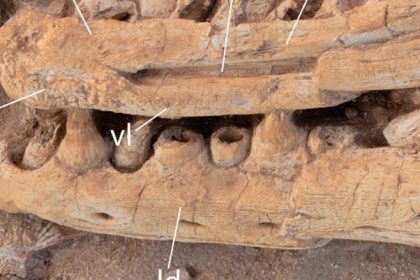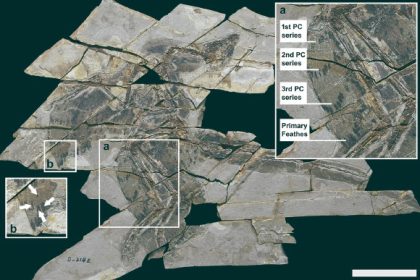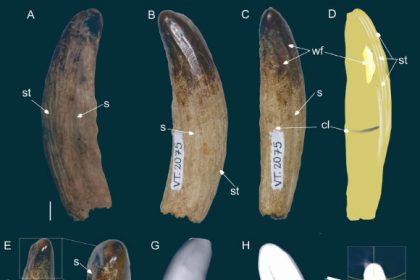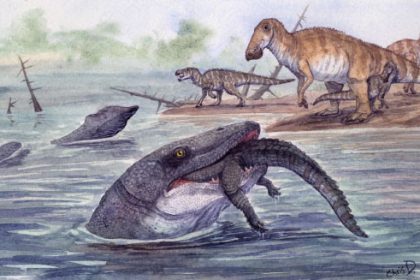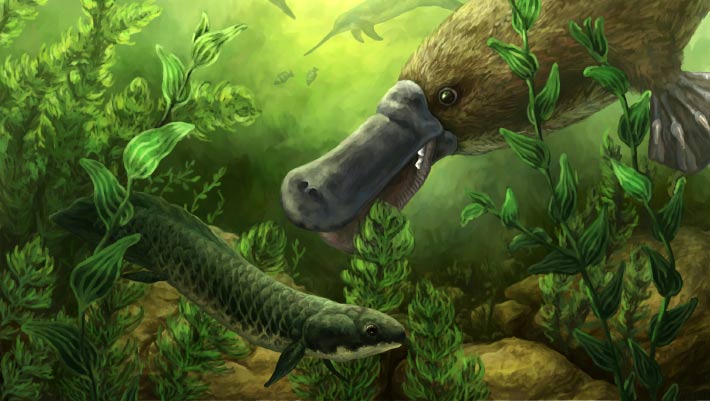
Recent fossil discoveries originating from South Australia’s Namba Formation indicate that approximately 25 million years ago, Obdurodon insignis—a predecessor of the modern platypus (Ornithorhynchus anatinus) that was larger and possessed teeth—flourished in extensive inland aquatic environments alongside freshwater cetaceans and other now-extinct fauna.
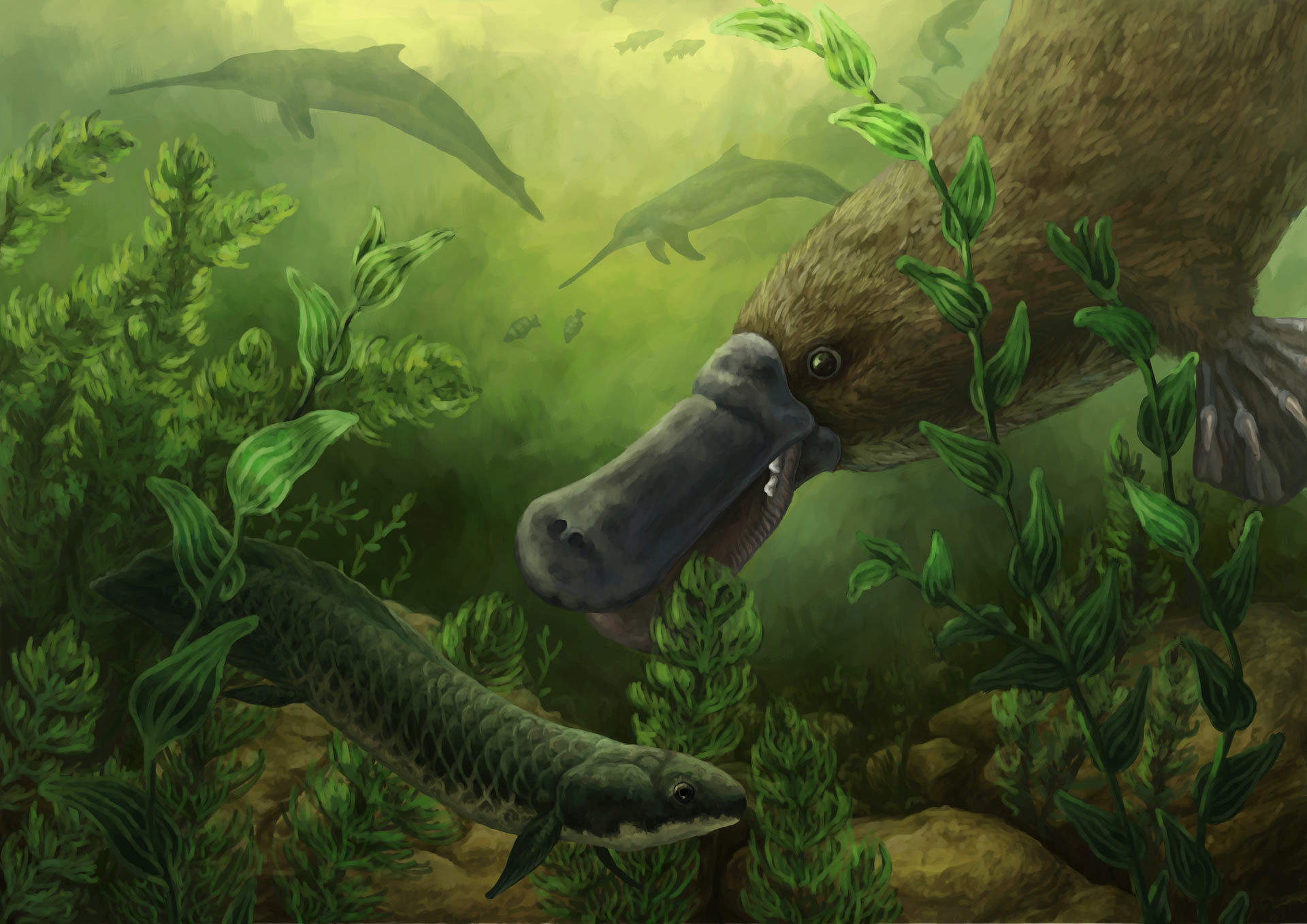
An artist’s impression of fossil platypus and environs circa 25 million years ago. Image credit: Gen Conway, Flinders University Palaeontology Lab.
“Fossil evidence of platypuses is exceedingly scarce and frequently limited to isolated teeth, making the acquisition of new skeletal elements to enhance our understanding of these unique monotremes particularly gratifying,” stated Dr. Aaron Camens, a paleontologist associated with Flinders University.
This species, first cataloged in 1975, inhabited the extensive, permanent freshwater lakes, gentle river systems, and wooded lowlands of central Australia during the Late Oligocene epoch, roughly 25 million years ago.
A primary distinguishing feature of this species compared to contemporary platypuses was its possession of fully developed molar and premolar teeth.
In contrast, the modern platypus is born with rudimentary teeth that are quickly lost, with adults relying on small keratinous pads for mastication.
Prior to these recent findings, the known fossil record of Obdurodon insignis consisted solely of one and a half molar teeth, a fragment of a mandible, and a portion of a pelvis.
However, insights were previously gleaned from exceptionally preserved fossils of a closely related, younger (17-14 million years old) species, identified as Obdurodon dicksoni.
This latter species, discovered in 1992, featured a skull comparable in size, though slightly larger, than that of the modern platypus, and importantly, it had teeth and a more robust bite force.
“The newly unearthed specimens of Obdurodon insignis include the first documented premolar, a critical tooth situated anterior to the molars,” elaborated Dr. Camens.
“This discovery suggests that Obdurodon insignis likely possessed formidable incisors, which, in conjunction with its substantial molar teeth, would have facilitated the effective crushing of shelled organisms such as yabbies.”
“Another significant, albeit rare, discovery involved a partial scapulocoracoid, the bone that anchors the forelimb,” added Dr. Trevor Worthy, also affiliated with Flinders University.
“This anatomical element demonstrates a forelimb structure remarkably analogous to that of the modern platypus, indicating a comparable capacity for aquatic locomotion.”
“These fossil remains underscore that 25 million years ago, Obdurodon insignis bore strong resemblances to its modern descendant, differing principally in its slightly greater size and the presence of teeth.”
According to the research team, the forested environments of 25 million years ago provided sustenance for a diverse array of arboreal fauna, including koalas and various possum species.
On the ground level, herbivorous marsupials, akin in size to sheep, grazed, with numerous smaller creatures inhabiting their immediate surroundings.
This terrestrial community also encompassed recognizable reptiles like skinks, amphibians, and small predatory marsupials.
Within the canopy, a multitude of avian species resided, including the previously identified colossal eagle, Archaehierax.
The ancient lake systems teemed with a variety of lungfish and other smaller piscine life.
Consuming these fish, or the aquatic vegetation and small invertebrates found within or along the lake margins, were several species of waterfowl, cormorants, and flamingos.
Less commonly known is the presence of a small dolphin species within these freshwater ecosystems, with its teeth and skeletal remains having been recovered from various sites exposing this ancient faunal assemblage.
“This reconstructs the ecological setting inhabited by the ancient, toothed platypus prior to its skeletal remains settling to the lakebed 25 million years ago,” remarked Dr. Gen Conway, also from Flinders University.
The findings are published this month in the scientific journal Australian Zoologist.
_____
Trevor H. Worthy et al. 2026. New material of the toothed platypus Obdurodon insignis (Monotremata: Ornithorhynchidae) from the Late Oligocene Pinpa Local Fauna at Billeroo Creek, South Australia. Australian Zoologist 45 (1): AZ26011; doi: 10.1071/AZ26011