The discovery of nearly complete skeletal remains of bovines at the Early Pliocene site of Camp dels Ninots in northeastern Spain indicates that the precursors to modern buffalo and cattle had already achieved substantial dimensions considerably before the advent of humans on the continent.
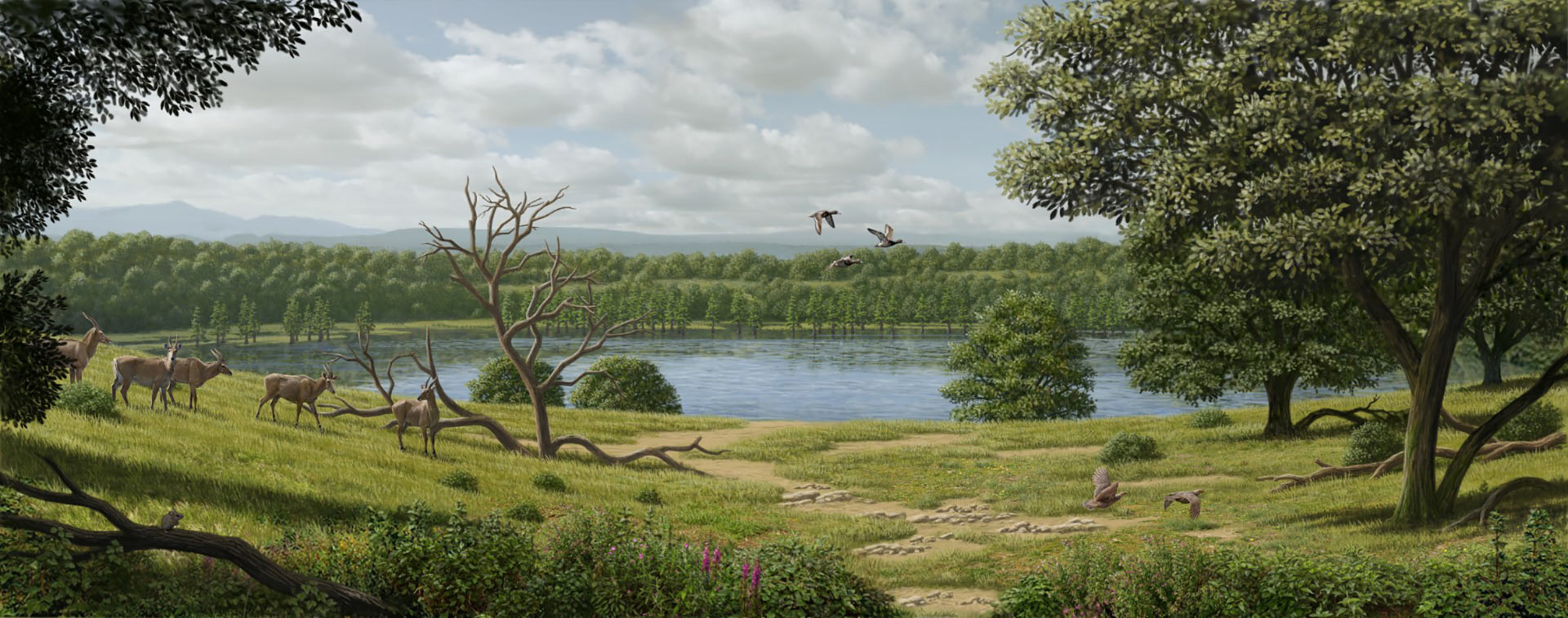
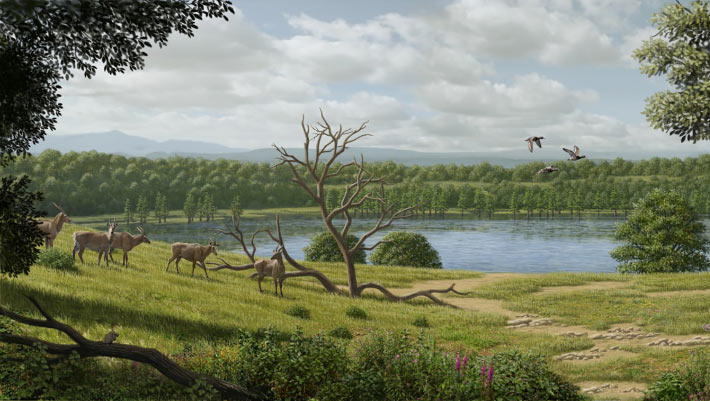
Paleoartistic reconstruction of the environment in the surrounding of Camp dels Ninots maar lake during the Early Pliocene. Image credit: Mauricio Antón.
“Bovines constitute a significant element in numerous contemporary ecosystems and are fundamental to human agriculture, especially species belonging to the tribe Bovini, which encompasses bison, buffalo, and cattle,” stated Dr. Leonardo Sorbelli of the Leibniz Institute for Evolution and Biodiversity Science, alongside his collaborators.
“However, their evolutionary beginnings and affiliations with closely related groups have remained somewhat obscure due to a scarcity of well-preserved early fossil specimens.”
Within the scope of this investigation, the researchers meticulously analyzed fossil evidence from a minimum of 14 individuals recovered from the Camp dels Ninots location in Spain.
These specimens were identified as Parabos tigneresi, belonging to one of five buffalo-like species that populated Europe during the Early Pliocene epoch.
The most substantial of these ancient creatures is estimated to have reached a mass approaching 500 kg. While this is less than the size of most extant cattle species, it significantly exceeds that of any other bovid of comparable antiquity.
Consequently, these animals are seen as representing an initial phase in the enlargement of body size within the bovine evolutionary trajectory, potentially an adaptive response to the climatic and environmental shifts that defined the European continent during the Pliocene.
Their anatomical characteristics suggest a habitat preference for environments that were both humid and densely vegetated, aligning with the scientific understanding of the abundant water resources present at the Camp de Ninots site.
According to the research team, the Early Pliocene marked the commencement of an era dominated by large bovines, yet the precise phylogenetic positioning of Parabos continues to be a subject of inquiry.
By drawing parallels with other species, they posit that Parabos either represents the most nascent members of the Bovini tribe or the terminal representatives of a related lineage, Tragoportacini, which was eventually superseded by true buffaloes, cattle, and bison.
Further scientific exploration into the morphology and ecological niche of Parabos will be instrumental in clarifying their exact placement within the broader narrative of bovine evolutionary history.
“The bovids unearthed at Camp dels Ninots rank among the most remarkably preserved fossils from the Pliocene epoch in Europe,” commented the scientists involved in the study.
“The extraordinary state of preservation of these specimens has afforded us a deeper comprehension of their anatomy and, by extension, the ecological dynamics of the initial large-bodied bovids that inhabited the continent.”
“Engaging with these ancient remains has proven to be both an intellectually stimulating and profoundly rewarding endeavor.”
“The exceptional fidelity of preservation and the sheer volume of the discovered remains have furnished us with an immense dataset, which is exceptionally rare for such ancient geological periods, thereby unveiling a novel perspective on our world prior to the appearance of humankind.”
The research findings have been disseminated online through the scientific journal PLoS ONE.
_____
L. Sorbelli et al. 2026. First of a line or last of a dynasty? Parabos tigneresi and the evolution of Eurasian Bovinae in the Early Pliocene. PLoS One 21 (6): e0340256; doi: 10.1371/journal.pone.0340256