Early Monday, China successfully deployed its Shenzhou-23 spacecraft, achieving a timely rendezvous and docking with an orbiting space station. This endeavor is a significant stride in Beijing’s strategic initiative to establish a human presence on the Moon by the year 2030, according to reports from state-affiliated media outlets.
A pivotal aspect of this particular mission involves a Chinese cosmonaut undertaking a complete year in orbit aboard the Tiangong space station. This extended duration represents a groundbreaking milestone in the advancement of China’s lunar exploration program.
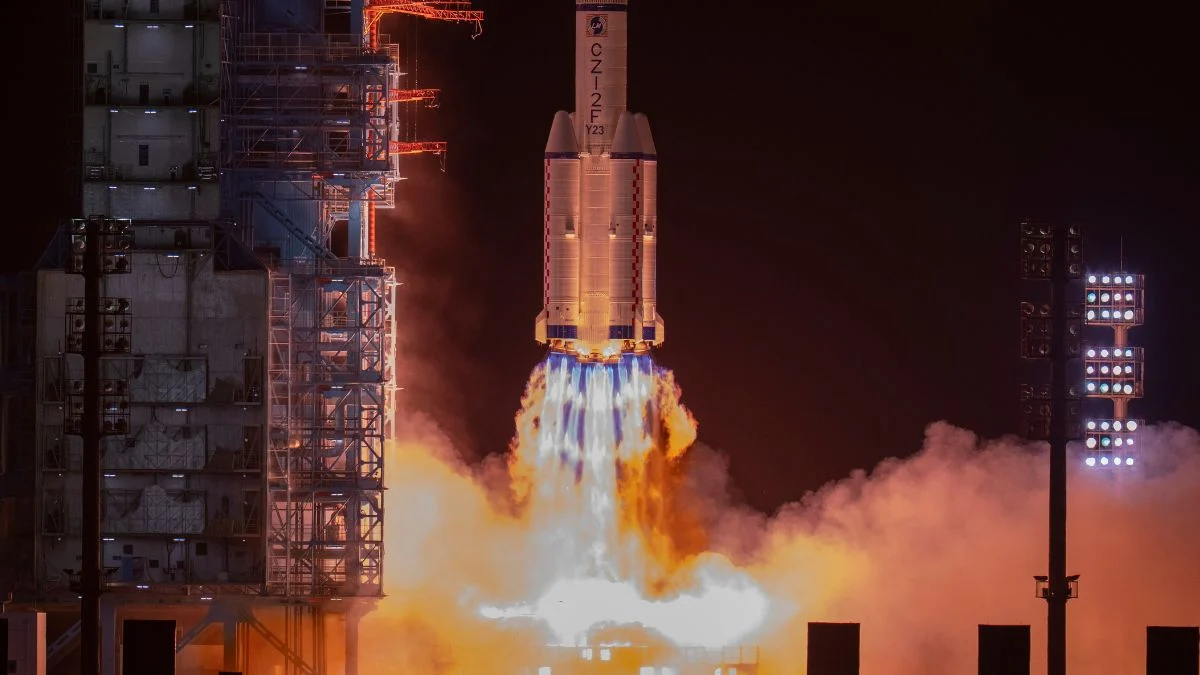
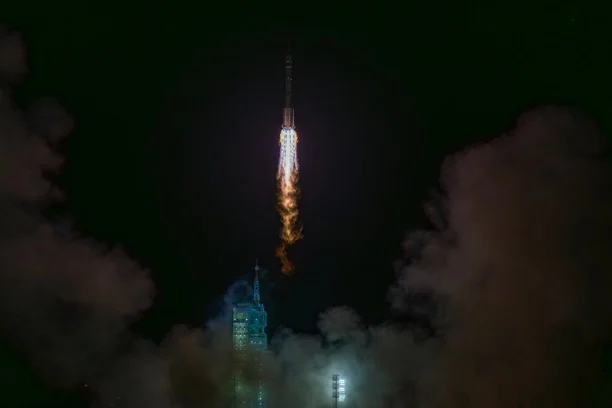
The Long March 2-F rocket commenced its ascent at precisely 11:08 pm (1508 GMT) on Sunday night, erupting in incandescent flames and a plume of smoke from the Jiuquan launch facility nestled within China’s northwestern Gobi Desert. Visuals captured by state broadcaster CCTV corroborated the on-schedule liftoff.
Approximately ten minutes post-separation from its launch vehicle, the spacecraft successfully entered Earth’s orbit, as confirmed by communications from the Chinese Manned Space Agency (CMSA) via social media platforms.
“The health of the astronauts is robust, and the launch concluded with unqualified success,” the agency further stated.
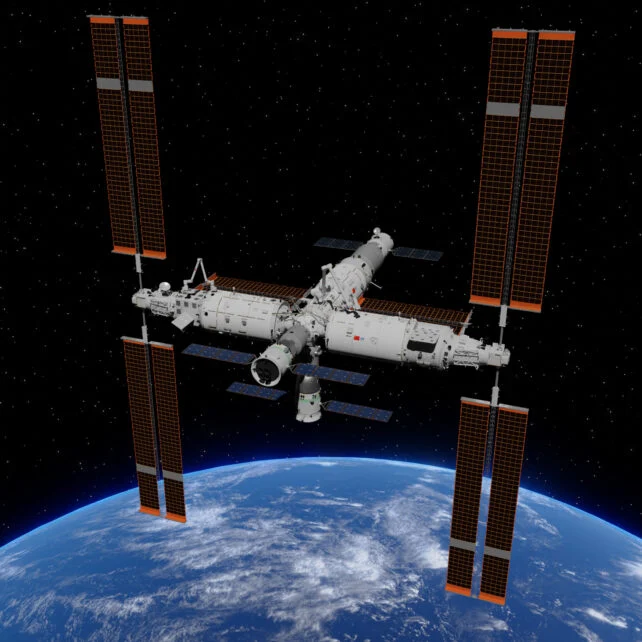
Following a flight spanning roughly 3.5 hours, the spacecraft achieved a secure docking with the Tiangong space station, as reported by the official Xinhua news agency, citing information from the CMSA.
This mission holds particular historical significance as it marks the inaugural space voyage for a cosmonaut hailing from Hong Kong. The selected individual is 43-year-old Li Jiaying (known as Lai Ka-ying in Cantonese), whose prior professional background includes service with the Hong Kong police force.
Accompanying her are 39-year-old space engineer Zhu Yangzhu and 39-year-old Zhang Zhiyuan, a former air force pilot making his maiden journey beyond Earth’s atmosphere. Zhang is embarking on his first-ever space expedition.
Enthusiastic spectators, waving national flags, gathered to witness a farewell ceremony prior to the launch, accompanied by a musical performance as the three astronauts acknowledged the crowd from the stage.
The crew’s objectives encompass the execution of a diverse array of scientific investigations across disciplines such as life sciences, materials science, fluid physics, and medical research.
A cornerstone experiment for Shenzhou-23 is the year-long orbital tenure of one crew member, designed to meticulously document and analyze the physiological and psychological repercussions of prolonged exposure to microgravity.
Year-long experiment
This extensive experimental undertaking is integral to China’s strategic preparations for both future lunar expeditions and potential missions to Mars.
A spokesperson for the CMSA indicated on Saturday that the identity of the cosmonaut designated for this unprecedented year-long mission would be disclosed at a later juncture, contingent upon the ongoing progress of the Shenzhou-23 endeavor.
Richard de Grijs, an astrophysicist and professor at Macquarie University in Australia, highlighted that the primary challenges associated with such extended stays involve mitigating the long-term effects on human physiology. These include potential bone density diminution, muscle atrophy, cumulative radiation exposure, disruptions to sleep patterns, and the onset of behavioral and psychological fatigue.
Furthermore, he underscored the paramount importance of highly dependable systems for water and air regeneration, alongside the capability to manage medical emergencies effectively when far removed from terrestrial support.
De Grijs elaborated to AFP that China is systematically accumulating operational proficiency for “sustained occupation” of its Tiangong space station. He views year-long missions as a crucial developmental stage en route to realizing more ambitious lunar and potentially deep-space objectives.
“A twelve-month period in orbit fundamentally alters the operational parameters for both the technological hardware and the human occupants, presenting a distinct challenge compared to the shorter Shenzhou missions characteristic of the program’s earlier phases,” he observed.
Until now, crews aboard the Tiangong station have typically concluded their rotations after approximately six months before being relieved.
The current Shenzhou-23 mission is a direct component of China’s overarching ambition to land astronauts on the Moon prior to the 2030 deadline, a pursuit that places it in a competitive race with the United States’ own Artemis program.
Pakistani crew members
To this end, China is actively testing the requisite hardware, with an orbital test flight scheduled for its new Mengzhou spacecraft in 2026.
The Mengzhou craft is slated to supersede the aging Shenzhou spacecraft lineage and will be instrumental in transporting Chinese astronauts to the lunar surface.
Beijing’s long-term vision includes the establishment of the initial phase of a crewed scientific outpost by 2035, designated as the International Lunar Research Station (ILRS).
Furthermore, China anticipates welcoming its inaugural international cosmonaut, a representative from Pakistan, to the Tiangong station by the close of the current year.
Over the past three decades, the Asian powerhouse has substantially augmented its space exploration initiatives, channeling considerable financial investment into this sector to narrow the technological gap with established spacefaring nations like the United States, Russia, and European entities.
In a landmark achievement in 2019, China successfully landed a probe, the Chang’e-4, on the far side of the Moon, a feat previously unaccomplished by any nation.
This was followed in 2021 by the deployment of a small rover onto the Martian surface.
Notably, China has been formally excluded from participating in the International Space Station (ISS) program since 2011. This exclusion stemmed from a directive by the United States prohibiting NASA from engaging in collaborations with Beijing, thereby compelling the Asian nation to pursue the development of its independent space station project.