An unusual surface topography observed on the Martian landscape has galvanized researchers at NASA.
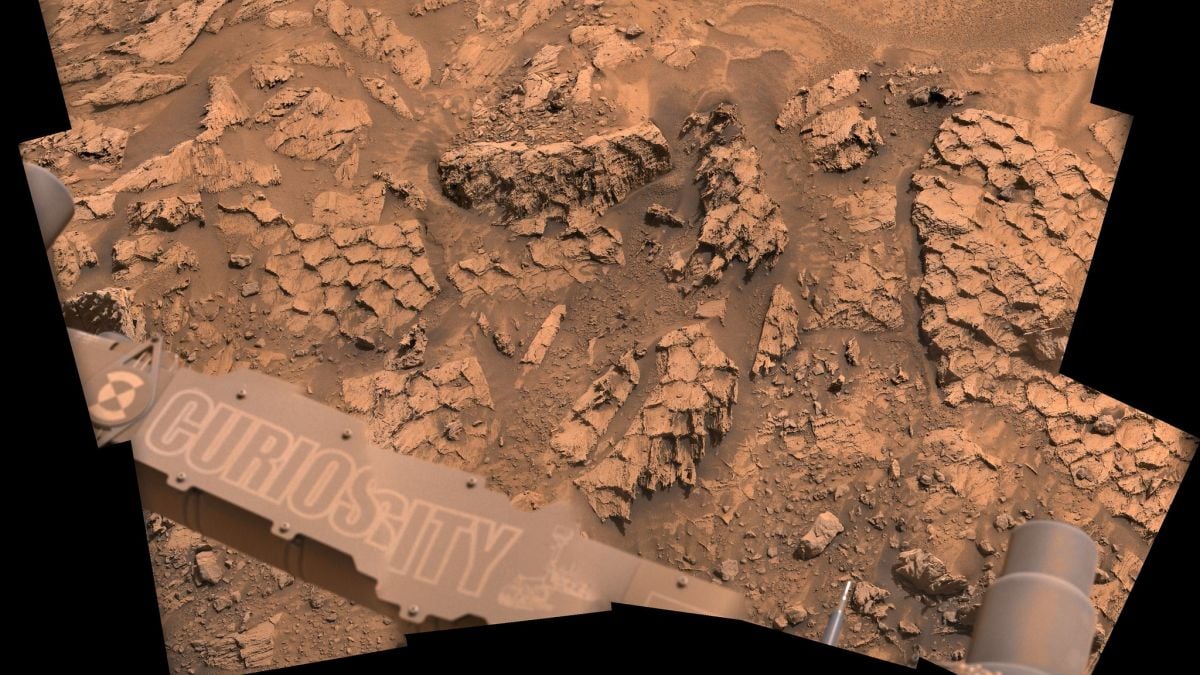
During its exploration towards a feature designated as Antofagasta crater, the Curiosity rover has recorded the presence of a distinctive textured geological formation on the planet’s crust. To the human eye, this arrangement strikingly resembles the scales of a reptile, evoking imagery of a mythical dragon once resting in ancient sedimentation.
Abigail Fraeman, a project scientist affiliated with NASA’s Jet Propulsion Laboratory, characterized these formations as “hexagonal tessellations” in a recent blog dissemination, remarking on the sheer multitude, numbering in the thousands.
She elaborated in her written account, noting, “While we have previously encountered polygonal rock formations, their occurrence on this occasion appears exceptionally widespread, spanning considerable expanses observable in our Mastcam panoramic captures.”
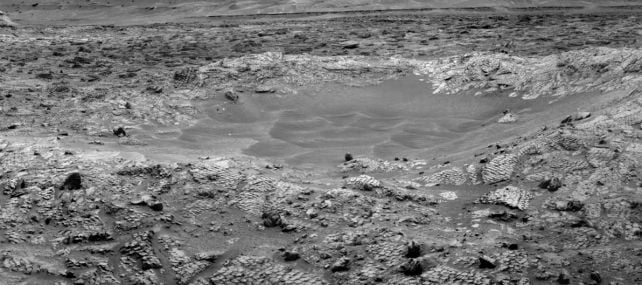
Given the recency of this observation – with imagery acquired on Sol 4865, corresponding to April 13, 2026 – a comprehensive understanding of the patterns’ origin and formation processes may require considerable time. Nevertheless, certain indicative factors offer insights into potential explanations.
On Earth, polygonal patterns are a relatively common geological phenomenon. Their typical genesis involves cyclical expansion and contraction of the ground substrate, frequently occurring subsequent to periods of saturation followed by desiccation.
Such patterns are frequently identified at the base of desiccated ephemeral water bodies, for instance. These are scientifically classified as desiccation crack formations.
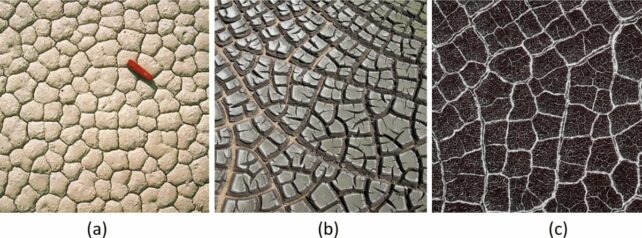
A comparable geological process is also implicated when ground ice undergoes expansion and contraction due to freeze-thaw cycles, as observed in locations such as Antarctica. These thermal fluctuations can similarly yield polygonal fracture networks, albeit stemming from thermal cycles rather than arid conditions.
However, on the planet Mars, the evidence for desiccation cracks has historically been substantially less prevalent.
The Martian environment is understood to have lost its accessible surface water eons ago. Indeed, the initial documented instance of desiccation cracks on Mars, within Gale Crater, was identified by the Curiosity mission less than a decade prior to this report.
Nonetheless, the current patterning observed at Antofagasta crater presents distinct characteristics. An additional significant clue emerges from prior research.
In 2023, a Martian locale named Pontours was identified as exhibiting a remarkably uniform and well-preserved hexagonal structure, bearing a striking resemblance to the more extensive formations now evident at Antofagasta.
Investigative publications concerning the Pontours geological feature suggest that its patterned configuration is not the product of a singular period of humidity, but rather of multiple such episodes.
When moist clay undergoes a single drying event, it develops T-shaped fissure intersections. Subsequent repeated cycles of desiccation lead to the maturation of these into Y-shaped fracture junctions. The continuous propagation and interconnection of these fissures culminate in the formation of a polygonal, often hexagonal, geometric arrangement.

This phenomenon strongly implies the influence of cyclical climatic conditions, perhaps seasonal or otherwise recurrent, which then persisted and solidified into the rock strata as Mars’s ancient climate transformed, effectively fossilizing these intricate honeycomb structures for subsequent detection by rovers like Curiosity.
Some divergences exist between the Pontours and Antofagasta formations. The patterns at Antofagasta, as noted by Fraeman, appear to be more extensive, featuring elevated ridges that could signify a subtle variation in the formative process or an advanced stage in the geological development at the time of rock lithification.
On Mars, such elevated ridges can originate when mineral precipitates infiltrate pre-existing fissures and subsequently exhibit enhanced resistance to erosion compared to the surrounding regolith.
Nonetheless, if its origins are analogous to those at Pontours, Antofagasta represents yet another site providing compelling evidence of past wet-dry climatic cycles on ancient Mars, a discovery of considerable scientific import.
It is premature to definitively assert a direct correlation between these two locations. Crucial data regarding the mineralogical composition of the rock at both sites remains to be fully assessed. Such analysis is anticipated to furnish significant insights; for instance, the Pontours formation was found to contain abundant salts, indicative of deposition from evaporative brine solutions.
Curiosity has completed its data acquisition at the Antofagasta site and has proceeded with its mission. Researchers are now tasked with meticulously analyzing the collected information to decipher the origins of this enigmatic surface patterning. Nevertheless, an accumulating body of evidence increasingly supports the hypothesis that Mars’s hydrological history was far more dynamic and intricate than its present arid and dusty facade might initially suggest.
Fraeman stated, “We have continued to gather extensive imagery and chemical data that will be instrumental in differentiating between the various theoretical explanations for the formation of these honeycomb textures.”