An extensive array of over 20 carbon-based chemical structures, including seven previously unobserved on the Martian surface, has been identified by NASA’s Curiosity rover within a sample procured from 3.5-billion-year-old clay-rich sandstones located in Gale Crater.
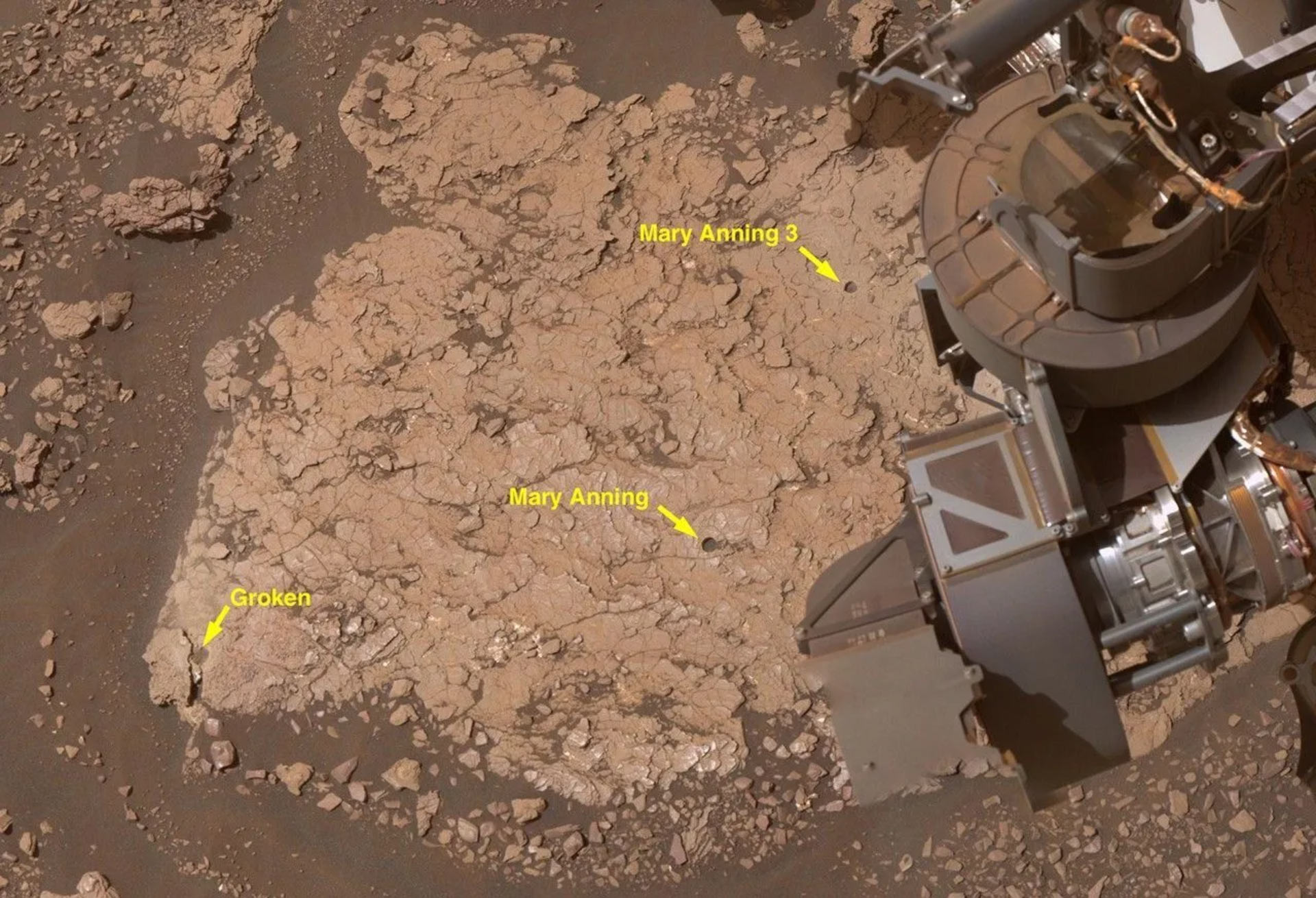
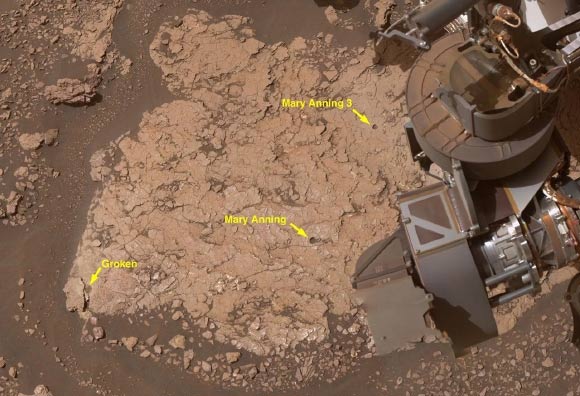
A close-up of three holes Curiosity drilled into Martian rock at a location nicknamed Mary Anning in October 2020. Image credit: NASA / JPL-Caltech / MSSS.
The rock specimen, designated Mary Anning 3 in honor of a notable English fossil collector and paleontologist, was obtained by Curiosity from a region of Mount Sharp that was once inundated by lakes and traversed by streams during ancient Martian epochs.
This environment, characterized by fluctuating periods of wetness and aridity over its past, contributed to the accumulation of clay minerals in the locale. These minerals possess a remarkable capacity for preserving organic compounds.
Among the newly identified molecular entities is a nitrogen heterocycle, a cyclic structure composed of carbon atoms that also incorporates nitrogen.
Such molecular architectures are considered foundational precursors to RNA and DNA, the fundamental nucleic acids responsible for encoding genetic information.
“This particular detection is quite significant as these structures can act as chemical progenitors for more intricate nitrogen-containing molecules,” remarked Dr. Amy Williams, a researcher affiliated with the University of Florida.
“Nitrogen heterocycles have not been previously documented on the Martian surface nor definitively identified in Martian meteorites.”
Another noteworthy discovery was benzothiophene, a molecule containing both carbon and sulfur, which has been frequently found in extraterrestrial meteorites.
A prevailing scientific hypothesis posits that these meteorites, along with the organic matter they contain, may have been instrumental in initiating prebiotic chemical processes across the early Solar System.
“The identification of this site, the acquisition of the sample, and these discoveries, facilitated by our remarkable robotic explorer, represent the culmination of efforts by dozens of scientists and engineers,” stated Dr. Ashwin Vasavada, a researcher at NASA’s Jet Propulsion Laboratory.
“This assemblage of organic molecules further strengthens the hypothesis that Mars may have harbored conditions conducive to life in its distant past.”
The analytical examination of the Mary Anning 3 sample was executed utilizing a sophisticated onboard laboratory designated Sample Analysis at Mars (SAM), housed within Curiosity’s chassis.
A drilling mechanism situated at the extremity of the rover’s articulated arm pulverizes a meticulously chosen rock sample into fine dust, which is subsequently channeled into SAM. Within this instrument, a high-temperature furnace heats the material, releasing gases that are then analyzed by SAM’s internal instrumentation to ascertain the rock’s elemental and molecular composition.
Furthermore, SAM is equipped to perform “wet chemistry” analyses, which involve introducing samples into a small receptacle containing a solvent.
The ensuing chemical reactions can facilitate the fragmentation of larger molecules that would otherwise be challenging to detect and characterize.
Although the instrument is equipped with multiple such receptacles, only two are filled with tetramethylammonium hydroxide (TMAH), a potent solvent reserved for samples of paramount scientific interest.
The Mary Anning 3 sample was the inaugural recipient of treatment with TMAH.
To validate the reactivity of TMAH with extraterrestrial materials, the research team also conducted experiments on Earth using a fragment of the Murchison meteorite, renowned as one of the most extensively studied meteorites discovered to date.
Dating back over 4 billion years, the Murchison meteorite is known to contain organic compounds that were distributed throughout the nascent Solar System.
A portion of the Murchison sample treated with TMAH was observed to break down larger molecular structures into compounds that bore resemblance to those identified in the Mary Anning 3 sample, including benzothiophene.
This experimental outcome lends credence to the notion that the Martian organic molecules detected in the sample could have originated from the degradation of even more complex compounds relevant to the emergence of life.
“Analysis of the spatial distribution of the organic matter is not possible with SAM; therefore, the origin of this material – whether introduced by meteorites, abiotically produced via aqueous processing such as serpentinization, or from electrochemical production – remains presently undetermined,” the scientists stated.
“Irrespective of its origin, the confirmation of macromolecular organic matter substantiates the potential for future, optimized TMAH thermochemolysis experiments to unveil ancient biosignatures preserved within macromolecules on Mars, should they exist.”
“The considerable structural diversity of organic molecules observed in situ from surface materials indicates that a degree of chemical variability has been preserved within ancient Martian sediments, despite over 3.5 billion years of diagenesis and radiation exposure.”
“These findings serve to augment the catalog of confirmed and suggested organic molecules that have endured over extensive geological timescales within the Martian near-surface environment and corroborate the presence of macromolecular carbon on Mars.”
The results of this investigation were disseminated on April 21, 2026, in the esteemed journal Nature Communications.
_____
A.J. Williams et al. 2026. Diverse organic molecules on Mars revealed by the first SAM TMAH experiment. Nat Commun 17, 2748; doi: 10.1038/s41467-026-70656-0