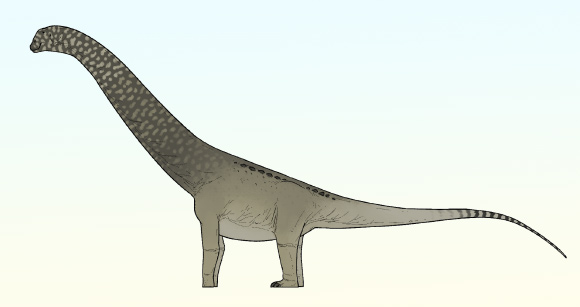
A novel genus and species of titanosaurian sauropod dinosaur, exhibiting affinities with South American species, has been formally characterized by a cohort of paleontologists spearheaded by Dr. Nick Longrich from the University of Bath.
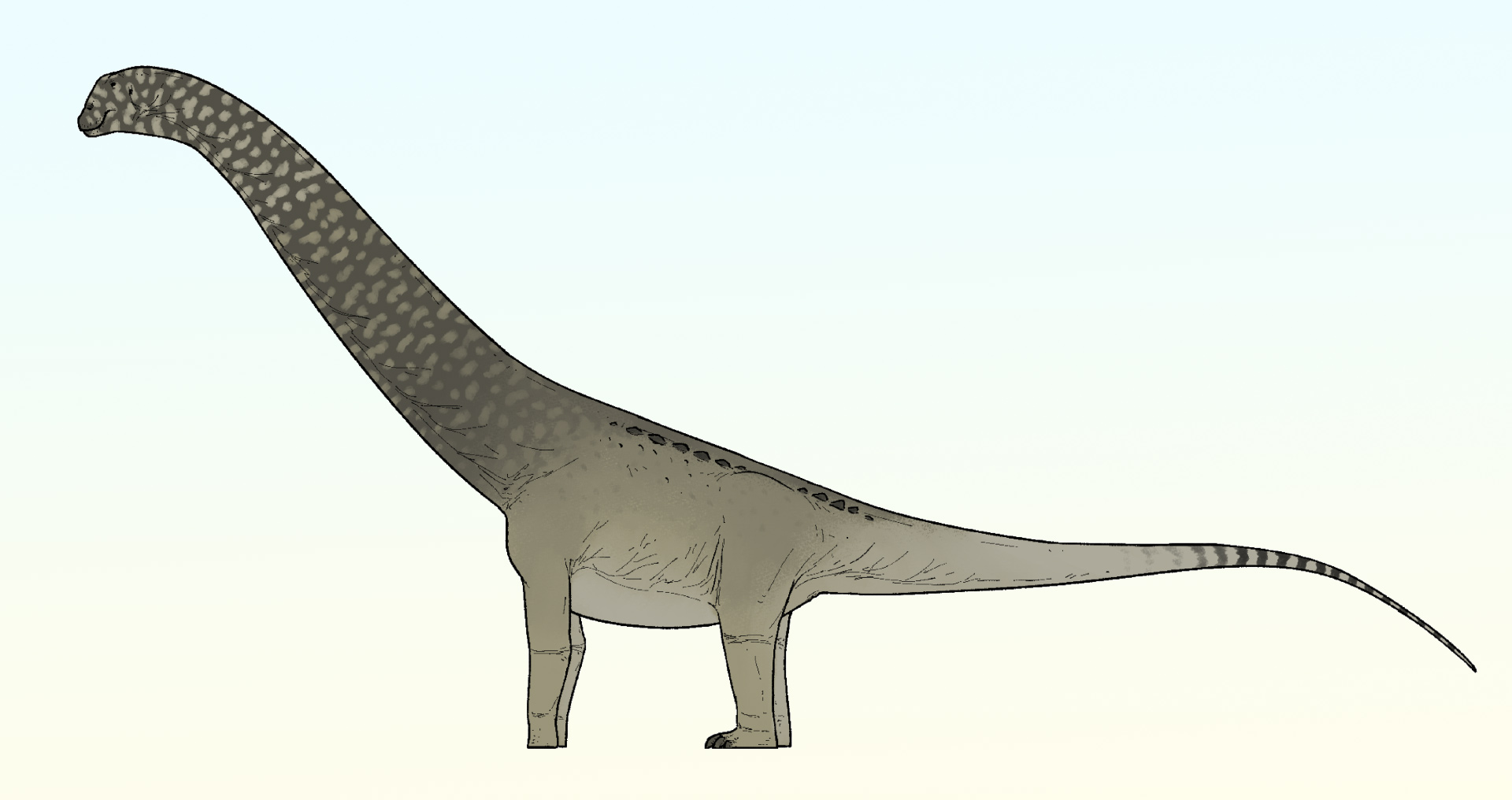
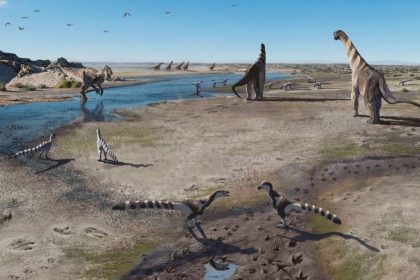
An artist’s reconstruction of Phosphatotitan khouribgaensis. Image credit: Connor Ashbridge.
The creature, designated Phosphatotitan khouribgaensis, inhabited the geographical area now recognized as Morocco during the latter portion of the Maastrichtian age of the Cretaceous period, approximately 70 million years in the past.
“The terminal Cretaceous epoch witnessed the culminating diversification of dinosaur lineages prior to the cataclysmic end-Cretaceous extinction event,” stated Dr. Longrich and his research associates in their academic publication.
“Discussions pertaining to Late Cretaceous dinosaurian diversity have predominantly centered on extensively documented faunas originating from Laurasia.”
“Conversely, far less is understood about the dinosaurian faunas of the Southern Hemisphere, particularly those from the African continent.”
The fossilized remnants of Phosphatotitan khouribgaensis were unearthed from phosphate-rich strata situated at Sidi Chennane, within the Oulad Abdoun Basin of Morocco’s Khouribga region.
The recovered skeletal material comprises dorsal and caudal vertebrae, in addition to segments of the sacrum and pelvis.
“The phosphate deposits of the Oulad Abdoun Basin in the Khouribga province are composed of phosphatic sandstones, marls, and limestones,” the paleontological team elucidated.
“These geological formations were deposited within a warm, shallow epicontinental sea during the Late Cretaceous and Early Paleogene, forming part of a significant phosphate belt that extended along the Atlantic and Tethys Ocean margins.”
Despite its discovery in North Africa, Phosphatotitan khouribgaensis demonstrates a close phylogenetic relationship to the Lognkosauria, a clade of titanosaurs previously identified exclusively in South America, which includes some of the largest terrestrial animals that have ever existed.
This evolutionary linkage indicates that these colossal reptiles were once broadly distributed across the ancient supercontinent of Gondwana before the continental separation of Africa and South America commenced over 100 million years ago.
Alternatively, this discovery introduces the possibility that subsequent dispersal events facilitated the crossing of narrow oceanic barriers between the continents by these dinosaurs.
“The newly described species exhibits morphological differences from titanosaurs documented in the Cretaceous periods of Africa and Europe, yet it bears a resemblance to South American Lognkosauria, particularly Patagotitan, by virtue of possessing abbreviated dorsal and caudal centra, broadened dorsal and caudal neural spines, and a comparatively wide pubis,” the researchers posited.
In contrast to its gargantuan South American congeners, Phosphatotitan khouribgaensis was of a comparatively diminutive stature.
The scientific assessment estimates the species’ body mass to have ranged between approximately 3.5 and 4 tons, a considerable reduction from the immense proportions of behemoths like Patagotitan. This diminished size may be attributable to environmental pressures or geographical isolation.
The researchers propose that certain regions of North Africa might have functioned as insular environments during the Late Cretaceous, a scenario that frequently favors the prevalence of smaller-bodied fauna.
“The existence of Phosphatotitan khouribgaensis, alongside previously identified hadrosaurids, suggests that Morocco harbored a distinct, endemic fauna during the terminal Cretaceous, differentiating it from assemblages found elsewhere in Africa,” the authors concluded.
“Elevated sea levels in the Late Cretaceous could have engendered isolated landmasses, fostering the development of unique faunas reflective of a convergence of vicariance, endemism, and regional extinction events.”
“The substantial degree of endemism observed in Late Cretaceous dinosaurs implies that our current understanding of dinosaurian diversity is likely substantially incomplete, thereby complicating efforts to decipher global patterns of dinosaurian diversity preceding the end-Cretaceous extinction.”
The scientific report detailing the discovery of Phosphatotitan khouribgaensis is featured in a publication within the esteemed journal Diversity.
_____
Nicholas R. Longrich et al. 2026. A Titanosaurian Sauropod with South American Affinities (Lognkosauria: Argentinosauridae) from the Late Maastrichtian of Morocco and Evidence for Dinosaur Endemism in Africa. Diversity 18 (5): 241; doi: 10.3390/d18050241