Recent discoveries originating from Neretva Vallis, a historical fluvial conduit that once directed water into Mars’ Jezero crater, have brought to light exceptionally elevated nickel concentrations within three-billion-year-old sedimentary deposits. These findings bear a striking resemblance to mineral signatures observed on Earth, which are occasionally associated with biogenic activity.
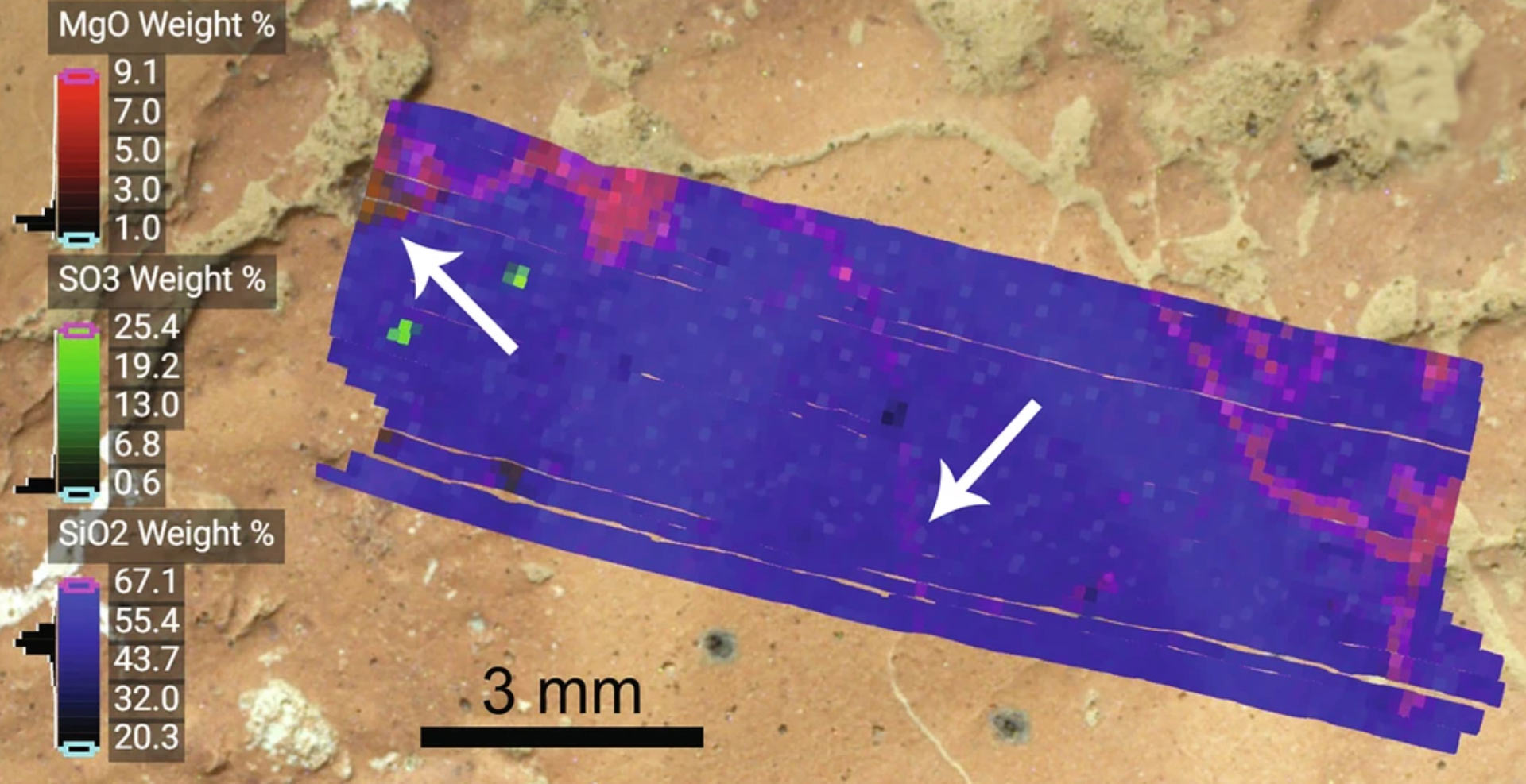
Nickel is present in bright magnesium-sulfate veins in Jezero crater on Mars, supporting an authigenic origin. Image credit: Manelski et al., doi: 10.1038/s41467-026-70081-3.
“The Perseverance rover commenced its mission in Mars’ Jezero crater in February 2021, with the primary objective of identifying ancient environments conducive to life and obtaining pristine core samples destined for eventual return to Earth as part of a forthcoming Mars Sample Return initiative,” stated Dr. Henry Manelski of Purdue University, alongside his research collaborators.
“Jezero is characterized as a 45-kilometer-diameter impact crater dating back to the Noachian epoch (approximately 3.8 to 4 billion years ago). Evidence suggests it formerly harbored a substantial lake, substantiated by the presence of two inflowing valleys, their corresponding fluvio-deltaic fans, and an outflow valley situated on the crater’s eastern periphery.”
“Following its touchdown, the rover has systematically explored the igneous crater floor, ascended onto the western fan deposit, navigated the Margin Unit—which is rich in olivine and carbonates—and ultimately entered the western inlet valley, identified as Neretva Vallis.”
In the course of their investigation, Dr. Manelski and his fellow researchers employed a laser instrument, infrared spectrometers, and an X-ray spectrometer aboard the Perseverance rover to meticulously scrutinize 126 sedimentary rock samples and 8 rock surfaces within Neretva Vallis.
Their analysis revealed the presence of nickel in 32 rock specimens, with concentrations reaching up to 1.1% of their mass. This represents the most significant abundance of nickel detected in Martian bedrock to date.
It was observed that nickel frequently occurred in conjunction with iron sulfide compounds and with sulfate minerals, such as jarosite and akaganeite, which are products of the weathering and degradation of these rocks.
The scientific team identified notable parallels between the chemical composition and morphology of the nickel-rich iron sulfide formations encountered in Neretva Vallis and those of pyrite—a common iron sulfide mineral—found within sedimentary rock strata on Earth.
On Earth, iron sulfides within sedimentary rocks are predominantly generated through microbial anaerobic respiration processes, which involve the utilization of sulfates in the presence of iron-bearing minerals.
Prior research had already documented the presence of iron sulfides in Neretva Vallis alongside organic carbon compounds, leading to hypotheses that these substances might have originated from biological entities.
“Nevertheless, it is imperative to note that these formations could also arise from chemical reactions that do not necessitate the involvement of living organisms,” the scientists elaborated.
“Our present research findings do not furnish definitive evidence supporting the existence of such ancient life forms.”
“Nickel is a vital constituent of enzymes found in numerous ancient archaeal and bacterial species. It plays a crucial role in specific metabolic pathways fundamental for energy generation, carbon assimilation, and the breakdown of organic matter.”
“The detection of nickel-rich geological formations suggests that, had extant organisms been present on early Mars, nickel might have been available in a bioavailable form, suitable for their utilization.”
“The source of this nickel could potentially be attributed to the geological disintegration of igneous rocks or to the impact of a nickel-rich extraterrestrial body.”
“Further scientific inquiry is indispensable to precisely ascertain the origin of the nickel within Neretva Vallis and to thoroughly investigate any potential correlations between its presence and the organic constituents found at this Martian locale.”
The investigation was officially disseminated this week in the esteemed journal Nature Communications.
_____
H.T. Manelski et al. 2026. Strong nickel enrichment co-located with redox-organic interactions in Neretva Vallis, Mars. Nat Commun 17, 2705; doi: 10.1038/s41467-026-70081-3