
The phenomenon of yawning being contagious is so pervasive that merely reading about it might induce an urge to yawn, independent of actual fatigue levels.
This imitative yawning extends even to interspecies interactions, a universal trait among vertebrates that appears to play a crucial role in maintaining optimal brain function. Furthermore, there’s a pronounced social aspect to its infectious nature.
Recent investigations spearheaded by a research collective at the University of Parma in Italy have revealed that the contagious spread of yawning may commence even before birth.
This finding challenges current assumptions regarding prenatal gaping, which emerges quite early in fetal development, around the eleventh week of gestation.
Previously, it was unclear whether fetuses yawned autonomously or if they might begin to synchronize their behavior with significant figures in their lives prior to emerging into the world.
The evidence now suggests that synchronization does indeed occur.
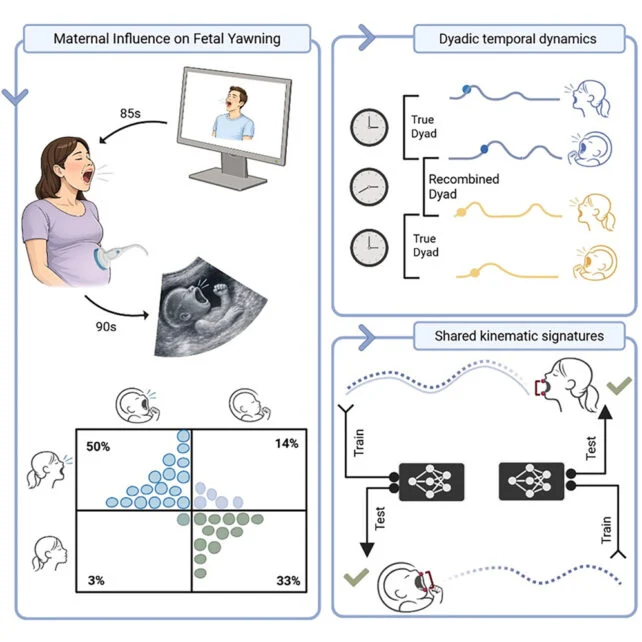
The study enlisted the participation of thirty-eight women, aged between 18 and 45 years, all in their third trimester of a healthy, singleton pregnancy, ranging from 28 to 32 weeks of gestation.
During the experimental sessions, participants were seated in a tranquil environment, observing a screen while their facial expressions were captured on video and their fetuses were monitored via ultrasound.
Initially, the mothers viewed a minute of neutral landscape imagery to establish a baseline of maternal and fetal behavior during a resting state.
Subsequently, the mothers were presented with three distinct 6-minute video sequences.
One sequence depicted individuals yawning, another featured individuals opening and closing their mouths in a manner resembling a yawn but distinct from a genuine one, and a final sequence displayed neutral, resting facial expressions.
To mitigate potential biases in data interpretation, the recordings of both mothers and fetuses were meticulously analyzed frame-by-frame by three independent assistants who were unaware of the video content viewed by the mothers during the recording periods.
The majority of the mothers exhibited at least one yawn while viewing the yawning video. Among these mothers, 18 instances were observed where their yawning appeared to trigger yawning in their fetuses.
“Fetal yawning selectively increases following maternal yawns but not during non-contagious control conditions,” the researchers reported.
It remains difficult to ascertain whether the contagious video was a prerequisite for the transmission of yawning from mother to fetus, as yawns were infrequent outside of this specific condition.
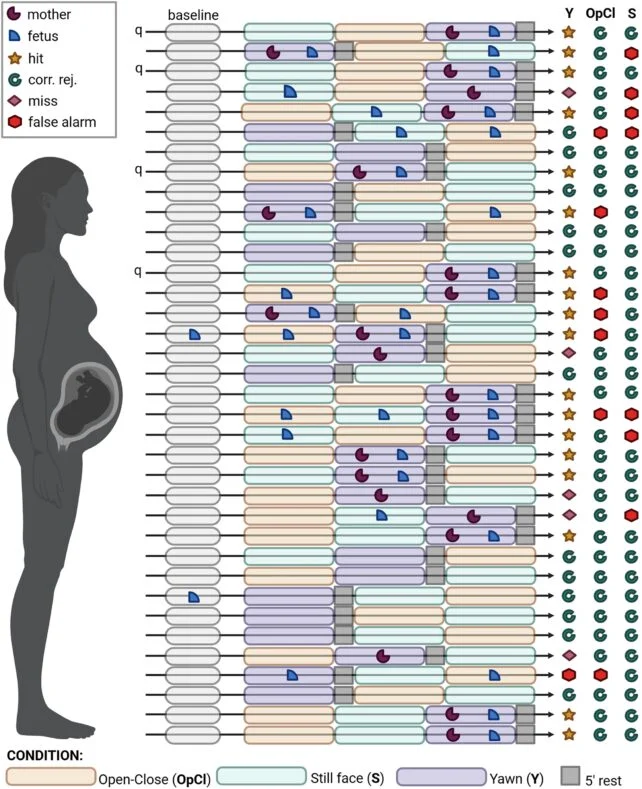
During the sessions involving yawning videos, maternal and fetal yawns occurred synchronously in approximately half of the observed cases. In 33 percent of instances, neither the mother nor the fetus yawned.
Only 14 percent of cases involved a mother yawning independently while viewing footage of yawning, whereas fetuses yawned on their own during this experimental interval only 3 percent of the time.
Occasional yawns were noted during the control sessions; however, in 80 percent of these instances, neither the mother nor the fetus responded.
Notably, the research team observed that “mothers who yawned more also tended to have fetuses that yawned more, revealing a robust positive association between maternal and fetal yawning frequencies.”
Collectively, these findings suggest that the contagious nature of yawning is deeply ingrained and originates at an earlier developmental stage than previously understood.
It is important to acknowledge the relatively small sample size, as all participants were patients at an Italian maternity hospital.
Furthermore, the study concentrates on a rather limited period within gestation.
The precise timing at which mothers and fetuses begin to synchronize their yawns remains unknown, as does the consistency of this phenomenon across the broader human population.
The authors acknowledge these limitations, advocating for further research involving larger and more diverse cohorts to provide clearer insights into these questions.
They also comment that “this research does not identify the physiological pathway through which maternal yawning influences fetal behavior,” which leads to the more fundamental question of why we yawn at all.
The most substantiated current hypothesis posits that yawning serves to regulate brain temperature. However, advancements in technology that enable direct observation of the human brain are continually uncovering alternative, or potentially complementary, explanations.
The underlying reasons for yawns being so catching also remain an enigma. Nevertheless, in the context of expectant mothers and their unborn infants, the phenomenon might extend beyond the mere perceptual mirroring that typically triggers yawn contagion in individuals.
“Rather, they are more consistent with a form of intrauterine physiological contagion, likely grounded in the bodily and interoceptive consequences of maternal actions,” the authors posited.
“Contagious yawning may be understood as the socially recruited expression of a motor pattern that is already robust and available early in development.”