A researcher from Colorado State University posits that Indigenous peoples in North America were engaged in the creation and use of dice and games of chance as far back as twelve millennia ago, a temporal placement significantly predating the previously held assumptions about such activities originating solely in the Old World.
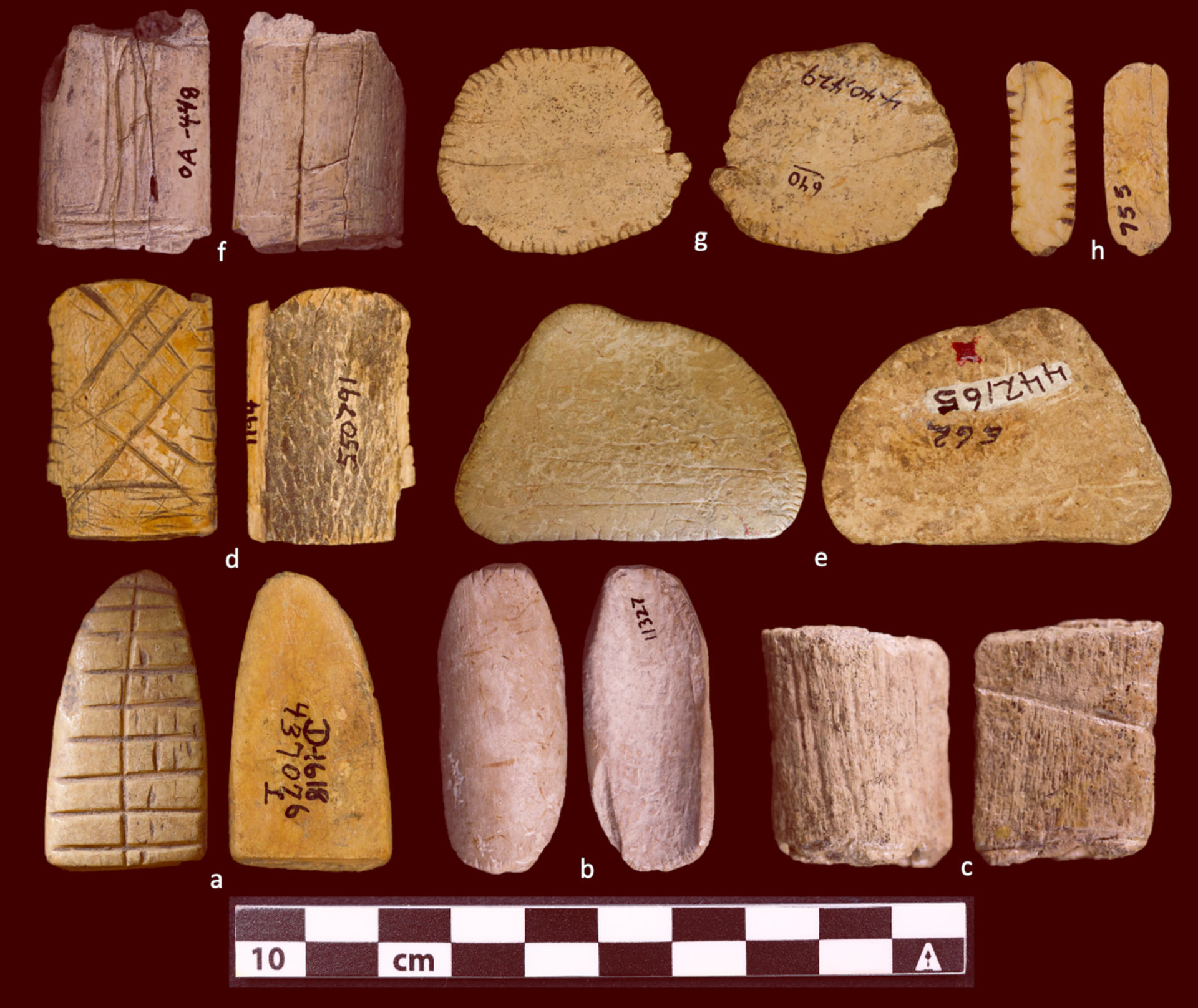
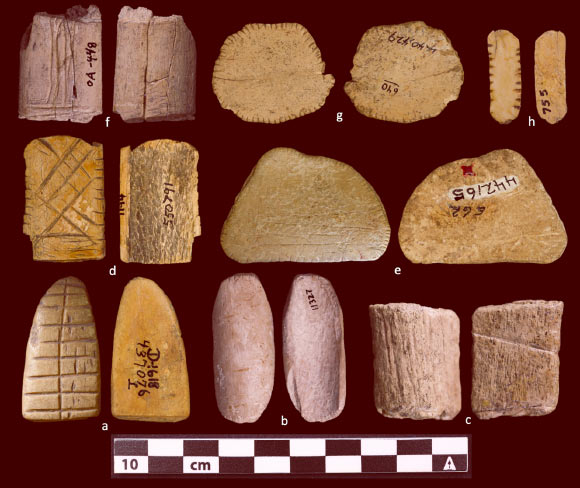
Diagnostic and probable prehistoric Native American dice: (a, d) Signal Butte, Nebraska (Middle Holocene); (b) Agate Basin, Wyoming (Early Holocene); (c, f) Agate Basin, Wyoming (Late Pleistocene); (e, g) Lindenmeier, Colorado (Late Pleistocene); (h) Irvine, Wyoming (Late Holocene). Image credit: Division of Anthropology, Smithsonian Institution, American Museum of Natural History / Department of Anthropology, University of Wyoming.
“The historical consensus has largely attributed the invention of dice and the principles of probability to civilizations of the Old World,” stated Robert Madden, a doctoral candidate at Colorado State University and the principal author of the recent investigation.
“However, the archaeological evidence unequivocally demonstrates that ancient Native American communities were purposefully manufacturing implements designed to yield unpredictable results, and subsequently incorporating these outcomes into structured recreational activities, an undertaking that commenced thousands of years earlier than previously understood.”
The most ancient artifacts identified by Madden originate from Folsom sites, with their chronology dating to approximately 12,800 to 12,200 years before the present.
Distinct from the cubic dice commonly used today, these were two-sided implements, often referred to as binary lots. They were meticulously fashioned, small objects crafted from bone, exhibiting a flattened or subtly convex profile, frequently adopting elliptical or rectangular forms. Their size was optimized for manual manipulation and tossing onto a designated playing surface.
The two distinct surfaces of these binary lots were differentiated by applied ornamentation, variations in surface texture, coloration, or other discernible modifications, akin to the heads or tails on a modern coin, with one side designated as the scoring surface.
Upon being cast, these objects reliably settled with one of their two surfaces facing upwards, thus generating a binary (two-outcome) result.
Collections of these dice were typically thrown in unison, and the resultant scores were calculated based on the quantity of dice that landed with the scoring face uppermost.
“These instruments are characterized by their simplicity and ingenuity. Yet, their deliberate construction is undeniable. These were not the incidental outcomes of bone carving; rather, they were purposefully engineered to produce random results,” Madden elaborated.
Rather than relying on subjective interpretations or conjecture, the current study introduces a novel, attribute-based morphological methodology for the archaeological identification of North American dice.
This analytical framework was developed through a comparative examination of 293 distinct collections of historic Native American dice, meticulously documented across the continent by ethnographer Stewart Culin in his seminal 1907 publication, Games of the North American Indians.
Subsequently, the investigation systematically applies this diagnostic test to the corpus of published archaeological findings. This process essentially involves a re-evaluation of artifacts that have historically been categorized as potential gaming implements or have otherwise been overlooked, in order to ascertain whether they meet the newly established objective criteria for dice.
In a significant number of instances, the requisite evidence had resided within the archaeological record for many years. However, in the absence of a definitive standard for dice identification, it had not been subjected to analysis as part of a comprehensive pattern.
By employing this refined approach, Madden has identified upwards of six hundred definitive and probable dice from archaeological sites that encompass every major epoch of North American prehistory, extending from the Late Pleistocene period through and beyond the era of European settlement.
“For the most part, these artifacts had already been unearthed and reported in academic literature,” Madden remarked.
“The deficiency was not in the availability of evidence, but rather in the absence of a clear, continent-wide benchmark for recognizing what these objects represented.”
“The conclusions drawn do not suggest that hunter-gatherer societies of the Ice Age were engaged in formal theoretical probability,” Madden clarified.
“However, they were intentionally creating, observing, and depending upon random outcomes in a systematic, rule-bound manner that leveraged the inherent regularities of probability, such as the principles outlined in the law of large numbers. This realization holds considerable significance for our understanding of the global historical trajectory of probabilistic thought.”
The research also meticulously documents the extraordinary diversity, as well as the enduring presence, of Native American dice games.
From the Paleoindian period through the Archaic and Late Prehistoric epochs, dice have been discovered at 57 archaeological locations spread across a twelve-state region, associated with a wide array of distinct cultural groups and subsistence strategies.
“This extensive application and longevity are indicative of their profound social relevance,” Madden observed.
“Games of chance and the practice of gambling established impartial, regulated environments for ancient Native American populations.”
“These activities facilitated inter-group interactions, the exchange of commodities and knowledge, the formation of strategic alliances, and the management of inherent uncertainties. In this capacity, they functioned as potent social technologies.”
The study has been published in the esteemed academic journal, American Antiquity.
_____
Robert J. Madden. Probability in the Pleistocene: Origins and Antiquity of Native American Dice, Games of Chance, and Gambling. American Antiquity, published online April 2, 2026; doi: 10.1017/aaq.2025.10158