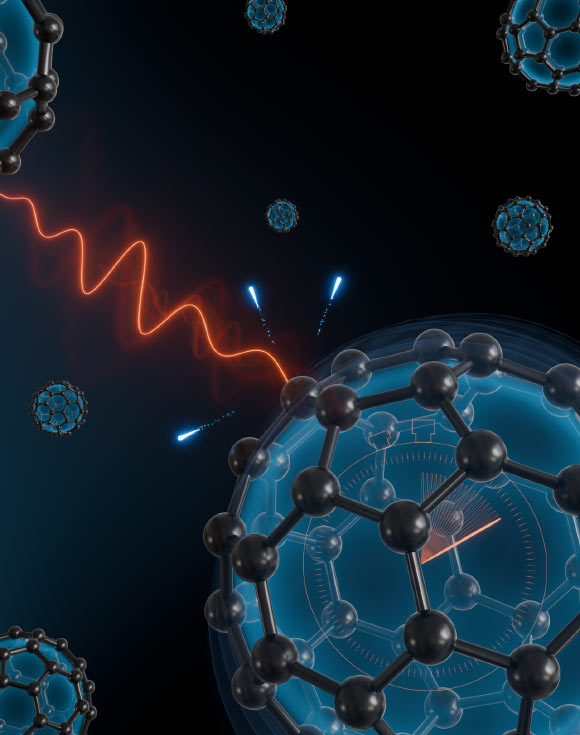
Investigators affiliated with SLAC National Accelerator Laboratory and the University of Hamburg have successfully documented the synchronized electron activity surrounding a minuscule C60 fullerene (buckminsterfullerene) molecule, a phenomenon triggered by fleeting light impulses.

The research team, led by Biswas, meticulously observed the coordinated movements of electrons around a buckminsterfullerene molecule, stimulated by rapid light bursts. Subsequently, this molecule released surplus energy through the emission of multiple electrons. The accompanying visual credit is attributed to RMT Bergues.
This collective electron behavior, termed plasmonic resonance, possesses the notable capability of briefly concentrating light energy.
The capacity to trap light has found utility across a diverse spectrum of applications, ranging from the photocatalytic conversion of light into chemical energy to the enhancement of light-sensitive electronic devices and the efficient transformation of solar radiation into electrical power.
While such phenomena have been extensively investigated in systems spanning several centimeters in size down to those measuring a mere 10 nanometers in diameter, this groundbreaking study marks the first instance wherein researchers have managed to transcend the established ‘nanometer barrier’ in this field.
Prior investigations have suggested the emergence of novel behaviors when plasmonic resonances manifest at exceptionally minute dimensions, thereby enabling the confinement and manipulation of light with unparalleled precision.
Consequently, comprehending the precise dynamics of these resonances at diminutive scales presents a subject of considerable scientific intrigue for researchers.
“To gain a more profound understanding of plasmonic resonance, we initiate the excitation of electrons surrounding a particle and then monitor their subsequent release of excess energy through electron emission,” explained Dr. Shubhadeep Biswas of SLAC National Accelerator Laboratory and his collaborators.
“By meticulously timing this interval, we are able to ascertain whether genuine resonance—characterized by the synchronized motion of all electrons—has occurred, or if the excitation has only impacted a limited number of electrons, specifically one or two.”
“However, these resonant events transpire on extraordinarily rapid timescales, on the order of attoseconds, which are equivalent to billionths of a billionth of a second.”
“The direct observation of these resonances in real-time had previously been beyond the capabilities of existing technological frameworks.”
Employing attosecond pulses of extreme ultraviolet light, the researchers successfully initiated and captured the dynamic behavior of electrons within the hollow, spherical buckminsterfullerene molecules, each measuring a mere 0.7 nanometers in diameter.
The experimental procedure involved precise temporal measurements, meticulously charting the process from the initial excitation of electrons by light to the precise moment of electron emission, which facilitated the expulsion of excess energy and allowed the remaining electrons to revert to their stable orbital configurations.
Each observed cycle spanned durations ranging from 50 to 300 attoseconds, with the collected data indicating a remarkably high degree of electron coherence, akin to the disciplined coordination of performers in a synchronized ensemble.
“These findings represent the inaugural demonstration that attosecond measurements can yield significant insights into plasmonic resonances at dimensions smaller than a nanometer,” stated Dr. Biswas.
This significant advancement empowers researchers to scrutinize a new category of extremely small particles, thereby uncovering plasmonic characteristics that hold the potential to elevate the efficiency of current technologies and foster the development of innovative applications.
“Through this measurement, we are uncovering novel understandings of the intricate relationship between electron coherence and light confinement at sub-nanometer scales,” commented Professor Matthias Kling, a physicist at SLAC National Accelerator Laboratory and Stanford University.
“This scientific endeavor vividly illustrates the potency of attosecond methodologies and paves the way for pioneering approaches in the control of electrons for future ultrafast electronic devices, which could potentially operate at frequencies up to a million times greater than present-day technology.”
“This pioneering research is establishing new pathways for the creation of highly compact, high-performance platforms, where the intricate interplay between light and matter can be precisely managed by leveraging the quantum phenomena that emerge at the nanoscale,” remarked Professor Francesca Calegari from the University of Hamburg.
The comprehensive details of these groundbreaking findings have been formally disseminated through publication in the esteemed journal Science Advances.
_____
Shubhadeep Biswas et al. 2025. Correlation-driven attosecond photoemission delay in the plasmonic excitation of C60 fullerene. Science Advances 11 (7); doi: 10.1126/sciadv.ads0494