Through the advanced application of high-resolution computed tomography (CT) and synchrotron scanning techniques, paleontologists have definitively confirmed that a fossilized specimen unearthed from the Early Triassic strata of South Africa’s Karoo Basin hosts an unborn dicynodont, identified as Lystrosaurus. This groundbreaking discovery effectively resolves a persistent scientific enigma regarding the reproductive methods of early mammalian progenitors – specifically, whether they laid eggs. The research team posits that the eggs of these dicynodonts likely possessed soft shells, a characteristic that would account for their extreme rarity and prolonged evasion of scientific detection.
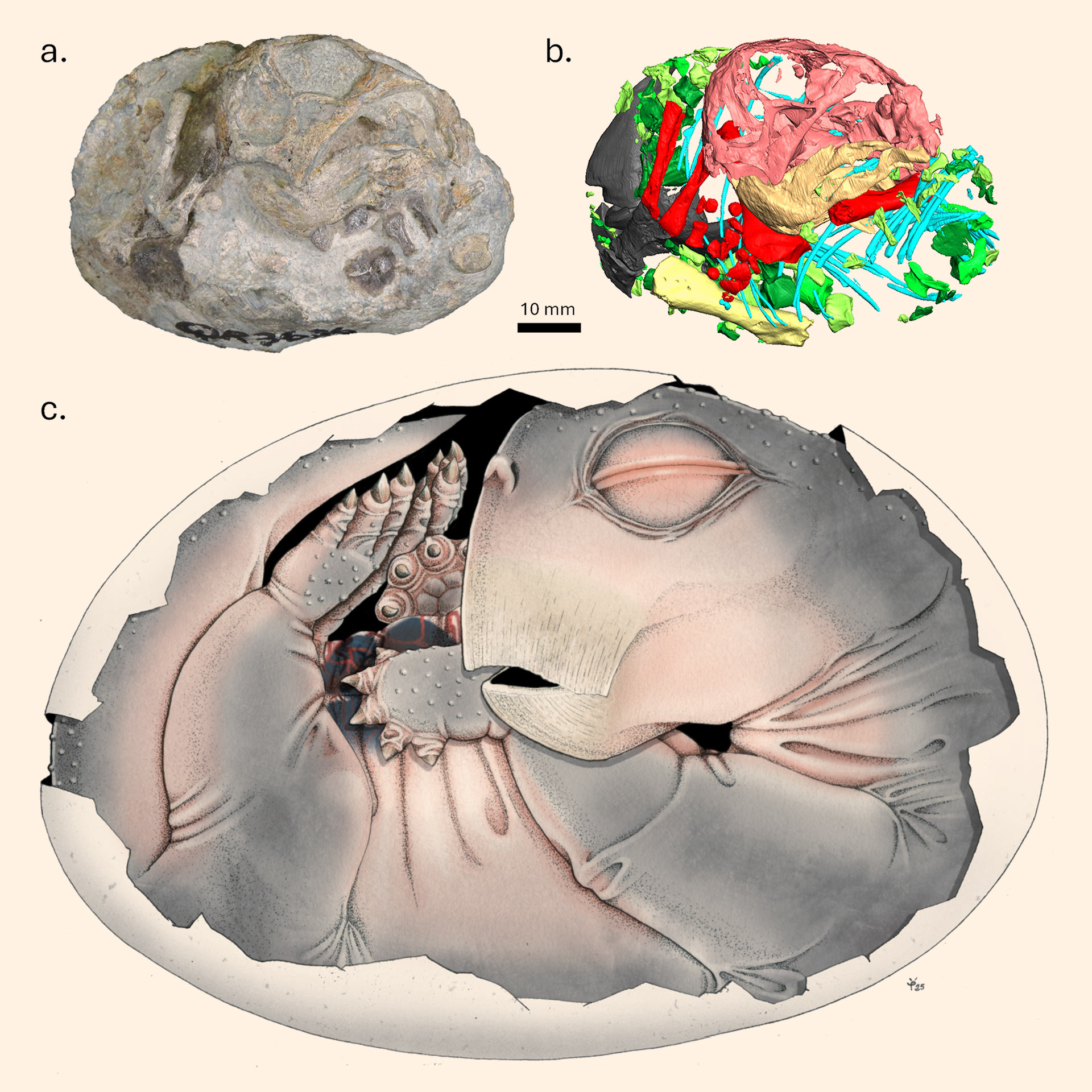
The embryonated egg of the Early Triassic dicynodont synapsid Lystrosaurus. Image credit: Benoit et al., doi: 10.1371/journal.pone.0345016.
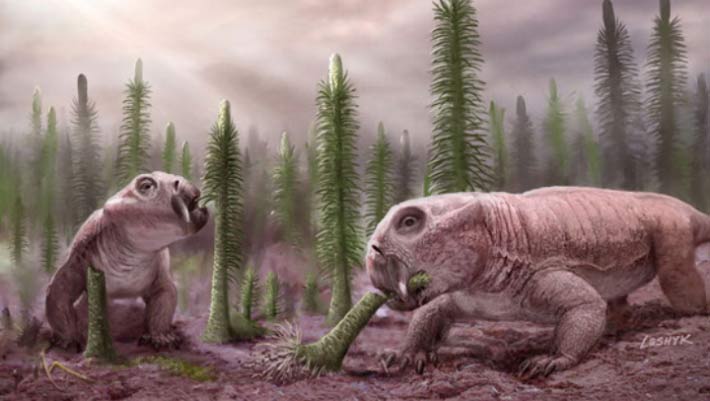
Lystrosaurus represents a significant clade of predominantly herbivorous tetrapods that flourished during the Permian and Triassic geological periods.
This ancient vertebrate typically measured between 1.8 and 2.4 meters (approximately 6 to 8 feet) in length, was devoid of typical teeth, yet was characterized by a pair of prominent tusks projecting from its upper jaw.
Fossil evidence of Lystrosaurus has been documented across diverse geographical locations, including China, Europe, India, South Africa, and Antarctica, and its widespread distribution was among the initial empirical indicators supporting the existence of the vast supercontinent, Pangea.
“For an extensive period exceeding 150 years of paleontological investigation in South Africa, not a single fossil had been irrefutably identified as an egg laid by a therapsid,” stated Professor Julien Benoit from the University of the Witwatersrand.
“This instance marks the inaugural occasion where we can assert with unequivocal certainty that ancestral lineages leading to mammals, such as Lystrosaurus, reproduced via oviparity, thus signifying a genuine watershed moment in this scientific discipline.”
Employing sophisticated imaging technologies, Professor Benoit and his research associates meticulously examined three perinate specimens of Lystrosaurus discovered within the Karoo Basin of South Africa.
One of these specimens exhibited a distinctively coiled posture, strongly indicative of its in-utero state within an egg, and notably lacked any discernible tusk development.
“Elucidating the reproductive strategies employed by mammal ancestors has constituted a protracted scientific conundrum, and this fossil artifact furnishes a pivotal component for deciphering this intricate puzzle,” remarked Dr. Vincent Fernandez, a distinguished researcher affiliated with ESRF – the European Synchrotron facility.
“It was absolutely critical that our scanning methodology was calibrated precisely to capture the requisite degree of detail necessary to resolve such minute and delicate skeletal structures.”
“Upon observing the partial mandibular symphysis, I experienced a profound sense of excitement,” Professor Benoit recounted.
“The mandible, which constitutes the lower jaw, is fundamentally composed of two distinct halves that necessitate fusion to enable the organism to commence feeding.”
“The absence of this fusion process clearly indicates that the embryonic individual was not yet equipped with the functional capacity for self-sustenance.”

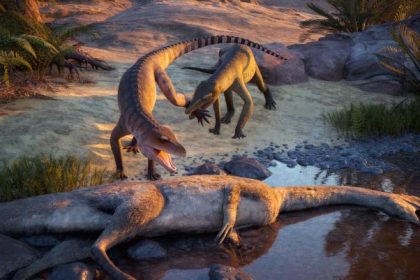
An artist’s impression of Lystrosaurus. Image credit: Victor O. Leshyk, www.victorleshyk.com / University of Birmingham.
According to the investigative team, Lystrosaurus reproduced by laying eggs that were proportionally substantial relative to its overall body mass.
“Among contemporary fauna, larger ova generally contain a greater volume of yolk, thereby supplying all the essential nutrients required for embryonic development to proceed independently, obviating the necessity for post-hatching parental provisioning,” the researchers elaborated.
“This observation strongly implies that species of Lystrosaurus did not engage in lactation, a practice characteristic of extant mammals.”
“Furthermore, the augmentation in egg size confers another significant evolutionary advantage: enhanced resilience against desiccation.”
“Within the arid, drought-prone ecological niches that characterized the post-extinction landscape, this attribute would have represented a crucial adaptation for survival.”
“The findings additionally suggest that neonate Lystrosaurus were likely precocial, emerging from their eggs at an advanced developmental stage.”
“These juvenile animals would have possessed the innate capability for self-sufficiency in foraging, evasion of predation, and achieving reproductive maturity in a timely manner.”
This groundbreaking discovery not only furnishes the inaugural direct empirical validation of oviparity among mammalian ancestors but also elucidates a compelling mechanism by which Lystrosaurus achieved ecological dominance in the aftermath of catastrophic extinction events.
“This research holds considerable scientific import as it provides the first definitive evidence that progenitors of mammals, exemplified by Lystrosaurus, reproduced by means of egg-laying, thereby definitively resolving a protracted query concerning the evolutionary origins of mammalian reproductive systems,” Professor Benoit affirmed.
“Beyond this fundamental biological insight, the research illuminates the profound influence of reproductive strategies on species’ resilience in challenging environments: by virtue of producing large, yolk-rich ova and precocial offspring, Lystrosaurus was demonstrably capable of prospering amidst the severe and unpredictable conditions that prevailed following the Permian-Triassic mass extinction event.”
The scientific exposition detailing this research is accessible in the esteemed journal PLoS ONE.
_____
J. Benoit et al. 2026. The first non-mammalian synapsid embryo from the Triassic of South Africa. PLoS One 21 (4): e0345016; doi: 10.1371/journal.pone.0345016