The cephalopod known as Pohlsepia mazonensis, initially identified in the year 2000 from a specimen dating back 300 million years and previously recognized in the Guinness Book of Records as the world’s most ancient octopus, has undergone a reclassification. It is now considered a distant relative of nautiluses, a development that significantly alters the established timeline for the evolutionary history of octopuses.

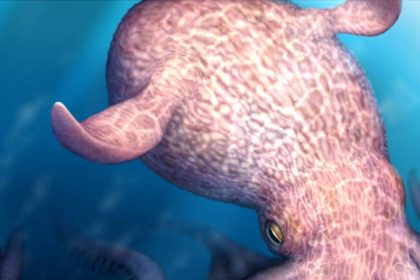
Reconstruction of a Paleocadmus decaying in the Mazon Creek marine basin; the separated shell is visible in the background; other Mazon Creek fauna are visible, such as the polychaete Esconites zelus (foreground) and Bandringa rayi, an elasmobranch shark (back left). Image credit: Franz Anthony.
“Discovered within a singular siderite concretion and described in 2000, Pohlsepia mazonensis profoundly impacted our comprehension of cephalopod evolution. It was initially believed to be the oldest known octopus, pushing back existing estimates by more than 150 million years,” stated Dr. Thomas Clements, a paleontologist affiliated with the University of Leicester and the University of Reading, along with his research associates.
“This striking yet debated fossil, originating from the Late Carboniferous Mazon Creek Lagerstätte (dating from 311 to 306 million years ago), was characterized by a fused, sac-like structure comprising the head and mantle, along with symmetrical fins, bilateral eye spots, and a crown of arms including both limbs and specialized appendages. Notably, it lacked any indications of an internal or external shell.”
In a recent investigation, the researchers undertook a renewed examination of this perplexing fossil, augmented by the study of numerous newly discovered specimens.
Employing a battery of sophisticated analytical methodologies, they identified a previously unobserved radula, which is the characteristic toothed feeding organ present in the majority of mollusks.
The specific morphology of this radula strongly suggests that Pohlsepia mazonensis should be categorized within the nautiloid lineage, a group characterized by shells.
It has been determined that the organism underwent significant decomposition prior to its fossilization, a process that for decades concealed its actual taxonomic identity.
“Our analysis leads us to the conclusion that Pohlsepia mazonensis is definitively classified as Paleocadmus sp. Based on the available morphological evidence, we have determined that this cephalopod is indeed synonymous with, and by established principles of scientific nomenclature, should be referred to as, Paleocadmus pohli,” the researchers reported.
This revised interpretation effectively resolves a long-standing enigma in the study of octopus evolution and brings to light the most ancient preserved soft tissue remnants of a nautiloid ever discovered.
“Our elemental mapping using synchrotron micro-X-ray fluorescence on Pohlsepia mazonensis revealed a previously undetected radula, which had been obscured by the surrounding concretionary material,” the scientists elucidated.
“The presence and specific characteristics of the radular components indicate unequivocally that Pohlsepia mazonensis does not represent a member of the crown octobrachian group but, rather, constitutes the oldest known fossilized soft tissue belonging to a nautiloid.”
“The reclassification of this puzzling cephalopod effectively refutes a Paleozoic origin for octobrachians, providing further substantiation for a Mid/Late Mesozoic origin of the crown Octopoda. This also diminishes the already weak support for the questionable coleoid affinity attributed to the enigmatic Cambrian soft-bodied fossil, Nectocaris pteryx.”
“Our findings underscore the inherent challenges in interpreting exceptional, yet occasionally ambiguous, instances of soft tissue preservation characteristic of the Mazon Creek Lagerstätte. This emphasizes the critical need for scrupulous re-evaluation when investigating fossil material exhibiting unusual soft-bodied preservation within concretions.”
The research paper detailing these findings was published today in the esteemed journal, the Proceedings of the Royal Society B.
_____
Thomas Clements et al. 2026. Synchrotron data reveal nautiloid characters in Pohlsepia mazonensis, refuting a Palaeozoic origin for octobrachians. Proc Biol Sci 293 (2068): 20252369; doi: 10.1098/rspb.2025.2369