Geological experts have ascertained that the African continent is undergoing a fragmentation process at an accelerated pace compared to prior estimations. An active tectonic fissure has attained a pivotal stage and is poised to rupture, ultimately ushering in the formation of a novel ocean basin.
Nonetheless, the term ‘imminently’ denotes a geological timescale, implying the process will still span several million years – a relatively brief interval in Earth’s history.
“Our investigations revealed that faulting within this region is more advanced, and the continental crust is demonstrably thinner, than previously understood,” stated Christian Rowan, a geoscientist affiliated with Columbia University.
“The degree of rifting progression in Eastern Africa surpasses earlier assessments.”
A particularly compelling aspect of this discovery pertains to its implications for understanding human origins. The Turkana Rift Zone in Kenya is a significant repository of early hominin fossil remains, indicating its historical importance as a nexus for human evolution.
However, the recent findings suggest that the region’s prominence for our ancestors might not stem from inherent superiority but rather from geological dynamics that fostered exceptionally favorable conditions for fossil preservation.
While the current arrangement of Earth’s continents may seem static to us, they are in perpetual, albeit infinitesimally slow, motion.
Over 200 million years ago, these landmasses were coalesced into a singular supercontinent, and projections suggest they will eventually reconverge in the far-future geological landscape.
The convergence of tectonic plates gives rise to mountain ranges, whereas their divergence initiates the formation of oceanic basins.
The East African Rift System serves as a prime illustration of the latter phenomenon. The African tectonic plate is currently undergoing separation into two distinct entities: the extensive Nubian plate to the west, encompassing the majority of the continent; and the smaller Somali plate, which includes a significant portion of the eastern coastline and the island of Madagascar.
For the present investigation, the research team concentrated on a specific segment of this system: the Turkana Rift, a geological feature extending across hundreds of kilometers through Kenya and Ethiopia. The scientists meticulously analyzed seismic data previously acquired from the area, performing calculations to ascertain the local crustal thickness.
The results indicated a crustal thickness significantly less than anticipated, measuring approximately 13 kilometers (8 miles) at the rift’s central axis. In contrast, the crustal thickness along the rift margins exceeds 35 kilometers.
When the crust in a rift zone thins to below approximately 15 kilometers, it signifies the onset of a stage termed ‘necking.’ Upon reaching this critical threshold, continental fragmentation becomes virtually inevitable.
Within a span of a few million years, this stage will be completed, leading into the subsequent phase: oceanization. As the designation implies, this is the process through which new oceans are generated.
The continental crust will attenuate to such an extent that molten rock from below will ascend, subsequently pooling and solidifying to establish a basin. This newly formed area will transition into a seafloor, with subsequent ingress of water from the Indian Ocean.
This geological transformation is already underway in the Afar Depression, situated in northeastern Africa in proximity to the Red Sea.
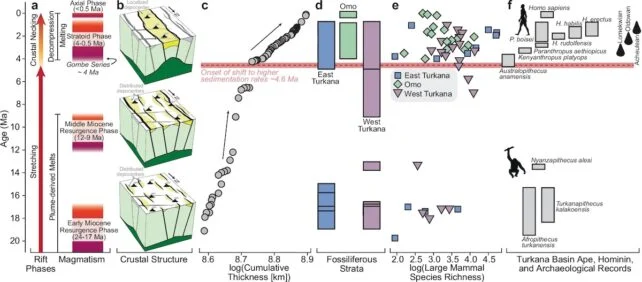
The researchers posit that the Turkana Rift entered its present necking phase approximately 4 million years ago, following an extended period of volcanic activity. Notably, this timeline aligns with the dating of the earliest hominin fossil discoveries and associated evidence unearthed in the region.
This temporal congruence is unlikely to be coincidental, the research team asserts. As the rift began thinning, sedimentation rates accelerated, creating an ideal environment for the meticulous preservation of the fauna that inhabited the area during that epoch.
“The temporal alignment between this tectonic transition and the commencement of continuous, thick sedimentary layers yielding fossils suggests that the necking phase furnished crucial conditions for fossil preservation,” the authors conclude.
“We put forth the hypothesis that these tectonic shifts played an instrumental role in shaping the Turkana Rift Zone’s remarkable paleoanthropological record.”
The researchers suggest that further investigations could delve deeper into this interconnectedness.
The findings of this research have been published in the esteemed journal Nature Communications.