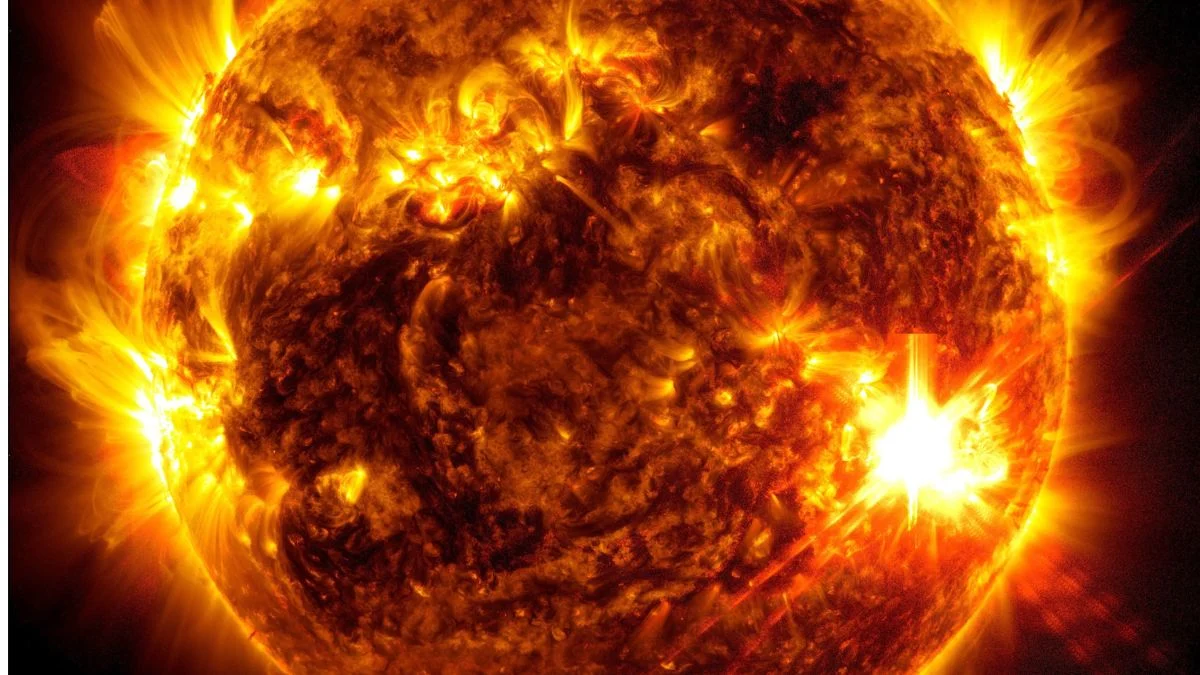
Recent scientific investigations have revealed that our understanding of the Sun’s radiated output, based on surface observations alone, has been incomplete.
By delving into the Sun’s internal dynamics, astronomers have detected considerable fluctuations over the last four decades through the analysis of its internal seismic activity.
According to their assessments, these findings suggest that our star may be transitioning into a novel operational paradigm.
“We have unearthed compelling evidence of systematic alterations in the solar activity cycle,” stated Bill Chaplin, lead author of the study and an astrophysicist at the University of Birmingham.
“Crucially, the magnetic activity is becoming increasingly concentrated closer to the surface with each successive cycle.”
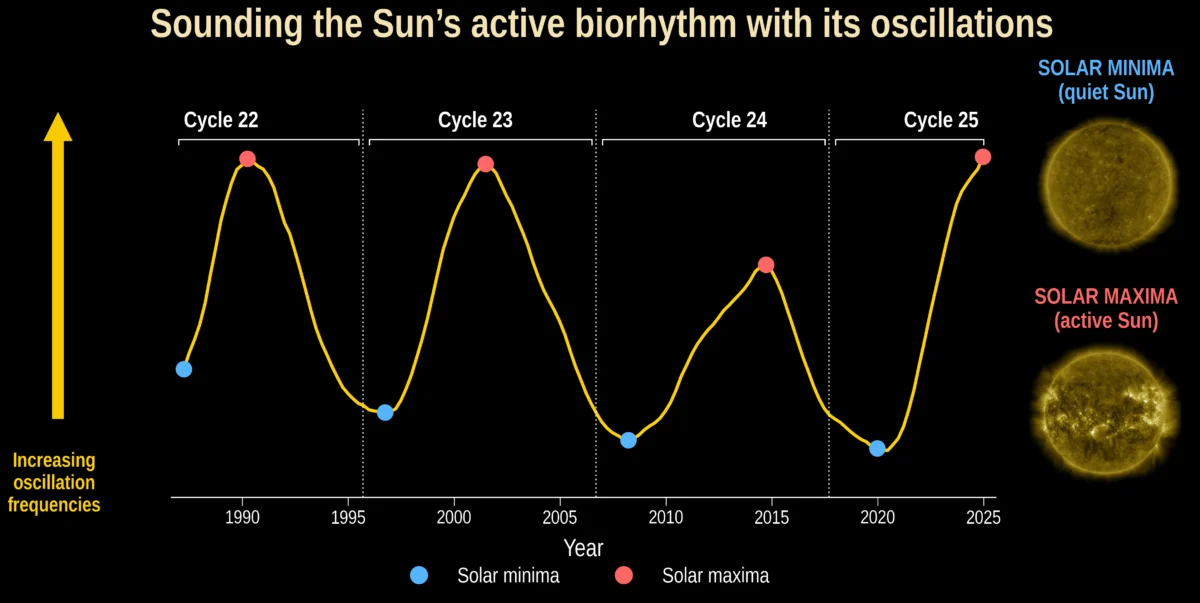
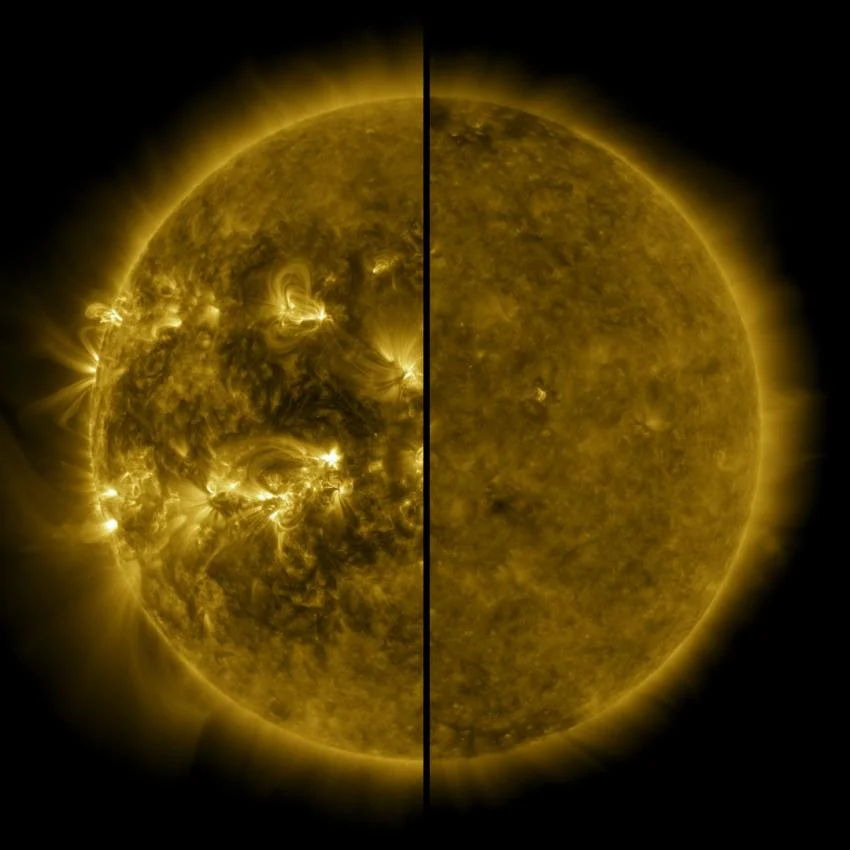
The Sun’s energetic activity follows an approximate 11-year cycle, characterized by periods of quiescence and peak intensity.
During solar minimum, the Sun exhibits reduced activity, posing less of a threat to Earth. Conversely, solar maximum unleashes powerful flares and coronal mass ejections, which can severely impact critical infrastructure such as satellites, GPS systems, communication networks, and power grids.
Similar to a basic bar magnet, the Sun possesses a magnetic field with distinct north and south poles. This field is generated by the continuous convective motion of superheated, electrically charged plasma that constitutes the Sun.
The dynamic processes within the Sun’s interior, coupled with its differential rotation (spinning faster at the equator than at the poles), contort and stretch this magnetic field in a complex, chaotic manner.
This intricate interaction ultimately leads to a reversal of the north and south magnetic poles, an event that occurs approximately every 11 years, marking the completion of a solar cycle.
The recent solar cycles have exhibited notable deviations in both overall activity levels and the evolution of the Sun’s magnetic fields.
For instance, the preceding Cycle 24 was characterized by diminished solar activity, including fewer sunspots and reduced radiation emissions across various wavelengths.
The current Cycle 25 was initially anticipated to follow this downward trend, however, it is now revealing intriguing changes occurring beneath the Sun’s visible surface.
To investigate the Sun’s internal activity, Chaplin and his team analyzed almost forty years of Doppler velocity data accumulated by the Birmingham Solar Oscillations Network (BiSON). This dataset, spanning from 1987, encompasses solar Cycles 22 through 25.
The BiSON observatory comprises a global network of six spectrometers dedicated to continuous solar observation.
Operational since 1976, it employs a technique known as helioseismology to monitor solar activity by detecting subtle variations in the Sun’s light, which are indicative of internal vibrations.
The researchers examined these vibrations, termed “p-mode oscillations,” which are generated by rippling sound waves within the Sun, causing it to resonate like an enormous thermonuclear bell.
To ascertain activity levels at different depths within the Sun, the team analyzed three distinct ranges of oscillation frequencies: low, intermediate, and high.
These internal measurements were then juxtaposed with several widely utilized “global activity proxies.” These proxies quantify the Sun’s surface activity, encompassing metrics such as the number and dimensions of sunspots, and the intensity of the Sun’s radio emissions. This comparative analysis aimed to correlate internal phenomena with events occurring in the Sun’s outer atmosphere, including its often-complex corona.
A striking pattern emerged from the analysis: while the Sun’s external activity appears to be less intense, aligning with recent expectations, its internal high-frequency oscillations are exhibiting greater strength, mirroring conditions observed in earlier solar cycles.
Consequently, the researchers posit that the solar-cycle-driven magnetic activity and consequent structural alterations within the Sun are becoming increasingly localized to shallower regions, approximately 1,000 kilometers (621 miles) beneath the surface.
“This constitutes a groundbreaking discovery, made possible by the extensive long-term observations from BiSON,” Chaplin further commented.
Sustained, long-term monitoring is indispensable for discerning discernible trends and shifts in the Sun’s behavior.
An enhanced comprehension of how magnetic fields influence solar outbursts, and vice versa, will lead to more accurate space weather forecasts. This improved prediction capability is vital for anticipating solar particle events and geomagnetic storms that can adversely affect Earth’s electrical infrastructure.
Furthermore, this research illuminates the interconnectedness between the Sun’s internal and external forces.
“We have determined that the correlation between internal solar oscillations and surface activity has undergone a transformation across the most recent solar cycles,” noted Sarbani Basu, an astronomer from Yale University.
Ongoing BiSON observations are anticipated to shed light on how this relationship evolves as Cycle 25 concludes and Cycle 26 commences, projected to occur around 2030.
Will this trend persist, or will it unexpectedly shift again?
Regardless of the outcome, this development signifies a profound modification in the Sun’s internal structure:
“This observed trend cannot be solely attributed to weakened magnetic fields. Instead, it suggests a fundamental reorganization in the mechanisms by which the Sun’s magnetic activity is stored beneath its surface,” Basu concluded.
This groundbreaking research has been published in the esteemed journal, Monthly Notices of the Royal Astronomical Society.