The most accurate assessment to date of the rate at which the cosmos is expanding reveals a significant and pressing challenge.
The H0DN Collaboration, an international consortium providing consensus on the Hubble constant, has refined the benchmarks employed for gauging cosmic expansion. This has established a framework that places the expansion rate in the observable universe at 73.5 kilometers per second per megaparsec, with an impressive 7-sigma level of confidence.
The core issue is that independent evaluations of the early universe’s expansion rate consistently yield a figure of 67.24 kilometers per second per megaparsec. These recent endeavors have done little to bridge this discrepancy, commonly referred to as the Hubble tension.
Brace yourselves for an explanation.
Our universe originated approximately 13.8 billion years ago and has been in a perpetual state of expansion since its inception. The velocity of this expansion is quantified by the Hubble constant, denoted as H0, which serves as a foundational metric for comprehending the vastness of space.
The Hubble constant is instrumental in calculating the age and dimensions of the universe. It aids in understanding the influence of dark energy, the enigmatic force driving cosmic expansion, and is a requisite value for determining distances between galaxies.
Astronomers possess several highly precise instruments for quantifying the H0 rate, and herein lies the crux of the problem.
All measurement tools applied to the local, more recent universe produce remarkably consistent results, generally falling between 72 and 74 kilometers per second per megaparsec. Similarly, tools used to measure the distant, early universe also yield compatible outcomes, typically around 67 or 68 kilometers per second per megaparsec.
However, a reconciliation between these two temporal measurements remains elusive, suggesting a significant missing piece in our understanding. This divergence is termed the Hubble tension.
The H0DN Collaboration tackled this challenge by concentrating its efforts on the local universe. To ascertain H0 in this immediate cosmic environment, scientists depend on a methodology known as the cosmic distance ladder, wherein each tier represents a distinct measurement technique.
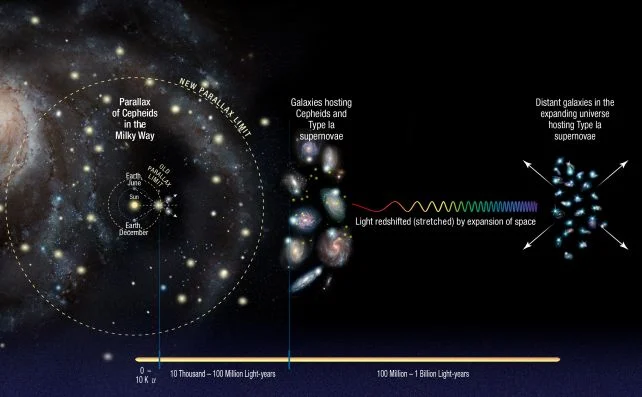
The initial step involves parallax, which quantifies the apparent positional shift of celestial objects when observed from varying perspectives. As Earth orbits the Sun, the parallax of nearby stars provides an indication of their distance.
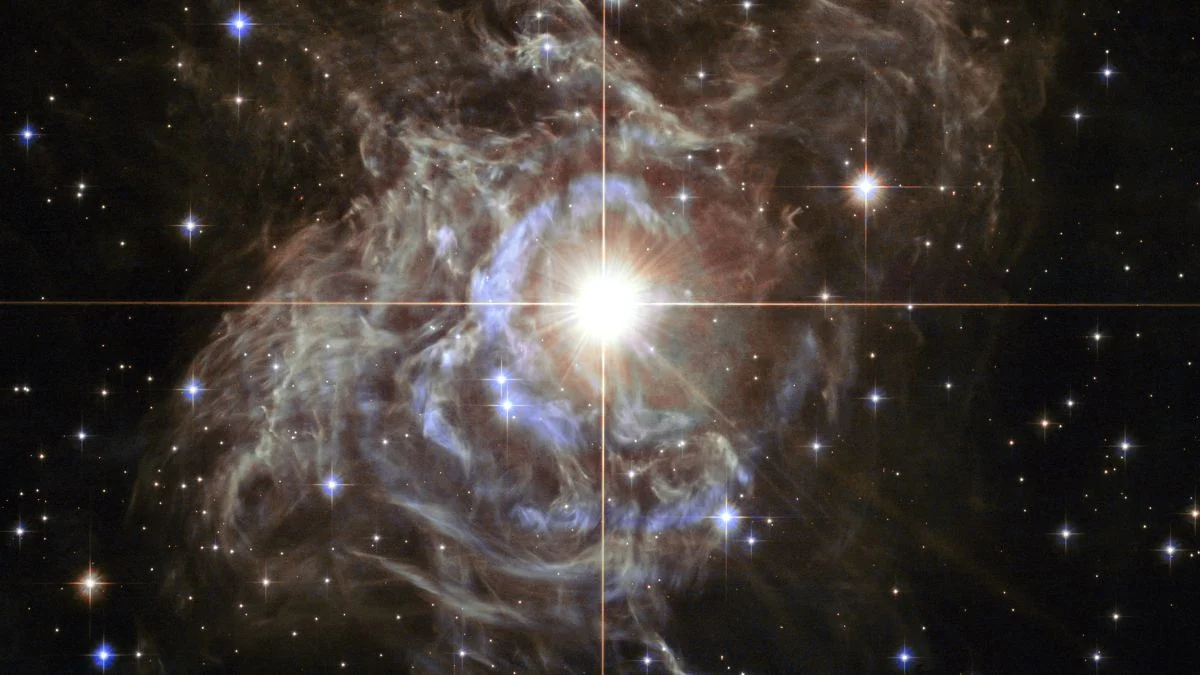
The subsequent tier utilizes stars of known luminosity, such as Cepheid variables. The third level employs Type Ia supernovae, characterized by a predictable peak brightness.
One plausible explanation for the Hubble tension posits a potential miscalculation within one of the distance ladder’s stages, which then propagates to the final result.
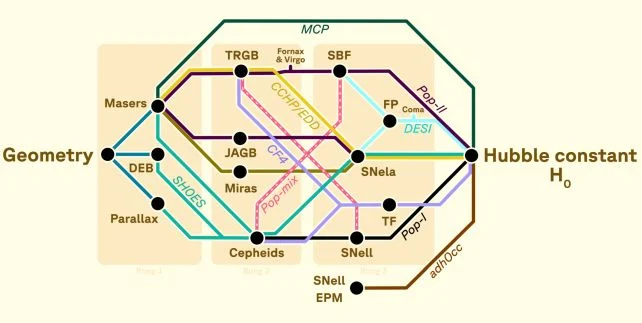
To investigate this, the collaboration eschewed a simple ladder in favor of a comprehensive distance network. This network integrates numerous overlapping techniques for distance determination, encompassing Cepheid variables, stars at the tip of the red giant branch, Mira variables, megamasers, Type Ia and Type II supernovae, surface brightness fluctuations, the Tully-Fisher relation, and the Fundamental Plane.
Each of these methods yields precise distance measurements to proximate stars and galaxies, with some overlap between them. The integrated Local Distance Network indicates that the local Hubble constant is established at 73.5 kilometers per second per megaparsec.
Crucially, the researchers subjected their findings to rigorous scrutiny. They systematically excluded individual methods and telescopes to determine if their removal impacted the outcome, which would signal a methodological flaw.
Furthermore, they experimented with different datasets and altered the foundational assumptions underpinning their analysis.
The results remained remarkably stable. This represents the most rigorous examination of local H0 conducted to date, and it has withstood every analytical challenge posed by the H0DN Collaboration.
However, measurements of H0 in the distant universe are also considered reliable, consistently showing values around the 67 kilometers per second per megaparsec mark.
In recent years, some research has aimed to resolve the Hubble tension by suggesting potential inaccuracies in our measurement techniques. Typically, when confronted with the choice between human error and unknown physics, the former is eventually identified as the cause, making this a reasonable line of inquiry.
Nevertheless, this novel research strongly suggests that the discrepancy is indeed a genuine phenomenon and may necessitate the introduction of new physical principles for its resolution.
The researchers have generously made their Local Distance Network code publicly accessible on GitHub, enabling others to attempt replication of their findings.
“Rather than solely serving to constrain dark energy models, as initially conceived a decade ago, the enhanced precision of H0 now exposes a broader inconsistency within the standard cosmological framework and bolsters the argument for new physics or a more profound re-evaluation of early-universe inferences,” the H0DN Collaboration states.
“The evolving significance of H0 has already begun to reshape our comprehension of precision cosmology, and further revelations may well emerge.”
This research has been published in the journal Astronomy & Astrophysics.