Advanced computational modeling indicates that ice giants such as Uranus and Neptune may contain a peculiar, nearly linear superionic state of carbon hydride, potentially revolutionizing scientific perspectives on planetary internal structures.
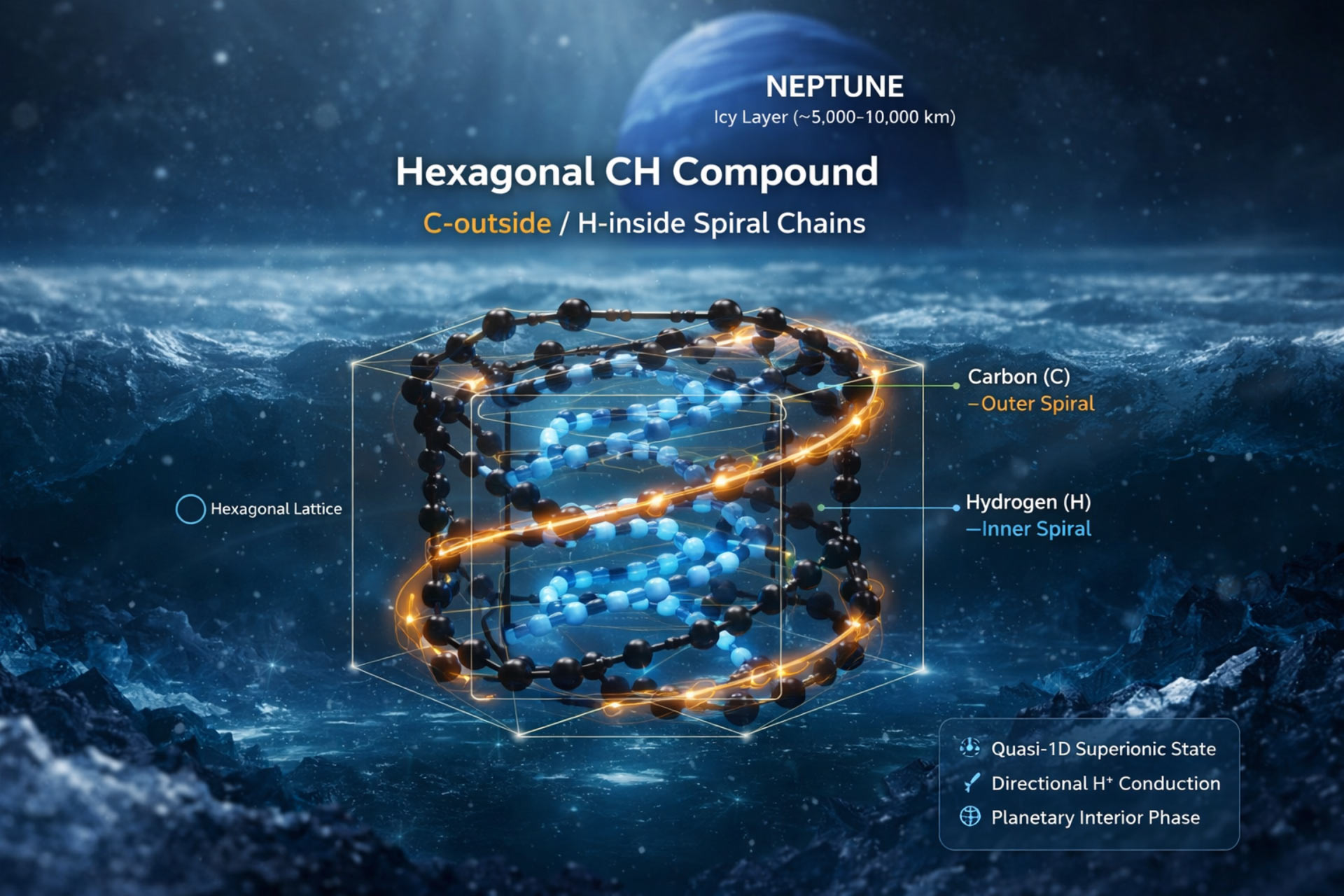
An illustration depicting the hypothesized hexagonal carbon hydride compound under conditions simulating Neptune’s internal environment. In this configuration, carbon atoms form the external helical chains (rendered in yellow), while hydrogen atoms constitute the internal helical chains (rendered in blue), aligning with the quasi-one-dimensional superionic characteristics identified through first-principles simulations. Image courtesy of Cong Liu.
Empirical data regarding the densities of Uranus and Neptune suggest the presence of intermediate strata composed of unusual hot ices deep within these planets, positioned beneath their gaseous hydrogen and helium atmospheres and above their solid, rocky cores.
It is theorized that these deep layers, primarily comprising water, methane, and ammonia, would likely undergo transformations into exotic material phases due to the immense pressures and temperatures encountered.
The unique physical dynamics prevalent in these high-pressure, high-temperature regimes are capable of fostering the emergence of atypical states of matter, prompting ongoing efforts by theoretical physicists and experimentalists to both anticipate and replicate these conditions and their outcomes.
Leveraging sophisticated high-performance computing resources and machine learning algorithms, Dr. Cong Liu, affiliated with the Carnegie Institution for Science, along with his research collaborators, conducted fundamental quantum physics simulations. These simulations explored the behavior of carbon hydride subjected to pressures ranging from approximately 5 million to 30 million times standard atmospheric pressure (equivalent to 500 to 3,000 gigapascals) and temperatures between 4,000 and 6,000 Kelvin.
The computational models predicted the formation of an ordered hexagonal lattice structure wherein hydrogen atoms exhibit directed movement along spiral trajectories, resulting in a novel quasi-one-dimensional superionic state.
Superionic substances represent an intriguing intermediate phase between solid and liquid states, characterized by one atomic species maintaining a fixed crystalline arrangement while another species becomes highly mobile.
“This newly predicted carbon-hydrogen phase is particularly striking because the atomic motion is not fully three-dimensional,” commented Dr. Ronald Cohen, also of the Carnegie Institution for Science.
“Instead, hydrogen moves preferentially along well-defined helical pathways embedded within an ordered carbon structure.”
The directional nature of this atomic movement carries significant implications for the transport mechanisms of heat and electrical charge within planetary interiors.
Such phenomena could exert considerable influence on the redistribution of internal energy, the electrical conductivity of these regions, and potentially impact our understanding of how magnetic fields are generated in ice giant planets.
These discoveries also contribute to a broader comprehension of how simple elemental compounds behave under extreme environmental duress, suggesting that even nominally simple systems can self-organize into surprisingly intricate phases.
“Carbon and hydrogen are among the most abundant elements found in planetary materials, yet their combined behavior under the specific conditions present in giant planets remains far from fully elucidated,” stated Dr. Liu.
The scholarly work detailing these findings was disseminated on March 16th within the esteemed journal Nature Communications via a publication.
_____
C. Liu et al. Prediction of thermally driven quasi-1D superionic states in carbon hydride under giant planetary conditions. Nat Commun, published online March 16, 2026; doi: 10.1038/s41467-026-70603-z