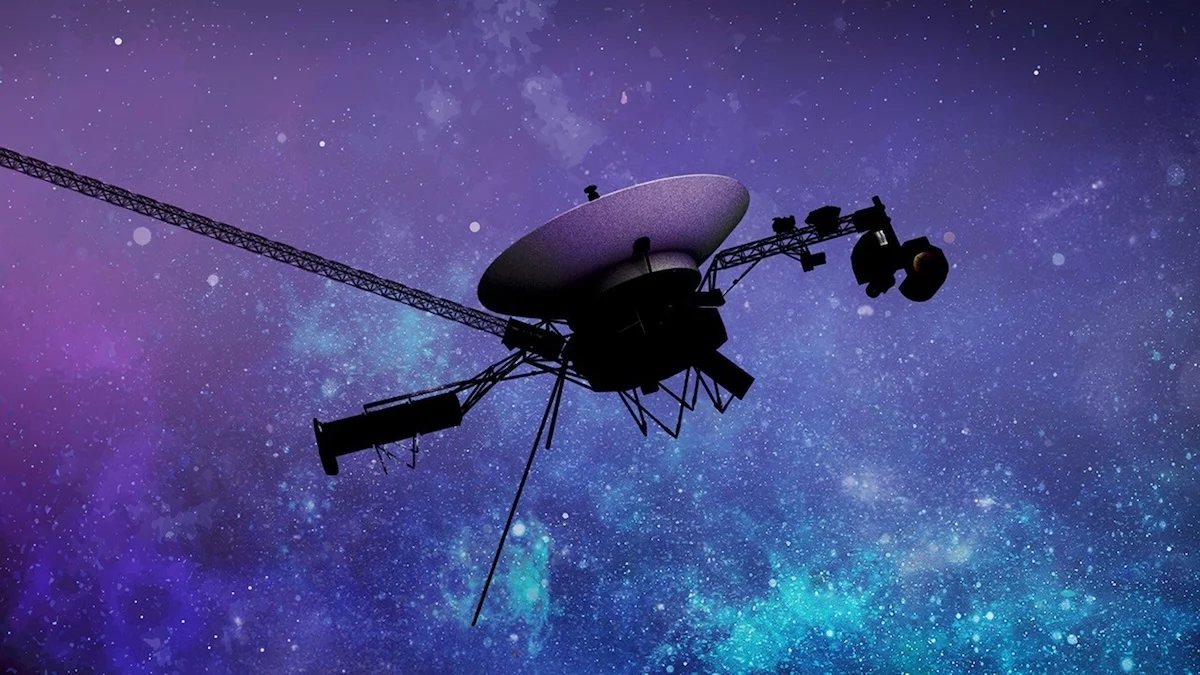
The furthest human-made emissary from our planet, the Voyager 1 probe, has recently decommissioned an additional scientific instrument.
This cessation of operations stems from the imperative for the Voyager mission personnel to conserve dwindling electrical resources aboard the aging interstellar craft.
The specific apparatus rendered inactive is the Low-energy Charged Particles (LECP) experiment. This instrument was instrumental in the Voyager probes’ investigation of solar wind dynamics and the interstellar medium (ISM).
Fundamentally, this operational curtailment was enacted to ensure the continued exploration of the cosmos by humanity’s pioneering interstellar mission.
In parallel with its celestial sibling, Voyager 1 is powered by three Radioisotope Thermoelectric Generators (RTGs). These sophisticated devices harness the thermal energy released from the radioactive decay of Plutonium-238 to generate electrical power. Following an operational tenure approaching half a century, these power sources are exhibiting considerable depletion.
Engineers at NASA’s Jet Propulsion Laboratory (JPL) dispatched commands to deactivate the instrument on April 17th. This follows the earlier deactivation of the Cosmic Ray Subsystem (CRS) in February 2025, and the progressive shutdown of its imaging system, ultraviolet spectrometer, and other components since 1990.
The LECP has functioned with minimal interruption since the inception of the Voyager 1 and 2 missions in 1977. Concurrently, the power output from Voyager 1’s RTGs has been diminishing at a rate of approximately 4 watts annually, and by April 2026, they were delivering less than half of their initial electrical capacity.
As power reserves have become critically low, mission controllers have been compelled to deactivate auxiliary heaters and scientific instruments, while simultaneously safeguarding the spacecraft’s propellant lines from freezing. This delicate equilibrium necessitates strategic determinations regarding which components can be relinquished at this advanced stage of the mission.
This decision was precipitated by an unforeseen power reduction experienced by Voyager 1 on February 27th, occurring during a routine roll maneuver. Such abrupt power fluctuations can inadvertently trigger the spacecraft’s undervoltage fault protection system, which automatically suspends instrument operations to maintain overall system integrity.
In such an event, the mission team would face the protracted challenge of executing a system recovery sequence. Given Voyager 1’s immense remoteness from Earth – a distance of approximately 25 billion kilometers (15 billion miles) – command transmissions would necessitate about 23 hours for arrival, and subsequent execution would require over 3 hours to complete.
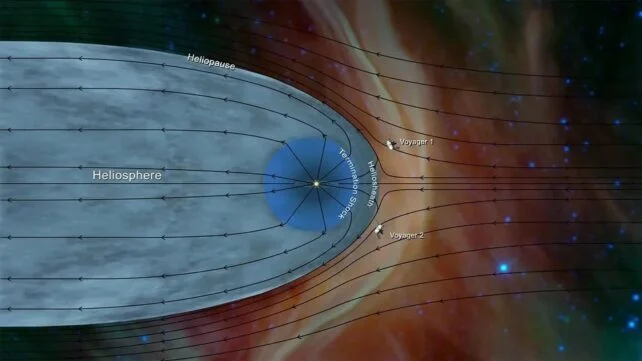
The decision to disable the LECP was not undertaken lightly. Since Voyager 1’s departure from the Solar System, the LECP has yielded invaluable empirical data concerning the structural characteristics of the interstellar medium, meticulously documenting pressure gradients and variations in particle density beyond the heliosphere.
This magnetic field, generated by the solar wind, constructs a protective envelope that insulates the Solar System from potentially damaging cosmic radiation. At the periphery where this influence converges with the interstellar medium, a phenomenon known as a “bow shock” is formed. The two Voyager probes stand as the sole celestial vehicles sufficiently distant from Earth to furnish direct observations from this critical demarcation zone.
Fortunately, the Voyager science and engineering cadres had proactively established a contingency strategy outlining the sequence for instrument deactivation. For Voyager 1, the LECP was designated as the subsequent candidate for shutdown, mirroring a similar measure previously implemented on Voyager 2 in March 2025. As articulated by Kareem Badaruddin, Voyager mission manager at JPL, in a NASA press release:
“While the decommissioning of a scientific instrument is certainly not the preferred course of action for anyone, it represents the most viable recourse. Voyager 1 presently retains two operational science instruments: one dedicated to the detection of plasma waves and another for the measurement of magnetic fields.
These instruments continue to function exceptionally well, transmitting crucial data from a spatial domain hitherto unexplored by any human-made apparatus. The team remains resolutely committed to extending the operational lifespan of both Voyager spacecraft to the greatest feasible extent.”
A diminutive motor responsible for orienting the LECP sensor to conduct comprehensive scans across all directions will remain energized. This provision allows for the potential reactivation of the instrument should increased power availability materialize in the future. In the interim, engineers are leveraging this temporal buffer to refine a more extensive strategy for mission longevity, a concept they refer to as the “Big Bang.”
This ambitious plan entails the simultaneous deactivation of a suite of power-consuming components, coupled with the activation of low-power alternative systems designed to maintain sufficient thermal equilibrium for continued scientific data acquisition.
Initial implementation of the Big Bang strategy is slated for Voyager 2, given its slightly more ample power reserves and its proximity to Earth. Testing is scheduled for May and June of the current year, and contingent upon successful outcomes, the team may proceed with the implementation on Voyager 1 no earlier than July. Should this initiative successfully liberate additional power, the LECP could be reinstated to resume its vital data collection on the interstellar medium.
This narrative was originally disseminated by Universe Today. Access the original publication here.