
A significant proportion—approximately one-third—of individuals diagnosed with major depressive disorder do not experience positive outcomes with conventional therapeutic interventions. However, an alternative treatment modality might be readily available.
Intriguingly, a novel strategy focused on addressing inflammation could offer a solution.
Tocilizumab, an established anti-inflammatory pharmaceutical agent typically administered for autoimmune conditions such as rheumatoid arthritis, shows promise in aiding patients whose depression is refractory to standard therapies.
During a preliminary four-week investigation designed to establish proof of concept, thirty individuals presenting with moderate to severe depression, who had not responded to conventional antidepressant medications and exhibited discernible signs of systemic inflammation, were allocated to receive either tocilizumab or an inert placebo.
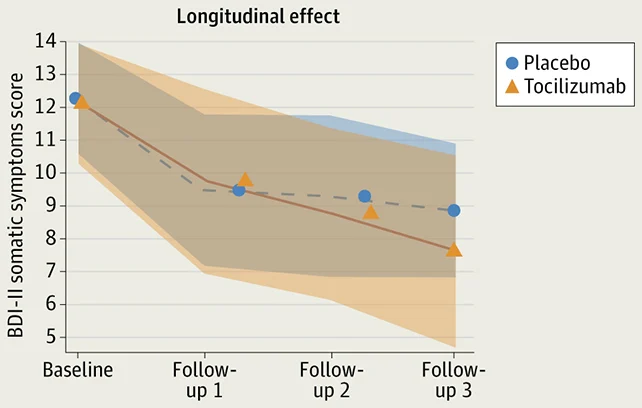
Participants administered tocilizumab reported notable enhancements in depression severity, diminished fatigue, reduced anxiety levels, and an improved overall quality of life when contrasted with the placebo cohort.
By the conclusion of the study period, a substantial 54 percent of the tocilizumab recipients (comprising seven individuals) achieved remission from depression, whereas 31 percent of the placebo group (five participants) attained a similar outcome.
“This research marks a pivotal advancement in the quest for novel therapeutic strategies for depression, particularly for treatment-resistant forms that impact millions across the United Kingdom alone,” stated immunologist Golam Khandakar from the University of Bristol.
Prior meta-analysis has established a clear correlation between depressive states and subclinical inflammatory processes within the body.
Consequently, could addressing one condition positively influence the other?
The therapeutic mechanism of tocilizumab involves targeting receptors for interleukin 6 (IL-6), a class of proteins classified as cytokines that are implicated in the body’s inflammatory responses.
Earlier investigations conducted by some of the same research group had posited a potential association between elevated IL-6 levels and the manifestation of depression in specific patient populations.
One of the physiological alterations induced by tocilizumab is the blockade of the IL-6 signaling pathway, thereby modulating the immune system and mitigating inflammation. This action underpins its efficacy in managing arthritis and suggests its potential utility in treating depression.
Numerous contemporary approaches to depression management are centered on rectifying neurochemical imbalances. While advancements are continually being made in these areas, emerging evidence increasingly indicates that combating persistent, low-grade systemic inflammation may also prove beneficial in a considerable number of cases.
A noteworthy observation by the researchers was that individuals who displayed higher baseline levels of inflammation at the study’s inception exhibited a more pronounced positive response to tocilizumab therapy, further reinforcing the proposed connection.
However, this ameliorative effect was specifically observed in individuals with elevated initial concentrations of a different inflammatory biomarker.
“This represents one of the inaugural randomized controlled trials to evaluate immunotherapy for depression, the first to investigate IL-6R as a therapeutic target, and the initial study to employ a precision approach for patient selection based on anticipated benefit, successfully demonstrating its efficacy,” commented Khandakar.
It is important to acknowledge that the observed outcomes in this trial did not achieve statistical significance. Nevertheless, given the limited sample size of only thirty participants, this was not the study’s primary objective. The investigation served as a proof-of-concept, aiming to ascertain the viability of further exploration in this research domain.
In this regard, the research team received an affirmative indication.
The findings emerging from this study provide a compelling rationale for conducting larger investigations involving a more diverse participant pool and extended observation periods. Such endeavors will contribute to a more profound understanding of the intricate relationship between inflammation and depression.
Given that tocilizumab is an already approved pharmaceutical for human use, its expedited regulatory authorization for depressive disorders is anticipated. Furthermore, no significant adverse effects were documented during the course of this trial.
This research also illuminates the multifaceted and nuanced nature of depression.
The presentation and severity of this condition can vary considerably among individuals, suggesting that future therapeutic strategies may need to adopt a more personalized and targeted approach.
“It is estimated that depression affects approximately 10 to 20 percent of the global population at some point in their lives. Despite this prevalence, current treatments remain insufficiently effective for a considerable number of patients,” explained immunologist Éimear Foley of the University of Bristol.
“Our investigation represents a step forward toward more individualized depression care, where therapeutic interventions are tailored to align with an individual’s unique biological profile. This will ultimately enable us to deliver the most appropriate treatment to the right patients at the opportune moment.”