A trek through the woods might be your chosen method to decompress from professional obligations and alleviate stress following an intensive work period. The avian chorus emanating from the upper foliage could be precisely the element that fosters your tranquility.
However, sounds that offer solace to humans can concurrently signify peril to other fauna, instigating apprehension throughout the forest ecosystem.
In our recent investigation, detailed today in the journal Current Biology, we elucidate how certain creatures, upon detecting a predator, emit an alert that is perceived by others and disseminated across the rainforest canopy.
Consequently, diverse species become temporarily integrated into a shared informational network, leading to a transient quietude within portions of the forest.
Avian and Primate Dynamics
During an expedition to a secluded sector of the Peruvian Amazon, in collaboration with an expert falconer, we employed trained birds of prey to elicit warning vocalizations from birds and primates. These calls were subsequently recorded, broadcast back into the environment, and the community’s reactions were meticulously observed.
It was previously understood that avian species occasionally echo the alarms of their fellows, sometimes even those of dissimilar species or primates. Our objective was to ascertain the extent of this behavioral prevalence within the broader animal populace.
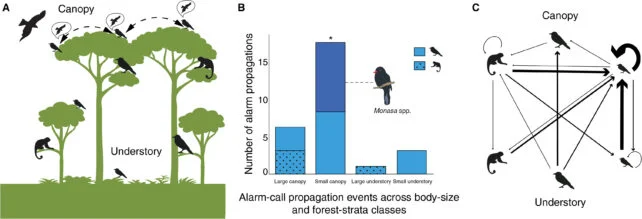
Our findings indicated that alarm signals originating from smaller avian species – those weighing under 100 grams – were most frequently retransmitted. Fellow avian inhabitants of the canopy represented the most likely conduits for relaying these calls, though other animal groups also participated.
Larger fauna, including capuchin and spider monkeys, exhibited occasional responses as well.
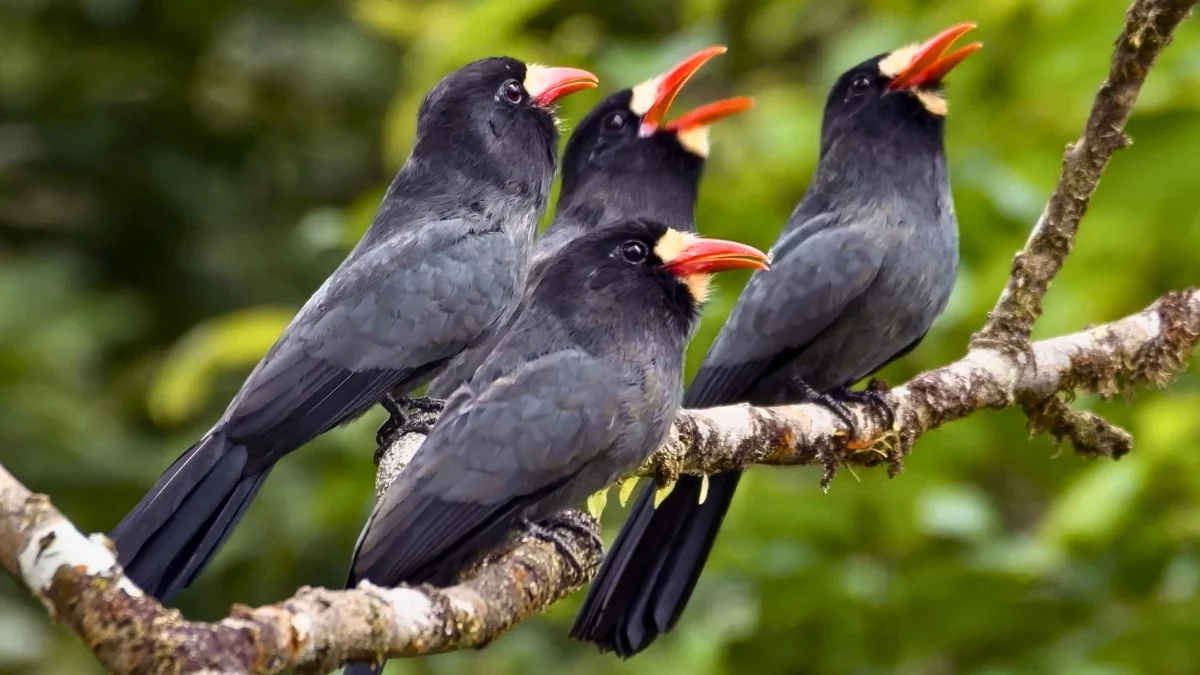
Specifically, two canopy species – the black-fronted nunbird and the white-fronted nunbird – distinguished themselves by their heightened propensity to replicate and propagate their neighbors’ warnings throughout the arboreal expanse.
Aural Cues and Abrupt Silences
Warning calls issued by species residing in the forest understorey demonstrated a significantly lower likelihood of propagation and replication by other avian or primate species.
Nevertheless, even in the absence of repeated calls, these signals altered the forest’s acoustic environment. Small canopy birds nearly ceased their vocalizations subsequent to perceiving a predator alert.
Concurrently, fauna inhabiting the lower strata of the forest frequently continued their vocal activity despite the perceived threat.
Collectively, these observations imply that the Amazonian canopy serves not only as the rainforest’s most enigmatic stratum – largely unexamined and harboring a considerable portion of its biodiversity – but also functions as a vital conduit for information, akin to a fiber-optic network facilitating the rapid transmission of danger signals among animals.
A Novel Dimension to the ‘Internet of the Forest’
Over the past decade, the concept of an ‘internet of the forest’ has gained prominence through the notion of the ‘wood wide web,’ wherein plants engage in the exchange of resources and information via their root systems and associated fungal networks.
Our research introduces an additional communicative system, one that operates at considerable elevations above ground level.
Suspended above us is an expansive ecosystem where animals engage in perpetual mutual auditory surveillance, establishing an eavesdropping network that disseminates critical intelligence within mere seconds.
The vocal activity of birds is typically associated with mate attraction and territorial defense. However, we have now ascertained that at times, this activity, or its cessation, may signify surges in a soundscape dictated by fear.
On your next sojourn through a rainforest, direct your gaze upward and attune your ear to the avian life. A sudden quietude could indicate the presence of a raptor coursing through the upper canopy.