A reassessment and reclassification of a fossil braincase and partial skull roof housed at the Carnegie Museum of Natural History has led to the identification of a novel genus and species of dicraeosaurid sauropod dinosaur, christened Athenar bermani.
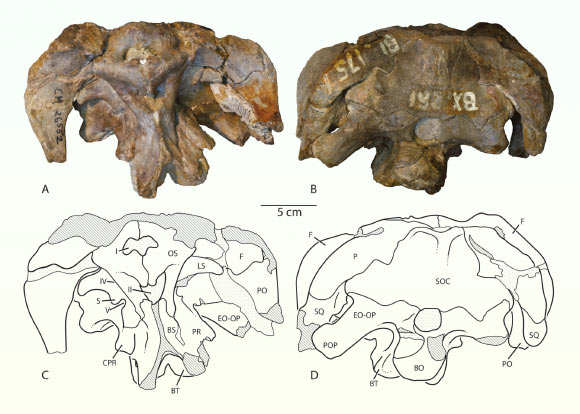
Holotypic braincase of Athenar bermani. Image credit: Whitlock et al., doi: 10.26879/1550.
Athenar bermani is understood to have inhabited the region now known as Utah, in the United States, during the Late Jurassic epoch, approximately 151 to 150 million years ago.
The paleontological remains, cataloged under the Carnegie Museum (CM) designation 26552, were initially unearthed in 1913 from rock strata belonging to the Morrison Formation within Carnegie Quarry at Dinosaur National Monument.
Prior to this recent investigation, the specimen had been categorized within the sauropod dinosaur genus known as Diplodocus.
“The Carnegie Museum of Natural History preserves a collection of specimens that are paramount to our comprehension of the cranial anatomy of diplodocoid sauropods,” stated Dr. John Whitlock, a researcher affiliated with Mount Aloysius College and the Carnegie Museum of Natural History.
“Specimen CM 26552, though frequently overlooked in favor of more complete cranial fossils, possesses an exceptionally significant historical role, as it served as the foundational evidence for the contemporary understanding of braincase anatomy within the Diplodocus genus.”
“In light of substantial new discoveries made over several decades since its initial description in 1978, a re-evaluation of the anatomical characteristics and taxonomic affiliations of this specimen has been undertaken.”
The contemporary analysis indicates that the discernible features of CM 26552 exhibit a stronger correspondence with a distinct lineage of sauropods, specifically the Dicraeosauridae family.
“CM 26552 displays a combination of features that facilitate its confident distinction from other recognized North American dicraeosaurid species,” the paleontologists reported.
“Consequently, we are assigning CM 26552 to the newly established genus Athenar, with the specific epithet bermani.”
Furthermore, the research elucidates that Athenar bermani shares a close ancestral relationship with the dicraeosaurid genus Suuwassea.
“The recognition of CM 26552 as a novel dicraeosaurid species serves to augment our understanding of this family’s diversity within the Morrison Formation and, more broadly, across North America, thereby expanding upon the previously underestimated sauropod diversity associated with this geological unit,” the researchers commented.
The comprehensive results of this investigation were made available online this month through the scientific journal Palaeontologia Electronica.
_____
John A. Whitlock et al. 2025. Athenar bermani, a new species of dicraeosaurid sauropod from Dinosaur National Monument, Utah, U.S.A. Palaeontologia Electronica 28 (3): a50; doi: 10.26879/1550