In Calabria, southern Italy, archaeologists have pinpointed a Roman defensive fortification, spanning 2.7 kilometers (1.7 miles) in length, comprising a wall and a ditch. Historically, this structure is attributed to the Roman general Marcus Licinius Crassus, who engineered it as a means to confine Spartacus, a Thracian gladiator and leader of a significant slave uprising, along with his followers.

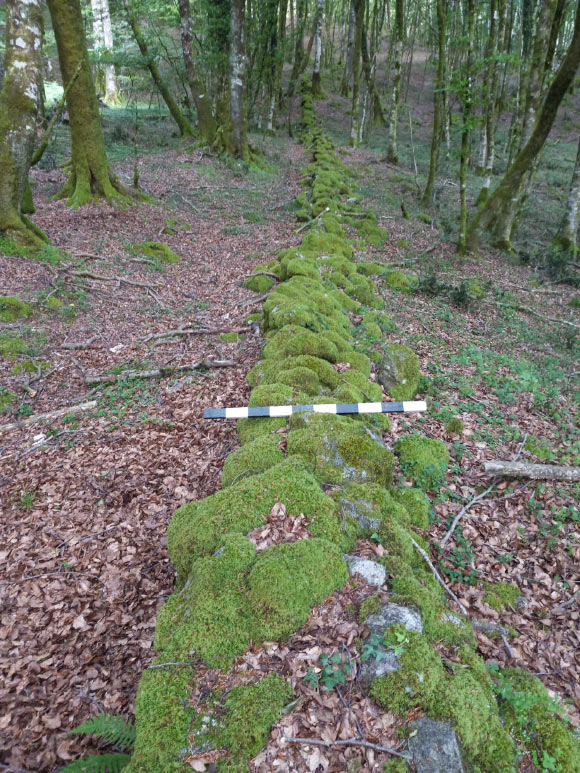
The 2,070-year-old Roman wall in the Dossone della Melia forest in south-central Calabria, Italy. Image credit: University of Kentucky.
Spartacus, a gladiator of Thracian origin, rose to prominence as a principal figurehead of a major rebellion waged by enslaved people against the Roman Republic, an event now recognized as the Third Servile War (73–71 BCE).
Originating from the region of modern-day Bulgaria around 103 BCE, he initially served within the Roman military before his subsequent capture and subjugation into slavery.
In 73 BCE, Spartacus, accompanied by approximately 70 fellow gladiators, initiated an escape from a gladiatorial training facility situated in Capua. They sought refuge on Mount Vesuvius, where they were soon augmented by an influx of other runaway enslaved individuals.
Spartacus demonstrated considerable aptitude as a leader and strategist, achieving notable victories against several Roman contingents and expanding his insurgent force to an estimated seventy thousand individuals, predominantly enslaved people.
He was not without fellow commanders; Crixus and Oenomaus, also gladiators who had escaped their bondage, constituted the other two leadership pillars within the triumvirate of the slave revolt.
The insurgence represented a profound menace to Rome, compelling the Senate to dispatch numerous legions with the objective of quelling the uprising.
Notwithstanding initial battlefield successes, Spartacus and his retinue were ultimately encircled by the Roman general Marcus Licinius Crassus.
The year 71 BCE marked the ultimate defeat of Spartacus’s forces in a decisive engagement in Lucania. Spartacus himself perished in this confrontation, though his remains were never recovered.
While Spartacus’s rebellion was not conceived as a movement for systemic social reform, it has resonated through history, serving as an enduring emblem of defiance against tyrannical subjugation.
“Our assessment is that Spartacus launched an assault against the recently unearthed wall in his endeavor to extricate himself from the confinement engineered by Crassus,” commented Paolo Visona, an archaeologist from the University of Kentucky.
The ancient stone edifice and its accompanying earthwork, extending for over 2.7 kilometers, are situated within the Dossone della Melia woodland in the southern-central portion of Calabria, Italy.
The archaeological team also exhumed a substantial quantity of fragmented iron weaponry. This yielded items such as sword hilts, broad, curvilinear blades, projectile points for javelins, a spearhead, and various other metallic detritus.
“The revelation of this site was facilitated by information provided by a local environmental advocacy group, who were aware of the wall’s presence but uncertain of its historical designation,” stated Professor Visona.
“Our exploration of the wall and ditch was conducted using advanced geophysical survey techniques, including ground-penetrating radar, LIDAR, magnetometry, and analysis of soil cores.”