A scholarly publication slated for presentation in the Planetary Science Journal, authored by researchers affiliated with the SETI Institute, Southwest Research Institute, Caltech, and the Observatoire de Paris, posits a radical reinterpretation of two of Saturn’s moons, Titan and Hyperion. Rather than being ancient, primordial bodies, these celestial objects are now theorized to be the consequence of a cataclysmic collision between two earlier moons. This groundbreaking perspective has the potential to necessitate a revision of existing hypotheses concerning the genesis of Titan’s substantial atmosphere and may even offer solutions to the enigma of Saturn’s distinctive ring system.
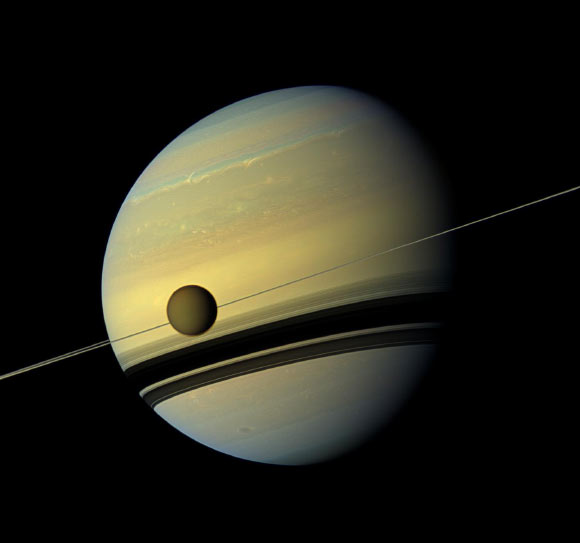
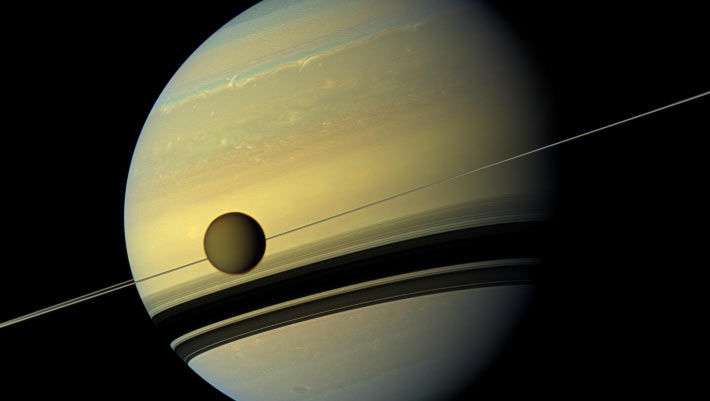
This mosaic of Saturn and its largest moon Titan combines six images — two each of red, green and blue spectral filters — to create this natural color view. The images were obtained with Cassini’s wide-angle camera on May 6, 2012, at a distance of approximately 778,000 km (483,000 miles) from Titan. Image credit: NASA / JPL-Caltech / Space Science Institute.
Within this research paper, Dr. Matija Ćuk, a scientist at the SETI Institute, along with his collaborators, introduces a novel model detailing the recent dynamic evolution of Saturn’s moon system.
“This proposition is spurred by the seemingly recent formation of Saturn’s rings, the apparent dynamical youth of its inner, medium-sized moons, the observed rapid outward tidal migration of Titan, the swift damping of Titan’s orbital inclination and eccentricity, and the observation that Saturn appears to have recently disengaged from its presumed historical spin-orbit resonance with the planets,” the authors articulated.
The researchers contend that Hyperion, a small, irregularly shaped moon locked in a 4:3 orbital resonance with Titan, is considerably younger than previously estimated.
Its current elliptical orbit suggests that Titan has receded outwards by approximately 4-5% since the two bodies entered their resonant relationship.
According to the research team, this specific resonance likely came into being as recently as 400 to 500 million years ago.
To account for Hyperion’s apparent recency, the scientists put forth a hypothetical scenario involving an additional, medium-sized moon—tentatively named proto-Hyperion—which once traversed an orbit situated between Titan and Iapetus.
As Titan’s orbit expanded, the entire system became destabilized. Consequently, proto-Hyperion was propelled onto an erratic trajectory, eventually culminating in a collision with Titan.
This catastrophic merger is believed to have disrupted a long-standing spin-orbit resonance between Saturn and the surrounding planets, thereby altering the axial tilt of the ringed planet.
Concurrently, ejected material from this impact event could have coalesced to form the current iteration of Hyperion. Evidence such as its low density and high porosity supports the notion that it is a conglomeration of rubble rather than an intact, ancient celestial body.
Extensive numerical simulations performed by the research group demonstrate that under such circumstances, collisions between Titan and this hypothetical moon occur with considerable frequency.
In numerous simulation runs, Iapetus exhibited orbital inclinations and eccentricities that closely mirror current observations, consistent with gravitational influences exerted during the period of instability.
Furthermore, the simulations indicate that Titan’s orbit typically experiences an abrupt outward displacement during the merger event, allowing its ongoing tidal migration—potentially driven by resonant interactions within Saturn’s gravitational field—to resume its course.
It is plausible that this period of instability was not confined solely to the outer reaches of Saturn’s satellite system.
The scientific cohort posits that an eccentric Titan, perturbed during this tumultuous episode, could have acted to destabilize Saturn’s inner moons through resonant gravitational interactions.
Subsequent collisions and re-accretion among these inner moons may have generated the particulate matter that ultimately constituted Saturn’s present-day ring system.
Previous, independent analyses had already suggested a relatively young age for Saturn’s rings—potentially in the range of a few hundred million years—based on factors including their mass, chemical composition, and their interactions with neighboring satellites.
The newly proposed model synchronizes the formation timeframe of the rings with the same epoch that gave rise to Hyperion and reconfigured the outer aspects of the Saturnian system.
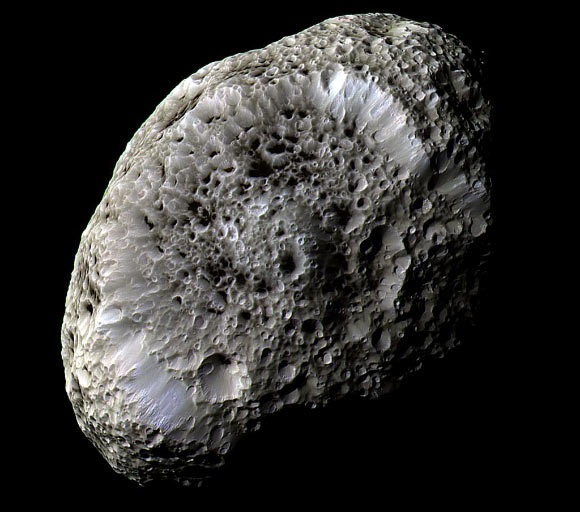
Cassini passed Hyperion on 31 May 2015 at a distance of about 21,000 miles (34,000 km). Mission scientists expect images from the encounter to arrive on Earth within 1-2 days. This view of the moon was obtained during Cassini’s flyby on 26 September 2005. It reveals crisp details across the strange, tumbling moon’s surface. Differences in color could represent differences in the composition of surface materials. Image credit: NASA / JPL-Caltech / Space Science Institute.
“Hyperion, the most diminutive of Saturn’s substantial moons, has furnished us with the most critical insight into the system’s historical trajectory,” stated Dr. Ćuk.
“Within simulations where the additional moon entered an unstable state, Hyperion was frequently lost, surviving only in infrequent occurrences.”
“We have ascertained that the orbital lock between Titan and Hyperion is of relatively recent origin, dating back only a few hundred million years.”
“This timeframe corresponds to approximately the same period during which the extra moon vanished.”
“It is conceivable that Hyperion did not endure this upheaval but, rather, emerged as a product of it.”
“Should the extra moon have collided with Titan, it would likely have generated debris in proximity to Titan’s orbit. This is precisely the locale where Hyperion would have subsequently formed.”
The authors also undertake a re-evaluation of Rhea’s orbital history. Its rapid outward migration implies that it would have traversed the so-called evection resonance with the Sun within the last few hundred million years.
Such dynamical indicators are more congruous with a system that has undergone recent, extensive reconfiguration than with one that has remained unaltered for eons.
“While the events detailed herein transpired hundreds of millions of years ago and are inherently challenging to verify through direct observation, recent empirical data have consistently challenged prior theoretical constructs and illuminated novel dynamical pathways,” the researchers concluded.
“Our hypothesis postulates a dynamically vibrant and comparatively young Saturnian system, whose current configuration is the outcome of recent, momentous occurrences.”
“Future orbital, geophysical, and geological data, particularly from exploratory missions targeting Saturn’s moons, will serve as indispensable benchmarks for testing this theoretical framework.”
_____
Matija Ćuk et al. 2026. Origin of Hyperion and Saturn’s Rings in a Two-Stage Saturnian System Instability. Planetary Science Journal, in press; arXiv: 2602.09281