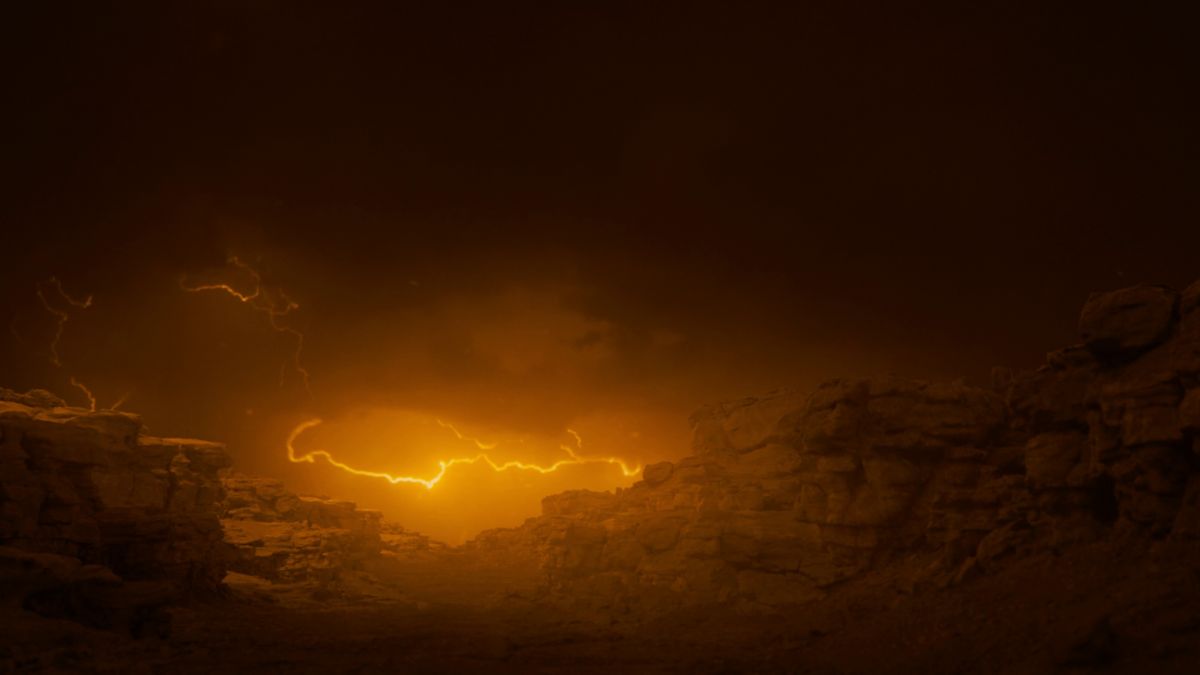
A radio emission, often termed a ‘howl,’ reminiscent of a lightning-like discharge, has been identified originating from Mars for the first time.
While in orbit around the Martian sphere, NASA’s MAVEN spacecraft captured an atypical electromagnetic signature on June 21, 2015. Scientific analysis has since confirmed that this signal aligns with a ‘whistler’—a dispersed radio wave phenomenon generated when emissions from lightning traverse a celestial body’s ionosphere.
This discovery strongly indicates that electrical discharges indeed take place within the Martian atmosphere. Furthermore, it suggests that the propagation pathways of their associated radio waves through plasma adhere to the same fundamental physical principles that govern lightning signals observed on Earth.
Although Earth and Mars share certain characteristics, significant differences exist to the extent that scientists cannot definitively ascertain whether the same phenomena occur on both planets, let alone if they are driven by identical underlying mechanisms.
Consider the phenomenon of lightning. These potent surges of electrical energy are theorized to arise when atmospheric turbulence agitates particles, causing friction that accumulates electrical charge. Eventually, this build-up reaches a critical point necessitating a discharge.
On our planet, terrestrial lightning is predominantly linked to cumulonimbus clouds laden with water vapor. However, Mars’ atmosphere contains a very minimal amount of water.
Fortunately, the presence of moisture is not a prerequisite. On Earth, lightning discharges are also observed within the massive plumes of ash ejected by volcanoes.
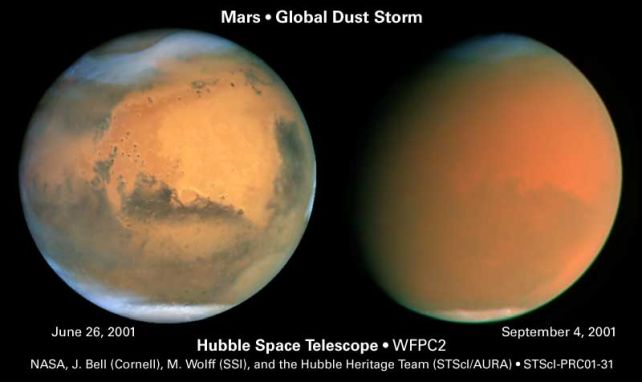
Moreover, just last year, researchers announced the definitive detection of electrical discharges on Mars. These are believed to be instigated by the friction between colliding sand particles within the planet’s turbulent dust storms.
A whistler represents a specific classification of signal originating from lightning. When lightning occurs, it emits electromagnetic radiation, encompassing the spectrum from very low-frequency radio waves to X-rays. The lowest-frequency radio components of this emission can ascend through the planet’s ionosphere, propagating as plasma waves that follow magnetic field lines.
Due to the higher velocities of higher-frequency waves compared to their lower-frequency counterparts, the signal undergoes temporal dispersion. When translated from plasma wave data into audio, this results in a descending tonal pitch, evocative of a distant marine creature’s vocalization.
The accompanying video provides an illustration of whistlers generated by lightning during a terrestrial volcanic eruption.
Mars lacks a global magnetic field, which would seemingly preclude the propagation of whistlers.
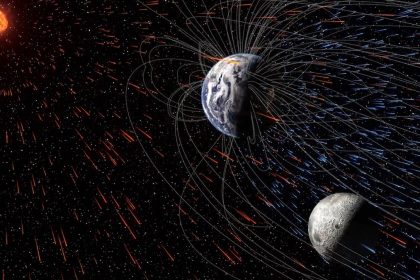
However, the planet does possess localized regions of magnetic field. These are preserved within magnetized minerals in its crust, serving as a historical record of its past magnetic field.
Prior investigations spanning several decades had offered the hypothesis that these localized crustal magnetic fields might facilitate whistler propagation.
The MAVEN mission commenced its observational campaign of Mars in 2014. It was outfitted with an array of scientific instruments, including a plasma wave instrument capable of recording within the relevant frequency ranges.
Under the leadership of atmospheric physicist František Němec from Charles University in Czechia, a scientific team meticulously analyzed 108,418 plasma wave recordings, specifically searching for the characteristic signatures of a whistler.
Remarkably, their search was successful. Even more astonishingly, the detected event precisely matched the predictions formulated decades prior.
This solitary whistler event was recorded above a localized crustal magnetic field, at an altitude of 349 kilometers (217 miles) on the night side of Mars. This latter detail is critical: Under direct solar irradiation, the Martian ionosphere undergoes compression, inhibiting the propagation of plasma waves.
The observed event bore a strong resemblance to whistlers detected on Earth. It persisted for approximately 0.4 seconds, exhibiting a downward frequency sweep over time, and registered approximately 10 times the strength of the ambient background noise.
When the research team modeled the Martian magnetic field and plasma density within that specific region, and factored in the estimated travel time of such a signal from the surface, their calculations yielded an almost perfect concordance with the observed data.
The source discharge would not have been a feeble one. Although the measured signal was comparatively weak relative to terrestrial whistlers, the researchers’ calculations, accounting for signal attenuation during propagation, indicated that the source energy level was comparable to a powerful lightning discharge by Earth standards.
This finding also sheds light on why more such signals have not been detected. Beyond the relatively limited number of orbital instruments monitoring Mars compared to Earth, specific environmental conditions must align: an almost vertically oriented magnetic field, on the nightside, with an ionosphere sufficiently tenuous to permit plasma wave propagation.
Fewer than 1 percent of the recorded wave data captured relevant magnetic geometry. Consequently, the detection requires a potent electrical discharge, occurring at a precise location and time, intercepted by a spacecraft equipped with the appropriate instruments at the opportune moment.
This suggests that lightning likely occurs on Mars more frequently than currently apprehended. This revelation, in itself, is quite significant, with even more compelling implications.
Certain laboratory experiments investigating the origins of life have demonstrated that electrical discharges can catalyze the formation of essential organic molecules. Such lightning-like processes may have played a role in initiating prebiotic chemistry on early Earth.
Should analogous discharges occur on Mars, these processes would represent an additional factor for astrobiologists to consider when assessing the planet’s past habitability.